The Best Content Formats for B2B Manufacturing Companies: 15 Powerful Strategies for 2026
11/21/2025
Marketing Strategy
For manufacturers competing on technical credibility and buyer trust, these content strategies reveal how to influence deals long before sales engagement.

In 2026, industrial brands win deals long before a rep is involved. Buyers complete a significant portion of research independently, so the manufacturers publishing the clearest, most technical and verifiable content earn attention, trust, and shortlist placement.



Why Content Matters More Than Ever for B2B Manufacturing


Recent B2B research shows buyers are often 57–70% through their journey before contacting sales, underscoring the need for content that educates early and decisively.
Engineers and procurement teams expect precise specs, safety and compliance details, and proof of performance—not fluff. Your content has to deliver all three.
How Buyers Research Manufacturing Solutions Today
Industrial buyers rely on:
- Technical spec sheets and datasheets
- Case studies with quantified outcomes
- Process documentation and SOPs
- Video: factory walkthroughs, machine explainers, maintenance demos
- Third-party reviews and peer signals
- AI-driven research tools and answer engines
- Manufacturer knowledge hubs with CAD/3D assets
Manufacturers who consistently publish rigorous, accessible content are the ones buyers trust first.
AEO and the Evolution of Industrial Content Discovery
Answer Engine Optimization (AEO) prepares your content to be the referenced answer in AI-driven results (e.g., Google AI Overviews, Microsoft Copilot, ChatGPT/Gemini). In 2026, being cited directly inside these interfaces can precede (or replace) a traditional click. AEO helps you:
- Rank inside AI-generated answers
- Reach engineers earlier in their evaluation
- Surface structured specs and constraints clearly
- Capture high-intent queries before competitors
AEO is no longer optional for industrial marketers—it’s table stakes.
Understanding the Manufacturing Audience
B2B manufacturing decisions involve multiple roles and risk tolerances. Your content mix should map to each one.
Engineers, Procurement Teams & Technical Decision-Makers
- Engineers: require technical accuracy, tolerances, materials, integrations, CAD.
- Procurement: needs price ranges, TCO/ROI, lead times, supplier stability.
- Operations/Plant: focuses on reliability, maintenance windows, safety.
- Executives: want business outcomes and risk mitigation.
What Industrial Buyers Look for in Content
Technical precision, transparency, compliance/safety data, validated performance and lifecycle reliability. Bring the proof—test data, certifications, case metrics—not superlatives.
Free Brand Health Audit
Make sure your brand is built to sell
Search has changed. Your customers aren't just Googling anymore. They're asking ChatGPT, Perplexity, Gemini and other AI platforms what to buy, who to trust and which brands they should consider.
If your brand isn't showing up clearly in those answers, you're already losing opportunities. Our free Brand Health Audit shows you where your brand stands across traditional search, AI search and brand positioning.

Sample brand audit
Live preview
Traditional search
72
AI search (GEO)
34
Brand positioning
58
The Best Content Formats for B2B Manufacturing Companies


1. Technical Blog Articles & Industry Guides
Establish topical authority and capture long-tail queries engineers search daily (“surface roughness Ra vs Rz,” “316L vs 17-4 PH use cases”).
Using SEO & AEO to Make Articles More Discoverable
- Clear definitions up top
- Concise answers (AEO-friendly summaries)
- Step-by-step methods and checklists
- Schema (FAQPage/HowTo/TechArticle)
- Scannable headings and tables
These structures increase eligibility for AI answers and rich results.
2. Product Datasheets & Specification Sheets
Non-negotiable for industrial buyers: dimensions, materials, tolerances, certifications, operating envelopes, safety notes, compatibility and finishes. Datasheets remain among the most requested industrial assets during evaluation.
3. Case Studies & Industrial Success Stories
Use before/after metrics, time-to-value, scrap reduction, line throughput, MTBF/uptime, and visuals of equipment in situ. Proof accelerates internal approvals; peer-style evidence is heavily weighted by B2B teams.
4. Process Explainer Videos & Plant Walkthroughs
Video reduces ambiguity and speeds consensus: factory tours, assembly/tear-down, quality checks, maintenance routines, safety briefings. Engineers and buyers increasingly expect video during consideration.
5. Whitepapers & Engineering Research Reports
Ideal for complex processes (e.g., heat-treat drift mitigation, additive post-processing, vision-system false-reject rates). Position your SME bench strength with references to standards and test methods.
6. CAD Files, 3D Models & Technical Downloads
Engineers love downloadable geometry and neutral formats (STEP, IGES, DXF) plus 3D web previews. Surveys show massive demand for accessible digital product data among engineers and designers—make CAD easy to find and frictionless to download.
7. Interactive Tools: Calculators, Selectors & Configurators
Torque, deflection, flow, heat-load, or coating-thickness calculators; material selectors; SKU configurators. These tools keep users on-site, capture first-party intent, and produce qualified MQLs.
8. Manufacturing Playbooks & Step-by-Step Guides
Operational handbooks (“commissioning checklist,” “5S audit pack,” “metal AM porosity reduction steps”) are highly evergreen and support operations and EHS goals.
9. Webinars & Live Demonstrations
Live sessions clarify specs and speed consensus across multi-stakeholder teams. Strong topics: “How the vision system handles reflective parts,” “New ISO/ASTM updates,” “Safety interlocks explained.” Webinars continue to convert at high rates in B2B.
10. Infographics & Visual Process Maps
Turn complex processes into visual clarity: assembly sequences, safety workflows, tolerance stacks, SPC loops, production timelines.
11. Product Comparison Sheets
Create apples-to-apples matrices: capacity, precision, cycle time, footprint, utilities, spares, integration requirements, certifications—everything procurement needs for due diligence.
12. ROI & Cost-Savings Tools
Show TCO and payback with transparent assumptions (energy, consumables, downtime avoidance). Quantified ROI content accelerates approvals and reduces internal friction.
13. Email Newsletters for Engineers & Operations
Deliver standards updates, application notes, troubleshooting tips, release notes, and field fixes. B2B buyers say digital content materially impacts vendor evaluation—keep your signal consistent.
14. Social Media Micro-Content for Manufacturing Brands
LinkedIn carousels (tolerances explained), YouTube Shorts (30-sec machine demos), quick Lab Notes, and behind-the-scenes testing clips. These improve reach and feed your long-form assets.
15. Customer Training Videos & Knowledge Base Libraries
Post-sale enablement reduces tickets and improves uptime: maintenance micro-videos, replacement procedures, parameter primers, and searchable KB articles. Better customer enablement = better lifetime value.
Want to learn more about Marketing Strategy? Keep reading!
If you need help with your company’s marketing strategy, contact us for a free custom quote.
Advanced Industrial Content Strategies for 2026
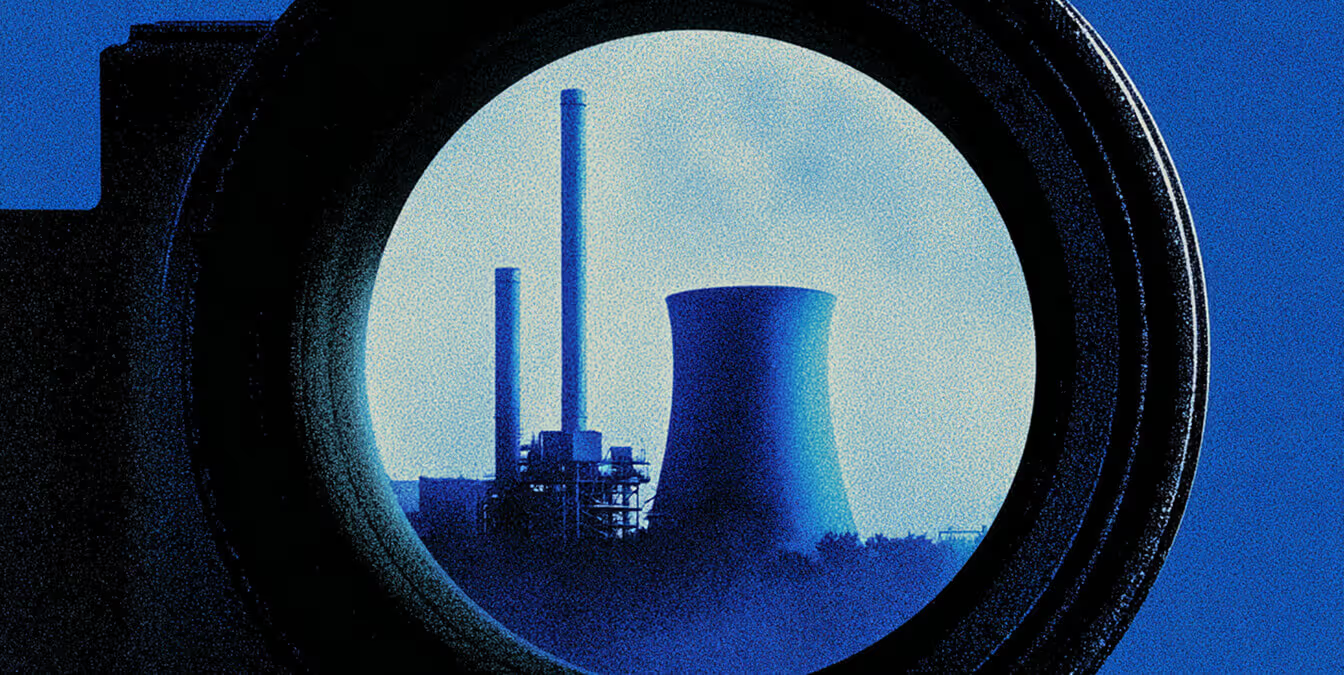
Using Predictive Analytics to Plan Content
Mine first-party data (search logs, configurator inputs, RFQ fields) to forecast topics, prioritize SKUs, and time content drops to seasonal demand. Use trend signals from your CRM and support tickets to define editorial calendars.
Structuring Content for Search Engines + Answer Engines (SEO + AEO)
Pair classic SEO (intent mapping, internal links, quality backlinks) with AEO (Q&A blocks, concise answers, schema, entity definitions). As AI-driven systems expand, visibility equals being cited as the answer—not only ranking #1.
AI-Assisted Content for Complex Industrial Topics
Use AI to draft diagrams, summarize test reports, and standardize spec tables—then have SMEs validate every claim. This speeds production without sacrificing accuracy for regulated or safety-critical content.
Building Topic Clusters for Manufacturing Niches
Create interlinked hubs (e.g., Industrial Automation → robotics basics, safety category 3/PLd primer, sensors, PLC standards, OEE/ROI). Topic clusters compound authority and improve discoverability across entire subject domains.
Common Content Mistakes Manufacturing Companies Make
Not Providing Enough Technical Detail
“Marketing-speak” erodes trust. Engineers want tolerances, test setups, standards, and boundary conditions—publish them.
Creating Content Without Buyer Intent
Tie each asset to a specific task (spec, evaluate, compare, justify, implement). Random acts of content don’t move pipeline.
Ignoring Video & Visual Content
In manufacturing, seeing how something works matters as much as what it does. Don’t make buyers imagine what a 12-axis motion path looks like—show it.
FAQs: The Best Content Formats for B2B Manufacturing Companies

What content do engineers prefer most?
Datasheets, CAD/3D files, and technical tutorials/how-tos.
Do videos work for manufacturing companies?
Yes—especially explainers, plant tours, and maintenance demos; B2B buyers strongly credit digital content in vendor evaluation.
How often should manufacturers publish content?
Aim for 2–4 high-quality pieces per month tied to buyer intent and topic clusters (plus continuous KB/datasheet upkeep).
Are webinars still effective in 2026?
Absolutely. Live education remains a top conversion driver for complex solutions.
What format builds the most trust?
Case studies with quantified outcomes and whitepapers anchored in standards/testing.
How do I optimize manufacturing content for AEO?
Provide concise, direct answers; add FAQ/HowTo schema; define entities (materials, standards, process names); include spec tables and glossaries.
Conclusion: The Future of Manufacturing Content Strategy
As 2026 unfolds, industrial buyers expect transparency, technical rigor, and frictionless access to specs and proof. Use these 15 content formats—backed by SEO and AEO—to reach engineers earlier, de-risk procurement decisions, and guide complex deals with confidence. At Branded Agency, we build content systems tailor-made for manufacturing: structured knowledge hubs, CAD libraries, calculators, and AEO-ready assets that compound visibility and pipeline over time.

Quincy Samycia
As entrepreneurs, they’ve built and scaled their own ventures from zero to millions. They’ve been in the trenches, navigating the chaos of high-growth phases, making the hard calls, and learning firsthand what actually moves the needle. That’s what makes us different—we don’t just “consult,” we know what it takes because we’ve done it ourselves.
Want to learn more about brand platform?
If you need help with your companies brand strategy and identity, contact us for a free custom quote.
We do great work. And get great results.
+2.3xIncrease in revenue YoY
+126%Increase in repurchase rate YoY



+93%Revenue growth in first 90 days
+144% Increase in attributed revenue




+91%Increase in conversion rate
+46%Increase in AOV



+200%Increase in conversion rate
+688%Increase in attributed revenue