Business-Level Strategy: Types, Examples, and How to Execute One That Actually Works
08/05/2026
Business / Marketing Strategy
Learn how to choose and execute the right business-level strategy to outperform competitors, strengthen your market position, and achieve sustainable business growth.

Every company competes somewhere. The question is whether you're competing with a clear plan or just reacting to whatever the market throws at you. Business-level strategy is the detailed plan that answers one critical question: how does your company win in its chosen market? This article breaks down the five main types, shows you real-world examples, and walks you through a practical six-step process for choosing, building, and monitoring a strategy that delivers results.
.png)





Key Takeaways
- Business-level strategy focuses on competitive advantage in specific markets. It sits between broad corporate level strategy (which markets to enter) and detailed functional level strategy (how departments execute day to day). Core components of business-level strategy include market definition, value proposition, and resource allocation.
- Five main types of business-level strategies exist: cost leadership, differentiation, focused cost leadership, focused differentiation, and integrated strategy. Each offers a distinct path to achieve competitive advantage depending on your industry, resources, and target customers.
- An effective business level strategy must align with overall corporate strategy, be supported by functional strategies across marketing, operations, human resources, and finance, and be backed by disciplined resource allocation and KPI tracking.
- Real firms prove these strategies work in practice. Walmart spends considerable money on supply chain scale and purchasing power to maintain cost leadership. Apple uses an integrated ecosystem for differentiation. Ryanair built a focused cost leadership strategy around ultra-low fares in European short-haul travel.
- The rest of this article gives you a step-by-step process for choosing, implementing, and monitoring a successful business strategy, including how to track key performance indicators and allocate resources effectively.
What Is Business-Level Strategy?
A business level strategy addresses a straightforward question: "How do we compete in this particular industry or market?" It defines your pricing approach, product positioning, customer segments, and the value you deliver relative to rivals. While corporate strategy decides which markets a company should enter, and functional level strategy governs what each department does daily, business-level strategy is the bridge connecting the two.
Think of a mid-sized B2B software company. Rather than competing on lowest price against enterprise giants, it might choose to compete on product differentiation and exceptional customer service for a narrow target market of healthcare providers. That choice shapes everything from product roadmap to hiring to sales messaging.
A successful business strategy must create a sustainable competitive advantage, something rivals cannot easily copy. In 2026, that typically means leveraging proprietary technology, data, brand strength, or specialized capabilities. Sustainable competitive advantage creates barriers to entry for competitors, protecting margins and market position over time. Business-level strategy is your business model's competitive DNA: the logic behind why customers pick you instead of the alternative.
Free Brand Health Audit
Make sure your brand is built to sell
Search has changed. Your customers aren't just Googling anymore. They're asking ChatGPT, Perplexity, Gemini and other AI platforms what to buy, who to trust and which brands they should consider.
If your brand isn't showing up clearly in those answers, you're already losing opportunities. Our free Brand Health Audit shows you where your brand stands across traditional search, AI search and brand positioning.

Sample brand audit
Live preview
Traditional search
72
AI search (GEO)
34
Brand positioning
58
Business-Level vs Corporate and Functional Strategies




Business-Level vs Corporate and Functional Strategies
Strategy operates on three classic levels. Corporate level strategy is a high-level plan for an entire parent company. It determines which markets a company should enter and how to manage resources across business units. Business-level strategy answers "how do we win in each specific market?" And functional level strategy governs what marketing, operations, finance, and human resources do to support that competitive approach. Below those sits operational strategy, the day-to-day process execution.
Consider Amazon in 2026. At the corporate level, Amazon decides to operate in e-commerce, cloud computing (AWS), streaming, and logistics. Each of those business units then pursues its own level strategy: AWS competes on scale and reliability, while Amazon.com blends cost leadership with digital convenience. Functional strategies then drive logistics optimization, content acquisition, HR practices, and marketing for each unit.
Resource allocation flows from corporate to business to functional level. When these levels are misaligned, execution suffers. A business unit pursuing differentiation won't succeed if corporate starves it of R&D budget, or if the marketing function runs discount-heavy campaigns that undercut premium positioning. The rest of this article focuses on business-level choices, but keeps linking them to the corporate and functional decisions that make or break execution.
Why Business-Level Strategy Matters in 2026
The 2026 business environment is defined by digital disruption, AI integration, persistent inflationary pressures, and rapidly shifting customer expectations, along with fast-moving branding trends around authenticity, sustainability, and immersive digital experiences. Without a clear business-level strategy, companies fall into strategic drift: inconsistent pricing, scattered marketing messages, reactive product changes, and poor capital deployment.
An effective business strategy provides three things: focus for investment, a consistent story for customers and employees across the entire organization, and a framework for daily trade-off decisions. It aligns resources and operations for sustainable growth rather than chasing every opportunity.
Consider what happened to mid-tier retailers between 2020 and 2025. Firms that were neither the cheapest nor the most distinctive lost ground steadily. A Harvard Business Review analysis from March 2026 confirmed that companies stuck in the middle market are losing share to both cost leaders and premium differentiators. Meanwhile, focused competitors like Aldi (cost) and Lululemon (differentiation) grew by doubling down on a clear competitive edge.
Core Idea: Competitive Advantage at the Business Level
Competitive advantage is the ability to earn above-average returns, either by delivering more value at the same cost, or the same value at lower cost, than competitors. Competitive positioning can involve low-cost leadership or product differentiation, and your business-level strategy determines which path you take.
Business-level strategy revolves around two dimensions from Michael Porter's framework, developed by the Harvard Business School professor: the source of competitive advantage (cost vs. differentiation) and the scope (broad market vs. niche market). Trying to "do everything for everyone" often leaves a firm stuck in the middle, with neither a cost advantage nor meaningful uniqueness.
When competitive advantage is strong, financial outcomes follow: higher gross margins, faster growth, stronger customer loyalty, and lower customer acquisition costs. The sections below detail each generic business level strategy, with definitions and modern examples to help you understand business level strategy in practice.
Types of Business-Level Strategies
Business-level strategies help companies differentiate from competitors by making deliberate competitive choices. The five main strategy types are: cost leadership strategy, differentiation strategy, focused cost leadership strategy, focused differentiation strategy, and integrated (best-cost) strategy. These generic strategies apply across B2B, B2C, and services, though execution differs by particular industry.
In practice, companies may blend elements, but one dominant logic should guide decisions. Analyzing generic strategies enhances clarity on where your firm competes and how. Before reading the implementation steps later, mentally map your current business to one of these archetypes.
Cost Leadership Strategy
A cost leadership strategy focuses on becoming the industry's lowest-cost producer while meeting acceptable quality standards. Cost leadership aims to be the lowest-cost producer, then passes savings to customers through lower prices. Cost leadership attracts price-sensitive customers and increases market share through volume.
Key levers include:
- Economies of scale and high-volume purchasing
- Streamlined, standardized operations
- Supply chain mastery and vendor negotiation
- Technology-enabled automation (AI, robotics)
- Tight overhead and fixed-cost control
Walmart and Ryanair are textbook cost leaders. Walmart spends considerable money building logistics infrastructure and purchasing power that rivals cannot match. Not every cost leader competes purely on rock-bottom pricing; some reinvest savings into convenience or speed.
Risks include price wars, perception of low quality, vulnerability when input costs spike, and underinvesting in innovation. Cost leaders generally monitor KPIs like unit cost per product, operating margin, inventory turns (healthy range: 4–8 times per year in retail), and cost-to-serve by segment.
Want to learn more about brand platforms, Brand Strategy and Brand Identity? Keep reading!
If you need help with your companies brand strategy and identity, contact us for a free custom quote.
Differentiation Strategy
A differentiation strategy competes by offering unique products or services that customers perceive as superior and are willing to pay a premium for. Differentiation focuses on unique product features and quality that set a company apart. Differentiation allows companies to command higher prices for unique products.
Typical differentiation drivers, especially when executed through strategic brand marketing campaigns that build emotional resonance and growth:
- Product innovation and design excellence
- Brand image and ecosystem integration
- Superior service and personalized experiences
- Sustainability credentials
- Data-driven customization (increasingly via AI in 2026)
Apple's integrated hardware-software ecosystem and Starbucks' consistent brand experience are classic examples. Tesla uses technology and brand storytelling to attract customers who value innovation over price.
Trade-offs matter: differentiation demands higher R&D and marketing spend, continuous innovation, and vigilance against imitation. Relevant key performance indicators include price premium vs. competitors, Net Promoter Score, innovation pipeline metrics, and gross margin trends. SaaS companies pursuing differentiation, for example, typically sustain gross margins of 70–85%.
Focused Cost Leadership
Focused cost leadership targets a specific market niche with low-cost offerings. Instead of competing across the broad market, a focused cost leadership strategy applies cost efficiency to a narrow, well-defined segment, whether a particular customer group, product category, or geography.
Ryanair's early model exemplifies this: ultra-low fares, point-to-point routes, minimal frills, all targeting price-sensitive European leisure travelers in a narrow target market. Regional discount grocery chains serving specific cities operate similarly.
Benefits include stronger fit with target customers and less direct competition from broad-market giants. Risks: over-dependence on a small segment, vulnerability if that particular market shrinks, and potential entry by bigger cost leaders once the niche proves profitable.
Focused Differentiation Strategy
A focused differentiation strategy serves a particular market segment with specialized offerings. It targets a narrow audience that values uniqueness and willingly pays more for it.
This strategy focuses on brand story, deep domain expertise, or extreme customization, often anchored in a distinct brand persona that clearly expresses the brand’s personality and values. Lululemon built premium athletic wear for a fitness-conscious community. Veeva Systems provides vertical SaaS exclusively for life sciences, commanding high prices through compliance expertise and specialized features.
Attractive aspects: high margins, strong customer loyalty, and defensible positioning when core competencies are hard to replicate. Challenges include limited scale, sensitivity to shifts in the niche's tastes, and the constant need to justify premium pricing to target customers.
Integrated (Best-Cost) Strategy
An integrated business level strategy, often called best-cost, deliberately combines elements of cost leadership and differentiation. Integrated strategies combine cost leadership and differentiation for superior value, offering value for money strategies that appeal to buyers who want quality features at reasonable prices.
Toyota's mid-range vehicles deliver reliability and quality without luxury pricing. IKEA pairs distinctive Scandinavian design with self-service cost savings. Albertsons is pursuing $1.5B in cost savings over three years while investing in fresh quality and digital experience, a hybrid integrated strategy.
Execution demands advanced process design, robust supply-chain management, and data-driven operations. A particular generic strategy of this type requires discipline: poor execution leaves firms stuck in the middle, lacking both a real cost advantage and a compelling differentiation edge. Each generic strategy entails trade-offs, but the integrated path is the most operationally demanding.
Choosing the Right Business-Level Strategy for Your Company
Choosing the right business level strategy is about fit: fit with market conditions, customer needs, and your existing capabilities. Target market identification involves clearly defining customer segments to serve before selecting a competitive approach.
Start with external analysis: market size, competitive intensity, customer segments, industry trends, and regulatory pressures. Pair that with internal analysis: strengths, weaknesses, resources, and culture. Frameworks like Porter's Five Forces and customer segmentation help reveal where profit pools exist in your particular industry.
A simple decision logic helps:
- If the industry is price-sensitive and standardized → cost leadership may fit
- If buyers value innovation and brand → differentiation strategy is stronger
- If large rivals dominate the broad market → a focused niche strategy can be attractive
- If you can genuinely deliver quality at mid-level prices through operational excellence → integrated strategy is viable
Pick one primary strategic logic. A firm's business level strategies should send a clear, consistent signal to the market rather than mixing conflicting messages.
Aligning Business-Level, Corporate-Level, and Functional-Level Strategies
Misalignment between corporate level, business level, and functional level strategies wastes resources and confuses execution. The overall corporate strategy sets portfolio management priorities and growth direction, deciding which business units receive investment and which face restructuring.
Each business unit then chooses a business-level strategy consistent with those priorities. One unit might operate as a differentiated premium brand while another functions as a cost leader. The overall business strategy of the corporation gains coherence when each unit's competitive approach serves the whole.
Functional strategies in marketing, operations, finance, and human resources must then support the chosen business-level strategy. For differentiation, marketing invests in brand-building; for cost leadership, the strategy focuses on channel cost efficiency. Business leaders should conduct periodic strategy alignment reviews, checking for conflicts between strategic initiatives and current projects across the entire organization.
Step 1: Analyze the Market and Competitive Landscape
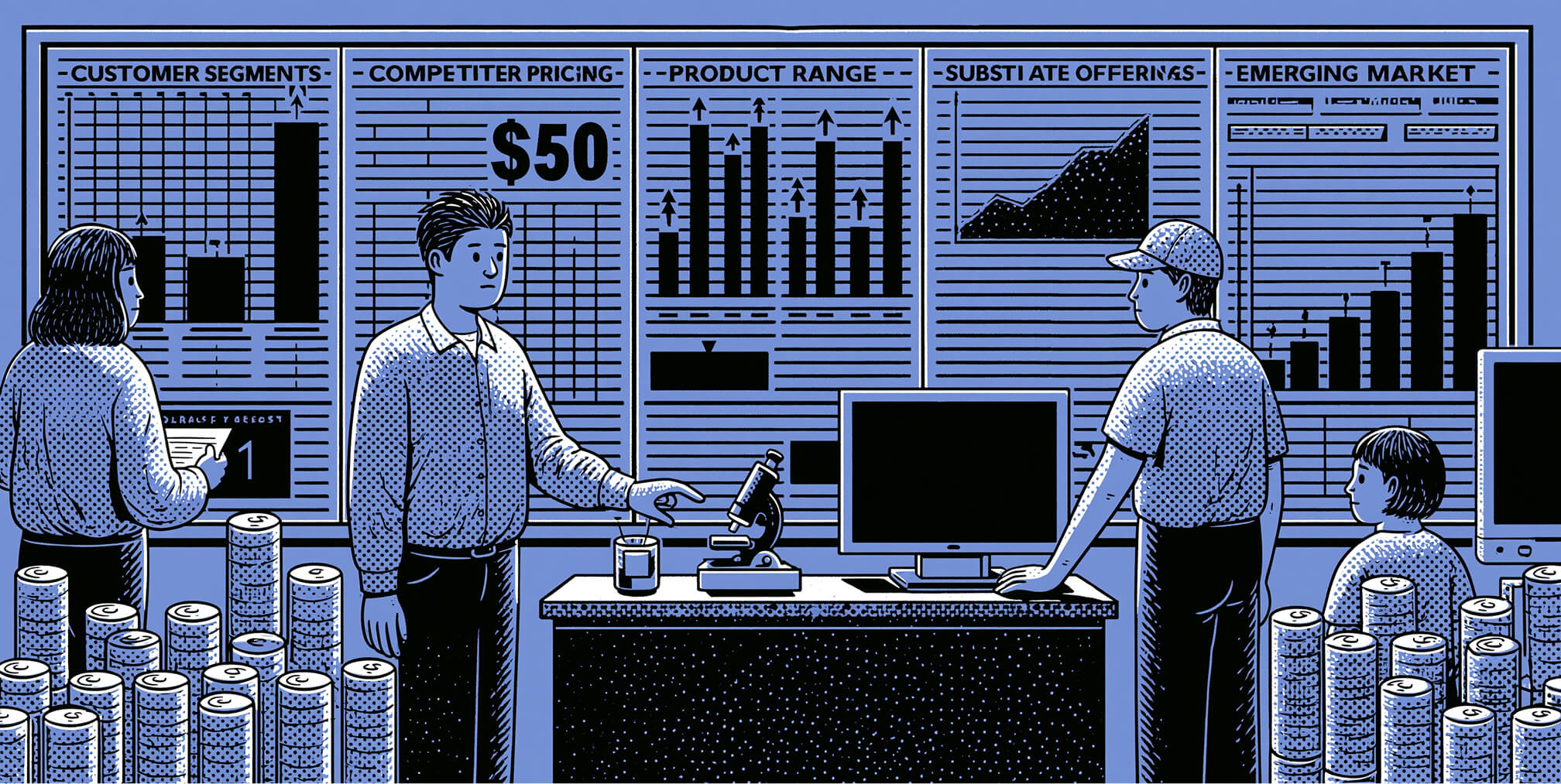
Effective implementation requires analyzing market and competitive landscape before committing to a strategy. Structure your market analysis around three activities:
- Define target market boundaries and key customer segments
- Map major competitors, their pricing, messaging, and product range
- Identify substitute offerings and emerging market trends
Use 2024–2026 data from industry reports, public filings, and customer surveys. Assess competitors' current strategies: who are the cost leaders, who are the differentiators, who serves a niche market? This analysis should reveal gaps or under-served segments that a refined business-level strategy could target.
Step 2: Evaluate Your Company's Strengths, Weaknesses, and Resources
Run a focused internal assessment using SWOT, core competencies analysis, and capability mapping. Core competencies entail leveraging internal strengths and unique resources to outperform competitors.
In 2026, strategic resources include proprietary data, algorithms, brands, patents, distribution networks, and specialized talent. For many companies, this now includes roles like an AI content strategist who can integrate artificial intelligence into marketing. Distinguish between table stakes (basic digital presence, standard quality) and true differentiators (unique platform, superior cost structure, niche reputation).
A manufacturer discovering that its supply-chain excellence provides a genuine cost advantage should lean toward cost leadership rather than trying to out-innovate design-led rivals. This step narrows feasible strategies, preventing aspirational choices that current capabilities cannot support.
Step 3: Define Strategic Positioning, Vision, and Value Proposition
Customer needs and value proposition focus on identifying customer needs and delivering unique value. Once analyses are complete, articulate your desired strategic position in customer-friendly language, using a structured brand positioning framework that clarifies audience, benefits, and differentiation:
- Cost leader: "The most affordable [product] for [segment]"
- Differentiator: "The most trusted premium [product] for [professionals]"
- Focused niche: "The only [product] built exclusively for [specific audience]"
Align this positioning with company vision and values so it feels authentic. You can translate it into a formal brand positioning strategy with templates and real-world examples. This positioning will later guide messaging, pricing, product design, and hiring criteria at the functional level.
Step 4: Set Clear Strategic Objectives and KPIs
Setting clear strategic objectives translates strategy into measurable outcomes. Set 3–7 concrete strategic objectives for the next 1–3 years:
- Cost leader example: "Reduce unit cost by 12% by end of 2027"
- Differentiator example: "Launch three premium features per year and increase NPS by 10 points"
Translate these into KPIs: revenue growth in target segments, gross margin, customer lifetime value, churn rate, cost per unit, customer satisfaction scores. Set baselines with specific numeric targets and dates.
Link each KPI to an owner (business unit head, CMO, COO) and define review cadence. Regularly tracking KPIs helps monitor strategy effectiveness and progress, turning strategic intent into operational accountability.
Step 5: Design Initiatives and Allocate Resources Effectively
Break strategic objectives into concrete initiatives. For cost leadership: "Implement warehouse automation by Q4 2027." For differentiation: "Build a customer success program by Q2 2027." PepsiCo's integrated cost architecture targeting 70% productivity gains through procurement and process redesign shows what disciplined initiative design looks like.
Effective resource allocation is guided by business-level strategy. Resource allocation should align with strategic priorities for maximum impact. The critical skill is saying "no" to projects that don't support the strategy, even attractive ones.
A company claiming to pursue cost leadership while over-investing in premium print and television advertising is misallocating resources. To allocate resources effectively, every budget line should trace back to a strategic initiative. Cross-functional dependencies across operations, marketing, product, finance, and human resources must be managed explicitly.
Step 6: Implement, Monitor, and Adapt Your Business Strategy
Implementation demands disciplined execution: defined milestones, clear roles, and governance structures like steering committees and quarterly strategy reviews. Monitoring and adaptation involve using KPIs to evaluate progress and adapt strategies based on what the data reveals.
Build a simple performance management rhythm:
- Monthly operating reviews with KPI dashboards
- Quarterly strategic check-ins comparing progress against plan
- Annual full strategy refresh
Continuous monitoring and adaptation are essential for strategy success. Use leading indicators (pipeline data, churn early warnings, input cost trends) to spot problems before they show up in financial results. A particular generic strategy tend to drift without active governance.
Successful strategy execution also requires culture. Employees at all levels need to understand the organizational strategy and how their daily work supports it.
Common Pitfalls in Business-Level Strategy (and How to Avoid Them)

Common mistakes that undermine even well-designed strategies:
- Stuck in the middle: Trying to be both the cheapest and the most premium simultaneously. Sears and Kmart lost market share when they couldn't match Walmart's costs or offer enough differentiation to justify higher prices.
- Copying without capability: Mimicking a competitor's differentiation strategy without having the R&D budget, talent, or brand equity to sustain it.
- Misaligned functions: A firm claiming differentiation but running marketing campaigns focused on discounts and promotions.
- Strategy drift during growth: Mid-sized firms are especially vulnerable. Adding product lines or entering regions without clear strategic focus dilutes the competitive edge.
Practical countermeasures: conduct annual strategy refreshes, run cross-functional alignment workshops, test new ideas with small experiments before big bets, and maintain a public list of "what we will not do." Incorporating business level strategies into regular leadership rhythms prevents complacency.
Business-Level Strategy Examples from Different Industries
Retail discount (cost leadership): Aldi uses limited SKU assortment, private labels, lean staffing, and minimal store design. KPIs: inventory turns, unit cost, operating margin. Gross margins are lower but volumes drive profitability.
B2B SaaS (focused differentiation): A vertical SaaS provider serving only healthcare providers with specialized compliance features and premium support. It commands higher prices within that niche market by solving problems no horizontal platform addresses. KPIs: churn rate, customer lifetime value, feature adoption.
Consumer electronics (integrated strategy): A brand offering moderate prices with differentiated design, supported by efficient global manufacturing. This leadership strategy balances cost discipline with innovation. KPIs: gross margin, average selling price, market share in target segments.
For each, the strategic management discipline is the same: clarity on which generic strategy dominates, alignment of capabilities, and rigorous measurement of whether the strategy delivers.
Using Data and AI to Strengthen Business-Level Strategy in 2026
Data analytics and AI now underpin both cost leadership (through supply chain optimization and automation) and differentiation (through personalization and advanced features). Concrete applications include demand forecasting to reduce inventory costs, recommendation engines to boost customer satisfaction across critical brand touchpoints in the customer journey, and AI-driven dynamic pricing.
Tracking key performance indicators in near real time is feasible with modern BI tools, enabling faster course corrections. The key is aligning your data strategy with your chosen business-level strategy rather than treating it as a generic technology initiative.
Companies that integrate AI capabilities into their competitive landscape positioning are more likely to sustain competitive advantage beyond 2026, whether as cost leaders or differentiators.
How Business-Level Strategy Evolves Over Time
Business-level strategies are not permanent. A strategy that delivered sustainable growth in 2015 may lose relevance by 2026 as technology, customer behavior, and regulations shift.
Typical evolution paths in an era of AI-powered creative services that reshape how brands tell stories:
- A focused differentiator broadens into wider markets as capability matures
- A differentiator adds cost discipline, moving toward an integrated strategy
- A cost leader adds selective premium offerings to defend against niche competitors
Consider a streaming service that began as a focused differentiator with niche content, then expanded its catalog and introduced multiple pricing tiers as competition intensified. That evolution was intentional and data-informed, not a reactive scramble.
Strategic evolution should be deliberate. Periodically reassess whether your current strategy type remains the best match for your environment and resources instead of being locked into legacy choices.
FAQ
How often should a company revisit its business-level strategy?
Most organizations should formally review their strategy annually, with lighter quarterly check-ins tied to KPI reviews and market developments. A full redesign is not always necessary; often the job is confirming that your current cost leadership, differentiation, or focus strategy is still valid and making tactical adjustments. Major external shocks like new regulations, disruptive technologies, or significant competitor moves should trigger additional ad-hoc reviews.
Does a small business or startup really need a business-level strategy?
Yes. Even very small firms benefit from an explicit choice about how they intend to compete, particularly on price vs. uniqueness and which target customers they will prioritize. Early-stage strategies can be simpler and more flexible, but having a defined direction prevents scattered experiments and confusing signals to the market. A lightweight but complete brand strategy framework can help structure those decisions. Write a one-page articulation of your chosen strategy and revisit it quarterly as you learn from customers and data.
What if my company seems "stuck in the middle" between cost leadership and differentiation?
Being stuck in the middle means lacking a clear cost advantage or distinctive differentiation, resulting in average margins and weak customer loyalty. Run a sharp diagnostic: compare your cost structure to benchmark competitors and assess whether customers truly perceive unique value in your offering. Then choose a primary direction, either doubling down on cost improvements or on differentiation investments, and prune initiatives that do not clearly support that choice.
Can a company pursue different business-level strategies in different markets?
Multi-business corporations often manage separate business units, each with its own strategy. One unit can operate as a cost leader while another pursues differentiation, as long as portfolio management keeps them clearly separated. Within a single business unit serving the same customer segment, running conflicting strategies under the same brand confuses customers and complicates operations. Use distinct brands or product lines if very different strategic positions are needed.
How do I know if my business-level strategy is working?
Success should show up in both leading and lagging indicators: improving margins or market share, growing customer lifetime value, positive customer feedback, and cost metrics trending in the right direction. Compare performance not just to your own history but to peers and industry benchmarks to see if you are actually gaining relative advantage. If, after 12–24 months of focused execution and adequate investment, key KPIs are flat or deteriorating, revisit your underlying assumptions and consider adjusting the chosen strategy.

Quincy Samycia
As entrepreneurs, they’ve built and scaled their own ventures from zero to millions. They’ve been in the trenches, navigating the chaos of high-growth phases, making the hard calls, and learning firsthand what actually moves the needle. That’s what makes us different—we don’t just “consult,” we know what it takes because we’ve done it ourselves.
Want to learn more about brand platform?
If you need help with your companies brand strategy and identity, contact us for a free custom quote.
We do great work. And get great results.
+2.3xIncrease in revenue YoY
+126%Increase in repurchase rate YoY




+93%Revenue growth in first 90 days
+144% Increase in attributed revenue




+91%Increase in conversion rate
+46%Increase in AOV




+200%Increase in conversion rate
+688%Increase in attributed revenue