Email Flows Every Shopify Store Needs (Welcome, Abandon, Win-Back)
12/18/2025
E-Commerce / Marketing Strategy
Explore the welcome, abandonment, and winback email flows that support a Shopify customer’s journey. Using Klaviyo examples, learn what starts each sequence, who should receive it, and how to measure its performance.
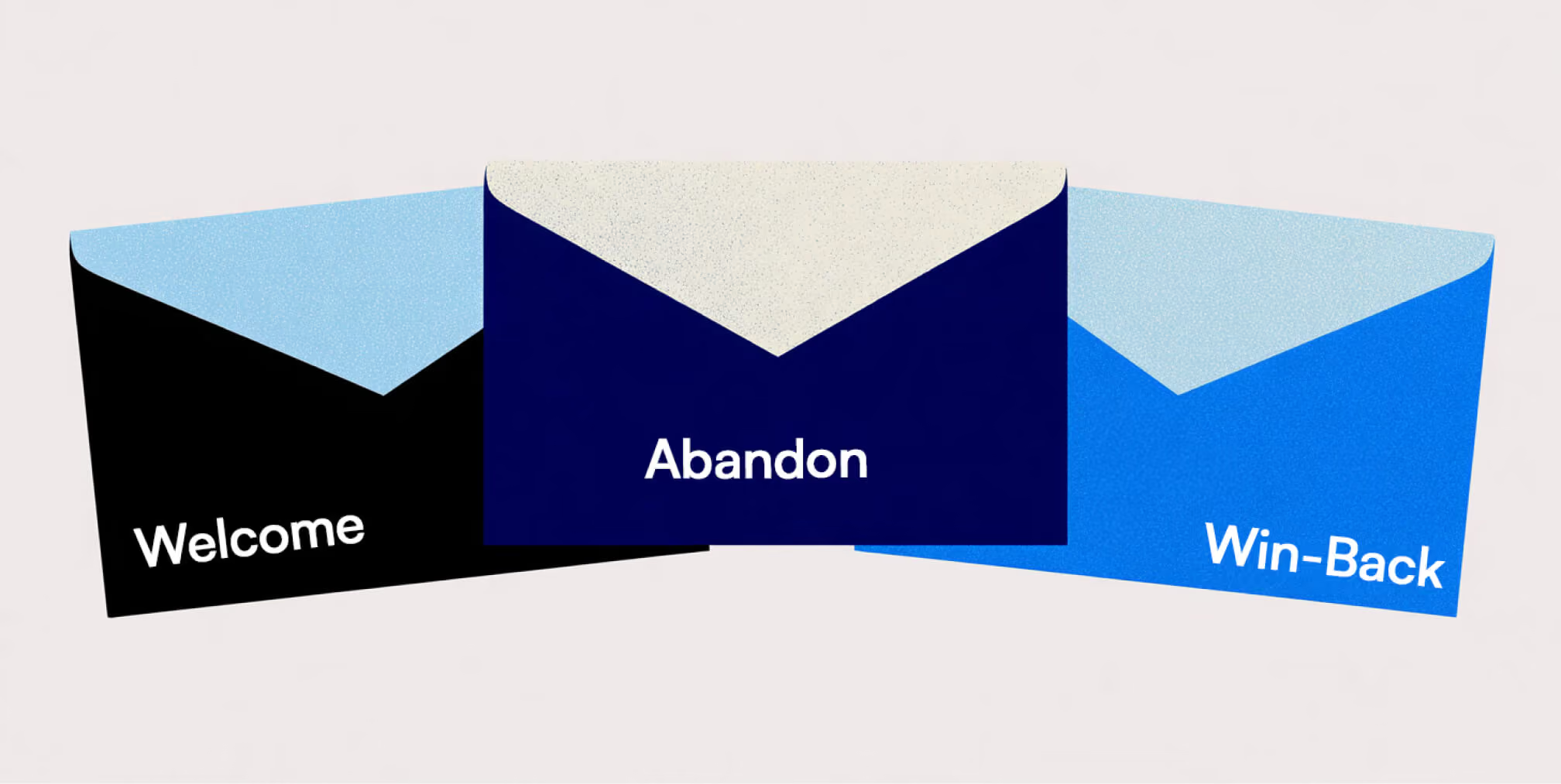
Email flows for Shopify stores are automated email sequences triggered by subscriber activity, shopping behavior, or purchase history. Welcome flows introduce new subscribers to your brand, abandonment flows follow up on unfinished purchases, and winback flows reconnect with past customers. Shopify provides the ecommerce storefront and order data. A connected email platform, such as Klaviyo, uses available customer data and tracking to manage audiences, run sequences, and send messages. In this guide, we use Klaviyo as the implementation example for Shopify stores. Each flow should address a specific customer need, whether that means helping someone choose a product, answering a question before checkout, or providing a relevant reason to purchase again. Clear eligibility rules, appropriate timing, and purchase exclusions help keep those messages useful. This guide explains how to plan your core flows, including triggers, consent checks, timing examples, exit conditions, and success metrics. You’ll also learn how to distinguish abandoned cart from abandoned checkout sequences, prevent overlapping messages, and check deliverability before activation.



Why Email Flows Matter for Shopify Stores in 2026


Email flows help Shopify stores follow up at important moments in the customer journey. A new subscriber can receive an introduction to your products, a shopper can get help completing a purchase, and an existing customer can receive guidance on using what they bought.
Automation makes these follow-ups possible without manually scheduling every message. Their effectiveness depends on your audience, content, timing, data quality, and customer experience.
There is no universal highest-ROI channel for every store. Evaluate email flows using conversions, repeat purchases, and revenue alongside platform fees, creative costs, management time, and discounts. Email-attributed revenue can inform that assessment, but it does not prove that every credited order was caused by email.
Start by identifying where customers need support, then build sequences around those moments.
How Automated Email Flows Differ From Scheduled Campaigns
Email flows and scheduled campaigns are complementary parts of an ecommerce email marketing strategy. The main difference is what determines when someone receives a message.
A campaign usually sends to a selected audience at a scheduled time, such as a product launch or seasonal promotion. A flow starts when an individual meets defined conditions, then follows rules for timing, eligibility, and subsequent messages.
Throughout this guide, Shopify is the ecommerce platform, and Klaviyo is the platform used to build and send the email flows.
Behavioral Triggers: What Starts a Flow?
A trigger is the event or condition that starts an automated sequence. Depending on your integration and tracking setup, examples include:
- An email subscription: Someone joins your list and qualifies for a welcome sequence.
- A product view: An identifiable, eligible subscriber browses an item and meets your follow-up conditions.
- A checkout event: Someone starts checkout, followed by a delay and a check for whether they purchased.
- A period of inactivity: A previous customer meets a defined condition for time since their last order.
A trigger alone does not make someone eligible to receive marketing. Each flow also needs consent and suppression checks, purchase exclusions, and rules that account for what the customer does next.
For example, an abandonment sequence should check for a completed purchase before each reminder. Someone who has already ordered should stop receiving messages asking them to finish that purchase.
Personalization Based on the Customer’s Stage
Customer stage helps determine which information is useful:
- New subscribers may need product guidance, brand information, or answers to common questions.
- First-time customers may benefit from instructions, care advice, or support after delivery.
- Repeat customers may appreciate relevant recommendations or replenishment reminders.
- Lapsed customers may respond to a product update or another meaningful reason to return.
These are starting points to test against your store’s buying patterns. Someone purchasing a durable product has a different buying cycle from someone ordering a consumable every month.
Flow rules should adapt when customers move between stages. A subscriber who places an order may need to leave a first-purchase sequence and enter an appropriate post-purchase flow.
The Role of Segmentation
Segmentation groups customers using relevant information, such as purchase history, product interests, engagement, and purchase frequency. Klaviyo’s segmentation tools support audiences based on customer attributes and tracked activity. Your available options depend on the data received from Shopify, connected tools, and configured tracking.
Useful segments might include customers who purchased a particular category, subscribers who have never ordered, or repeat buyers approaching their usual reorder interval.
Start with distinctions that change what you would say or when you would say it. A customer who recently purchased a refill should receive different messaging from someone who may be running low.
Finally, coordinate campaigns and flows so customers do not receive duplicate reminders, conflicting offers, or too many messages close together. Relevant segmentation works best alongside clear rules for message frequency and flow eligibility.
Free Brand Health Audit
Make sure your brand is built to sell
Search has changed. Your customers aren't just Googling anymore. They're asking ChatGPT, Perplexity, Gemini and other AI platforms what to buy, who to trust and which brands they should consider.
If your brand isn't showing up clearly in those answers, you're already losing opportunities. Our free Brand Health Audit shows you where your brand stands across traditional search, AI search and brand positioning.

Sample brand audit
Live preview
Traditional search
72
AI search (GEO)
34
Brand positioning
58
Three Core Email Flows to Prioritize for Your Shopify Store

Welcome, abandonment, and winback flows address three important moments: joining your audience, leaving a purchase unfinished, and going longer than expected without ordering again.
Your priorities should reflect your store’s activity. A new store may focus on welcoming subscribers and following up on checkout activity, while an established store may have more opportunities to reconnect with previous customers.
The timings below are examples to test, not universal recommendations. Adjust them to your products, buying cycle, and customer response.
1. Welcome Flow: Help New Subscribers Make Their First Decision
A welcome flow introduces your brand, delivers any promised signup benefit, and helps subscribers decide whether your products meet their needs.
Start with a clear introduction and useful product guidance. Later messages can answer common questions, share relevant customer reviews, or explain what makes your products different.
Example setup in Klaviyo:
- Trigger: A subscriber joins the designated email marketing list.
- Eligibility: The contact has subscribed to email marketing, is not suppressed, and qualifies for the intended welcome sequence. Complete any required confirmation before sending.
- Example delay: Send the first message after confirmed signup, followed by additional messages two and four days later.
- Purchase exclusion: For a first-purchase sequence, exclude existing buyers and check for new purchases before each message.
- Exit: Stop first-purchase messaging when the subscriber orders, unsubscribes, becomes suppressed, or completes the sequence.
- Success metric: Track first-purchase conversion among recipients over a defined period, alongside clicks, unsubscribes, and spam complaints.
If an existing customer subscribes, use a separate branch or sequence that acknowledges their relationship with your brand. They should still receive any applicable signup benefit without being treated as someone who has never purchased.
See Klaviyo’s welcome series guide for platform setup guidance.
2. Abandoned Cart and Checkout Flows: Help Shoppers Complete a Purchase
Abandonment emails follow up with eligible shoppers who showed purchase intent but did not complete an order. Useful messages remind them what they selected and address practical questions about delivery, returns, sizing, or product suitability.
First, distinguish between two starting points:
- Added to Cart: The shopper adds an item to their cart but may not start checkout.
- Started Checkout: The shopper begins checkout but does not complete a purchase within your chosen delay.
Klaviyo’s abandoned cart flow guide covers checkout-triggered recovery. Check the actual event used in your account rather than relying on the flow’s name.
Example setup for a checkout-triggered flow:
- Trigger: Klaviyo receives a Started Checkout event from the connected Shopify store.
- Eligibility: The shopper is identifiable, eligible to receive the message under your consent requirements, and not suppressed. The event must contain the information needed to populate the email correctly.
- Example delay: Wait four hours before the first reminder, then another 20 hours before a second message.
- Purchase exclusion: Check that the customer has placed no order since starting the flow before each send.
- Exit: Stop reminders when the customer purchases, loses sending eligibility, or completes the sequence.
- Success metric: Track recipient purchase rate and attributed order value over a defined window, alongside discount costs, unsubscribes, and complaints.
For an Added to Cart flow, also exclude shoppers who have since started checkout so the checkout sequence can take priority. Check for duplicate recovery messages from Shopify or other connected apps before activation.
An incentive is optional. Start by answering questions and removing uncertainty; test discounts only where the potential benefit justifies the effect on margin.
3. Winback Flow: Give Past Customers a Relevant Reason to Return
A winback flow reconnects with customers who have gone beyond their usual buying interval. Its timing should reflect how often people realistically need your products.
Useful content might introduce a relevant new product, revisit a previous favorite, or provide an update that gives the customer a reason to return.
Example setup in Klaviyo:
- Trigger: A Placed Order event starts a sequence with a delay based on the expected repurchase cycle.
- Eligibility: The customer can receive email marketing, is not suppressed, and has not reordered during the waiting period. Exclude active subscribers or other customers for whom the message would be inappropriate.
- Example delay: For a product commonly reordered within 30–60 days, test an initial message after 90 days, followed by a second seven days later.
- Purchase exclusion: Check for any new order since the triggering purchase before each message.
- Exit: Stop the sequence when the customer orders again, unsubscribes, becomes suppressed, or reaches the final message.
- Success metric: Measure the proportion of recipients who purchase again within a defined period, alongside revenue per recipient and incentive costs.
Klaviyo’s winback flow guide explains the order-triggered approach. Coordinate this sequence with replenishment reminders and promotional campaigns so customers receive a coherent set of messages.
These flows form part of a broader retention marketing strategy. Review them together, assign clear ownership, and test eligibility, purchase exclusions, and overlapping sends before turning them on.
Want to learn more about E-commerce and Marketing Strategy? Keep reading!
If you need help with your company’s website and marketing, contact us for a free custom quote.
Beyond the Core Three: Additional Email Flows for Shopify Stores

Additional flows are useful when they address a specific gap in your customer experience. Prioritize them according to your products, available data, and capacity to maintain them.
The timings below are illustrative starting points. Test them against delivery times, product usage, and actual purchase patterns. Every marketing flow should check consent, suppression status, and overlapping messages before sending.
Post-Purchase Follow-Up Flows
Post-purchase emails help customers use, care for, or get more value from what they ordered. Keep product education relevant to the purchased item and coordinate it with existing order and shipping notifications.
- Trigger: An order, fulfillment, or delivery event, depending on the available integration data.
- Eligibility: Customers with a qualifying purchase who are eligible to receive the planned messages.
- Example delay: Send usage guidance two days after confirmed delivery.
- Purchase exclusion: A new order does not necessarily make educational content irrelevant. Suppress duplicate guidance and exclude canceled or returned items where that data is available.
- Exit: End the sequence after the planned guidance, or when the order status or sending eligibility makes further messages inappropriate.
- Success metric: Track engagement with the guidance and relevant customer outcomes, such as product-related support requests or repeat purchases over a defined period.
Browse Abandonment Flows
Browse abandonment follows up on product interest before a shopper reaches the cart or checkout. It requires an identifiable visitor and suitable tracking; it cannot email every anonymous person who views a product.
- Trigger: A tracked Viewed Product event.
- Eligibility: An identifiable contact who can receive marketing and has not recently received the same follow-up.
- Example delay: Wait six hours before checking eligibility and sending a product reminder.
- Purchase exclusion: Exclude anyone who has purchased since entering the flow. Also exclude shoppers who added to cart or started checkout so a more relevant sequence can take priority.
- Exit: Stop when the shopper progresses to cart, checkout, or purchase, loses sending eligibility, or completes the sequence.
- Success metric: Track recipient purchase rate alongside clicks, unsubscribes, and complaints.
See Klaviyo’s browse abandonment guide for tracking prerequisites and flow configuration.
Product Review and Customer Content Requests
Review requests invite customers to share their experience after they have had time to use a product. Requests for photos or videos can also help you collect customer content, with permission for any intended reuse.
- Trigger: A delivery event or an order event followed by an appropriate delivery allowance.
- Eligibility: Customers who received the product and qualify for the request. Avoid duplicate requests from your review app and email platform.
- Example delay: Request feedback 14 days after delivery, allowing longer for products that take time to evaluate.
- Purchase exclusion: A new purchase need not stop the request, but avoid repeated requests for the same product or order.
- Exit: Stop reminders after a submission, return, cancellation, loss of sending eligibility, or completion of the sequence.
- Success metric: Measure completed reviews or usable, permissioned submissions per delivered request.
Ask for honest feedback rather than only positive reviews. Collecting reviews does not automatically improve search rankings; their value depends on their usefulness, authenticity, and how they are published.
Replenishment Reminders
Replenishment flows suit products customers use up and reorder. Timing should reflect the item, quantity purchased, and realistic consumption period.
- Trigger: A purchase of a qualifying consumable.
- Eligibility: Customers eligible for marketing who may be approaching their next reorder.
- Example delay: For a roughly 30-day supply, test a reminder around day 25, accounting for delivery time.
- Purchase exclusion: Exclude customers who have already reordered the relevant product or receive it through an active subscription.
- Exit: Stop after a relevant reorder, subscription enrollment, loss of eligibility, or the final reminder.
- Success metric: Track product-specific reorder rate and time to the next purchase.
Klaviyo’s replenishment flow guide explains how purchase events and delays can support this setup.
Subscription Education Flows
Subscription customers may need onboarding, product guidance, and clear information about managing their subscription. Coordinate these emails with notifications already sent by your subscription app.
- Trigger: A subscription-start event supplied by the connected subscription tool.
- Eligibility: Active subscribers who qualify for the message type.
- Example delay: Send onboarding after enrollment and product guidance after the first delivery.
- Purchase exclusion: Expected recurring orders should not remove someone from useful onboarding, but they should not restart it unnecessarily.
- Exit: Stop or change the sequence when the subscription is paused or canceled, eligibility changes, or onboarding is complete.
- Success metric: Track subscription continuation through a defined renewal period and subscription-related support requests.
Keep required service notifications separate from optional promotional content.
How Personalization Makes Email More Relevant
Personalization uses customer information to change the content, timing, or purpose of a message. Its value should be tested rather than assumed to produce higher ROI.
Product Recommendations Based on Available Data
Depending on your configuration, Shopify and Klaviyo data can inform recommendations using purchase history, tracked product views, and stated preferences.
Check that suggested items are available and relevant. Avoid recommending an item someone just bought unless there is a clear reason to purchase it again. Include a useful fallback when there is insufficient data for a personalized recommendation.
Messaging That Reflects the Customer Relationship
A first-time buyer may need reassurance and instructions. A frequent customer may prefer information about a new product or an addition to something they already own.
Use these distinctions when they change the message meaningfully. Where audience size permits, compare personalized content with a more general version using purchase rate, revenue per recipient, and negative engagement signals.
Brand Storytelling That Supports the Message
Brand storytelling can give emails a recognizable voice and explain why your products exist.
Use founder perspectives, product development details, and relevant customer experiences where they help the reader. Keep the practical purpose clear: a replenishment email should still make reordering easy, and a product education email should still answer the customer’s question.
Choosing the Right Email Platform for Shopify
Choose your platform by checking whether it supports your required journeys, data connections, reporting, and team workflow.
When to Evaluate Klaviyo
Klaviyo is the implementation platform used in this guide. Evaluate whether your proposed setup can capture the necessary Shopify events, apply the required exclusions, and coordinate the flows you plan to build.
Ask for a demonstration using your actual requirements, such as a product-specific replenishment reminder or a checkout sequence that stops after purchase.
Comparing Alternatives
If you are considering Attentive, Sendlane, Omnisend, or another provider, test the same requirements in each platform. Confirm current functionality, plan restrictions, and integration coverage directly with the provider.
Compare:
- Data connections: Which shopping, order, delivery, and subscription events are available?
- Flow controls: Can you manage eligibility, delays, purchase exclusions, exits, and repeat entry?
- Message coordination: How will campaigns, email flows, SMS, and app notifications avoid duplication?
- Reporting: Can the team explain conversion definitions and attribution settings?
- Total cost: What are the platform, implementation, migration, and ongoing management costs?
- Ownership: Who maintains integrations, approves content, tests flows, and reviews results?
Our guide to ecommerce email marketing services explains how strategy, setup, creative, and ongoing management fit into a defined service scope.
Before Activation: Deliverability and Flow Checks
Before switching on these sequences, review both sending requirements and the customer experience.
- Authenticate your sending domain: Check SPF, DKIM, and DMARC configuration with your platform or technical owner.
- Verify unsubscribe handling: Test the visible unsubscribe link and one-click unsubscribe where required.
- Check consent and suppression: Confirm that ineligible contacts cannot receive marketing messages.
- Test purchase exclusions and exits: Use test profiles to confirm that messages stop or change after relevant customer actions.
- Check overlapping sends: Review Shopify notifications, review apps, subscription tools, campaigns, and other flows.
- Inspect email content: Test mobile rendering, links, offers, product details, and fallback content.
- Monitor after launch: Assign someone to review bounces, complaints, unsubscribes, and unexpected sends.
Google’s email sender requirements specify authentication and delivery standards for personal Gmail accounts, with additional requirements for bulk senders, including SPF, DKIM, DMARC, and one-click unsubscribe for marketing messages. Review the full guidance against your sending setup before launch.
FAQs About Shopify Email Flows
1. Are Shopify email flows built in Shopify or Klaviyo?
“Shopify email flows” describes automated email sequences for a Shopify store. In this guide, those sequences are built in Klaviyo using data from the connected store and configured tracking. Shopify handles the ecommerce experience, while Klaviyo manages the email flow’s messages, timing, and audience rules.
2. How can email flows strengthen brand identity?
Email flows reinforce brand identity through consistent language, design, product messaging, and customer support. Welcome emails can introduce your perspective, while post-purchase messages demonstrate how you help customers after the sale.
Consistency matters, but each message should also serve a practical purpose. Familiar branding works best alongside information the recipient needs.
3. Do welcome flows improve long-term customer loyalty?
Welcome flows can support the beginning of a customer relationship by setting expectations, explaining products, and helping subscribers make informed decisions. They do not establish long-term loyalty on their own.
Product quality, delivery, service, and the experience after purchase also matter. Evaluate welcome flows using first-purchase conversion, then examine repeat-purchase behavior over a suitable period rather than treating the first order as proof of loyalty.
4. Should email flows connect with paid marketing campaigns?
Yes. Coordinate email content with the offers and expectations established by your ads and landing pages. A subscriber joining through a specific promotion should receive relevant follow-up and any promised signup benefit.
This coordination may support conversion, but it does not guarantee higher return on ad spend. Advertising and email platforms may both claim credit for the same order. Review overall acquisition costs, sales, and margins alongside platform reports.
5. How many emails should each flow contain?
There is no universal ideal number. Start with the messages needed to serve the flow’s purpose, and add follow-ups only when they provide distinct value.
For example, you might test three welcome emails, two checkout reminders, or one initial winback message followed by a second. These are starting points, not performance benchmarks. Adjust the sequence using purchase behavior, clicks, unsubscribes, and complaints, while accounting for other messages the customer receives.
6. Should abandoned cart emails include a discount?
A discount is optional. Start by reminding shoppers about their selected products and addressing questions about shipping, returns, sizing, or suitability.
If you test an incentive, assess whether additional purchases justify the reduction in margin. Apply clear eligibility rules and avoid continuing the offer after someone has purchased.
7. Can email flows work with a small subscriber list?
Yes. Eligible subscribers and customers can receive useful automated messages even when the list is small. However, revenue potential depends on how many people enter the flows, their purchase intent, and your products.
With limited volume, focus on correct setup and relevant content. Allow enough time to gather meaningful evidence before drawing conclusions from small changes in conversion rates.
8. What is the difference between abandoned cart and abandoned checkout flows?
An abandoned cart flow starts from an add-to-cart event. An abandoned checkout flow starts when a shopper begins checkout. Both require a delay and checks to determine whether a purchase followed.
The distinction matters because these events represent different stages of intent. If both flows are active, shoppers who progress to checkout should leave the cart sequence, and purchasers should stop receiving recovery reminders. Check the actual trigger in your account; Klaviyo’s abandoned cart setup guide describes a checkout-triggered approach.
9. How do you measure whether an email flow is working?
Choose a metric that matches the flow’s purpose. Examples include first-purchase conversion for welcome flows, completed purchases for checkout reminders, and returning-customer purchases for winback flows.
Review those outcomes alongside sending volume, costs, unsubscribes, and complaints. Keep comparison periods and attribution settings consistent. Email-attributed revenue is credit assigned under platform rules, not proof that email caused every credited sale. Klaviyo’s attribution guidance explains how those rules affect reporting.
Build Email Flows Around the Customer Journey
A useful email program gives customers relevant support before and after a purchase. Welcome, abandonment, and winback flows provide a starting point; additional sequences should address specific needs such as product education or replenishment.
Start with clear triggers, eligibility rules, and measurable objectives. Test purchase exclusions and overlapping sends, then review performance as your products and customer behavior change.
At The Branded Agency, we help Shopify brands plan and build Klaviyo email flows through strategy, copywriting, design, setup, and ongoing review.
Explore our retention marketing services, or contact our team to discuss your current setup and the flows worth prioritizing next.

Quincy Samycia
As entrepreneurs, they’ve built and scaled their own ventures from zero to millions. They’ve been in the trenches, navigating the chaos of high-growth phases, making the hard calls, and learning firsthand what actually moves the needle. That’s what makes us different—we don’t just “consult,” we know what it takes because we’ve done it ourselves.
Want to learn more about brand platform?
If you need help with your companies brand strategy and identity, contact us for a free custom quote.
We do great work. And get great results.
+2.3xIncrease in revenue YoY
+126%Increase in repurchase rate YoY


+93%Revenue growth in first 90 days
+144% Increase in attributed revenue


+91%Increase in conversion rate
+46%Increase in AOV


+200%Increase in conversion rate
+688%Increase in attributed revenue