Email Marketing for SaaS: The 2026 Playbook for Lifecycle-Driven Growth
08/11/2026
Marketing Strategy
.png)


How SaaS Email Marketing Supports Growth and Retention
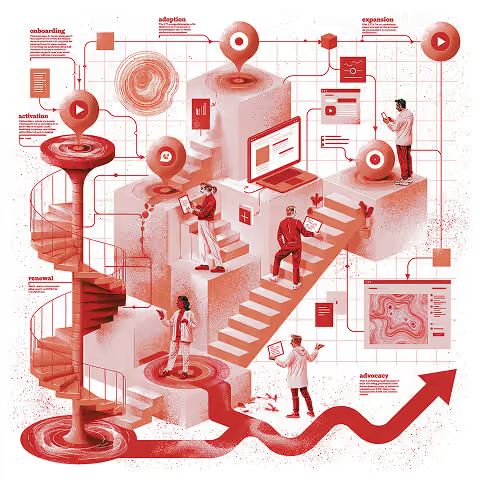
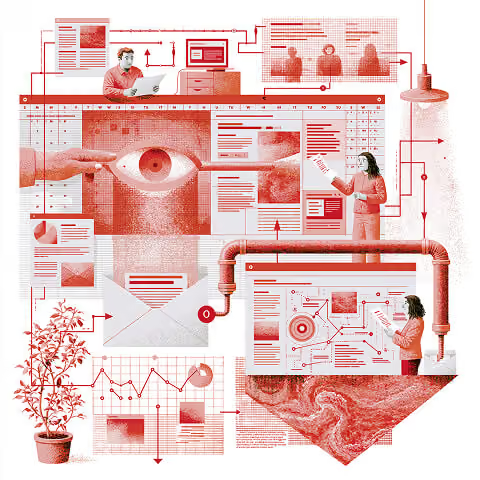
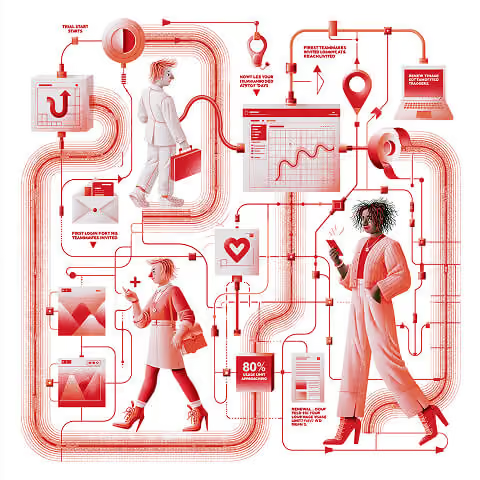
SaaS email marketing helps prospects and customers take useful steps toward understanding, adopting, and continuing to use your software. Those steps might include completing setup, trying a relevant feature, inviting a teammate, or preparing for renewal.
An effective program connects messages to the customer’s stage, role, and product activity. For example, someone who has not connected a required integration may need setup guidance, while someone already using it needs a different next step.
Email can support these outcomes, but it cannot compensate for poor product fit, unresolved support issues, or a confusing onboarding experience. Evaluate its contribution alongside product improvements, sales activity, and customer success support.
Key Takeaways
- Plan around customer milestones. Define what users need to accomplish during evaluation, onboarding, activation, adoption, and renewal. Not every customer follows the same path.
- Use behavior to make messages relevant. An automated email strategy should specify triggers, eligibility, timing, and exit rules. Stop reminders once the requested action is complete.
- Make education actionable. Tutorials, examples, and customer stories should help recipients solve a specific problem or complete a meaningful task.
- Coordinate across teams and channels. Align email with in-app messages, sales outreach, and customer success conversations to avoid repetitive or conflicting communication.
- Measure product and business outcomes. Track activation, trial-to-paid conversion, adoption, and retention alongside clicks, unsubscribes, and complaints.
- Test rather than promise returns. Email ROI varies with your acquisition model, contract value, audience, and delivery costs. Broad email benchmarks should not be presented as expected SaaS results.
What Makes Email Marketing Different for SaaS?
SaaS customers typically need to experience ongoing value to continue paying for a product. That makes onboarding, product adoption, and customer retention central to the email strategy.
The relationship may also involve several people. An end user needs workflow guidance, an administrator needs setup and team-management information, and a billing contact needs accurate renewal details. Sending the same message to everyone can miss those different responsibilities.
Product Activity Shapes the Next Message
When available and appropriate to use, product events, account roles, plan details, and billing information can help determine what to send.
For example:
- A trial user who has not completed setup receives guidance on the missing step.
- A user who completes setup exits that reminder sequence.
- An administrator preparing to add teammates receives relevant onboarding resources.
- An account approaching renewal receives communications directed to the appropriate decision-maker or billing contact.
A login alone does not establish that someone has received value. Define activation using actions that meaningfully reflect success with your product, then test whether those milestones are associated with continued use.
User-Level and Account-Level Messaging
In B2B SaaS, individual activity and account health are different. One inactive user does not necessarily mean the entire account is at risk, and one active user does not establish broad team adoption.
Use user-level information for individual guidance and account-level information for conversations about adoption, expansion, or renewal. Coordinate with the account owner before sending automated sales messages to customers already discussing a change.
SaaS and eCommerce Email Marketing Compared
Both SaaS and ecommerce benefit from relevant education, segmentation, and retention messaging. The practical differences come from what customers buy and how they experience value.
DimensionSaaS email marketingeCommerce email marketingInitial conversionDemo request, signup, trial, or paid subscriptionFirst product purchase or subscriptionOnboardingAccount setup and completion of useful product actionsDelivery, product use, and care guidanceBehavioral signalsSetup progress, feature usage, user role, and account activityProduct views, cart activity, order history, and replenishment needsRetention focusContinued adoption, subscription value, and renewalProduct satisfaction, repeat purchases, and subscription continuityExpansion opportunitiesAdditional seats, higher plans, or relevant add-onsComplementary products, replenishment, or higher-value purchasesOutcome measuresActivation, trial-to-paid conversion, account retention, and expansionPurchase conversion, repeat purchase rate, order value, and margin
These differences should shape your content and measurement. For SaaS, the central question is: does this message help the recipient achieve something valuable with the product?

The best SaaS marketing should focus on the user's lifecycle stage to drive continuous product adoption and retention.
Free Brand Health Audit
Make sure your brand is built to sell

Map Email to the SaaS Customer Lifecycle
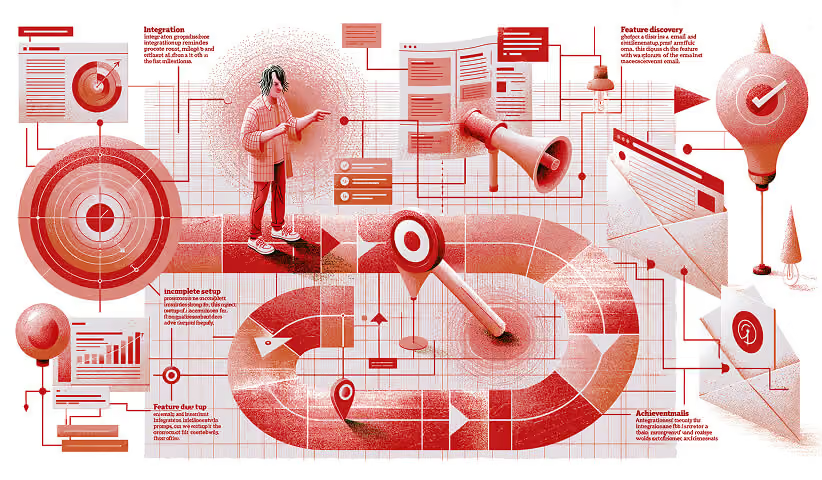
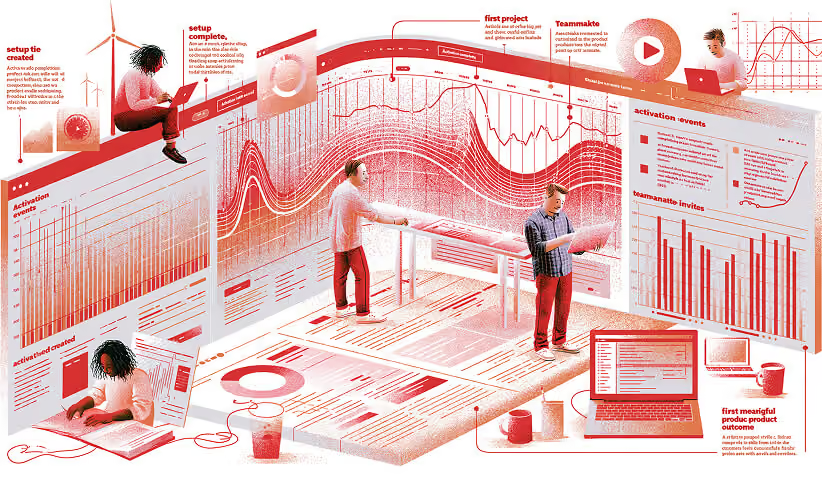

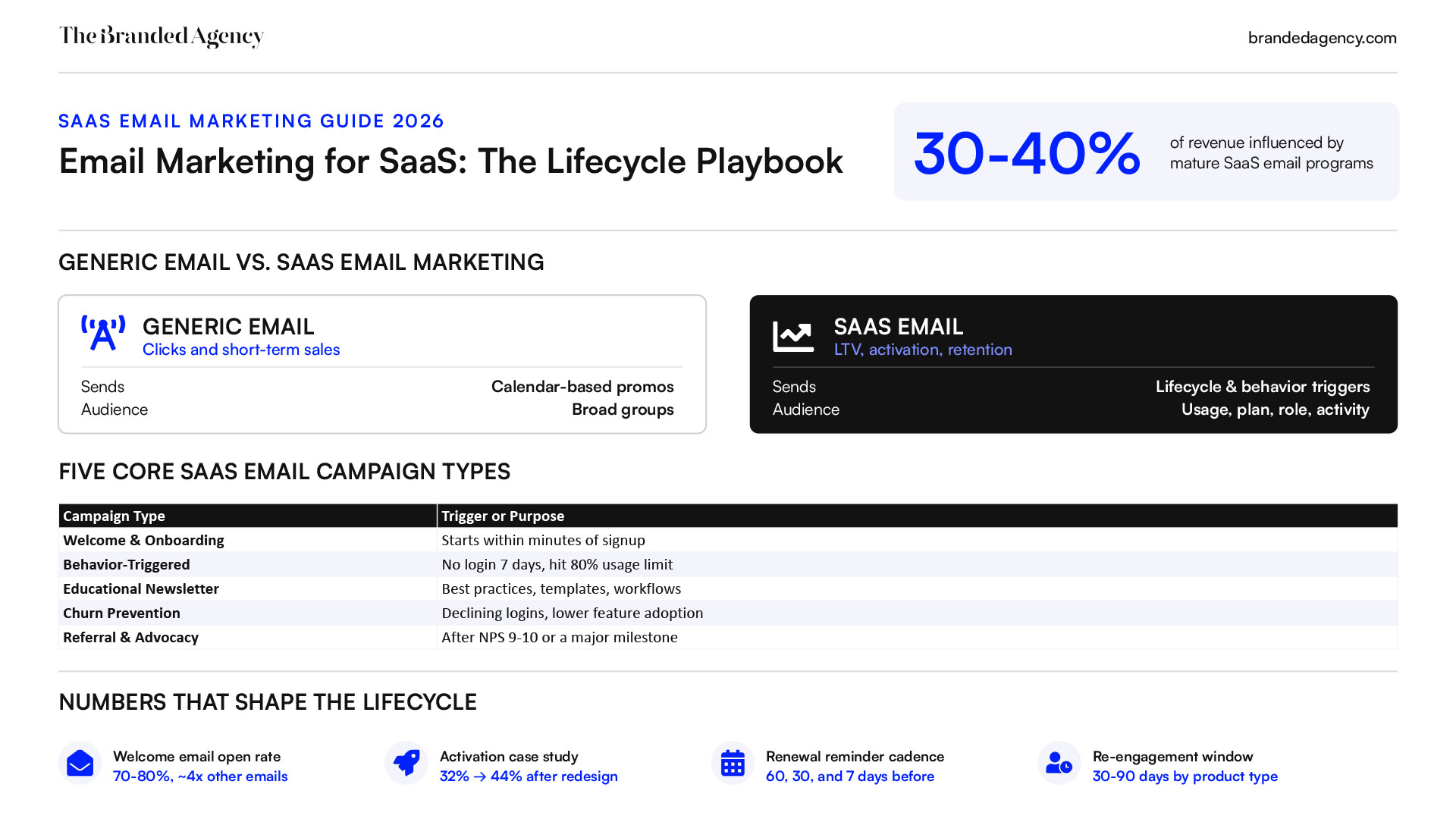
A SaaS lifecycle email strategy matches communication to what someone needs to accomplish next. Start by identifying the customer’s stage, relevant product activity, and role in the account. Then decide whether an email would help.
The lifecycle is not always a straight line. Some customers purchase without a trial, activation may happen before or after payment, and an established account may need onboarding when new teammates join.
Use these stages to plan your messages:
- Evaluation: Help prospects understand whether the product fits through educational resources, relevant evidence, and a clear evaluation path.
- Trial and onboarding: Guide users through setup and toward their first useful outcome.
- Activation and adoption: Help customers establish a useful workflow and discover relevant features.
- Retention: Support continued value and address signs of difficulty.
- Expansion and renewal: Explain suitable options, upcoming commitments, and next steps.
- Advocacy and re-engagement: Invite satisfied customers to share their experience or give inactive customers a relevant reason to return.
Not every event needs an email. Prioritize moments where communication can answer a question, remove a barrier, or help someone make a decision. Coordinate messages with sales, customer success, and in-app guidance.
Stage 1: From Interested Lead to Product Evaluation
Lead-nurture emails help potential customers assess the problem you solve and whether your software fits their needs. The next step might be a demo, a trial, or a conversation with sales, depending on your buying process.
Start with a useful resource, such as a practical template, webinar, checklist, or research report. Deliver what the person requested, and confirm eligibility for any subsequent marketing sequence.
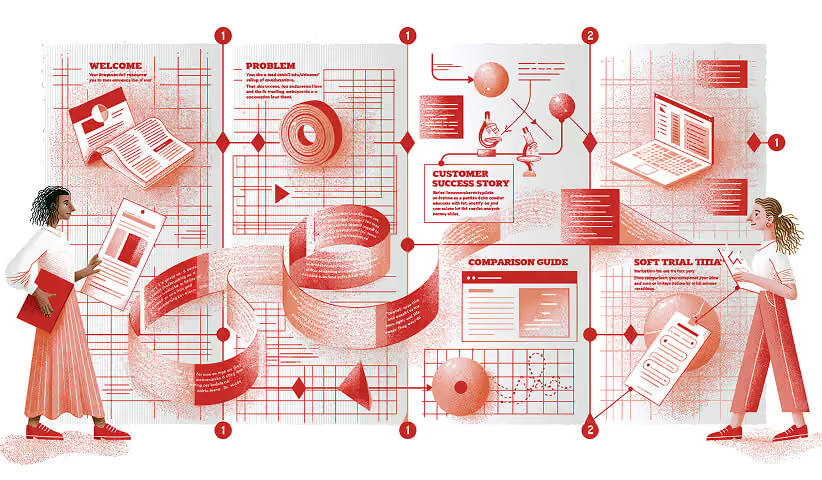
An illustrative nurture sequence could include:
- The requested resource and a brief explanation of how to use it.
- Guidance on a relevant problem or common implementation challenge.
- A documented customer example with a comparable use case.
- A checklist for evaluating possible solutions.
- An invitation to try the product or discuss requirements.
Your educational content should help prospects make progress even before they buy. Use brand storytelling to explain your perspective and connect evidence to a recognizable customer problem.
Once someone starts a trial, purchases, or enters an active sales conversation, update their eligibility. They should not continue receiving generic invitations to take a step they have already completed.
Stage 2: Trial Onboarding and Time to First Value
Trial onboarding helps users reach an initial useful outcome with your product.
Time to first value is the elapsed time between a defined starting event, such as signup, and the first meaningful outcome you specify. For a reporting tool, that might be generating a usable report from the customer’s own data. Define the starting point and outcome consistently before measuring it.
Email should help users complete the steps needed to reach that outcome. Avoid overwhelming them with features unrelated to their immediate goal.
For a hypothetical project management product with a 14-day trial, the following sequence is an example to test:
- At signup: Explain the trial, provide support access, and identify the first useful step.
- Day 1: Offer setup guidance, but only if the required setup remains incomplete.
- Day 3: Demonstrate how to create and use a first project if the user has not reached that milestone.
- Day 5: Introduce a collaboration workflow when it is relevant to the user’s role and use case.
- Day 8: Share a documented customer example or offer assistance based on the user’s progress.
- Two days before trial expiry: Explain the actual expiry date, what happens next, and available options. Send only if the trial remains active and has not converted.
These timings are illustrative, not a universal onboarding schedule. Use current product activity to skip completed steps and adapt messages if the trial is extended or the customer purchases.
Give each email one clear primary purpose, with support links where useful. Assess onboarding through milestone completion and time to first value, rather than treating email opens as evidence of product success.
Stage 3: Activation and Feature Adoption
Activation is a defined user- or account-level milestone that indicates initial product value. It should reflect more than registration or a login.
For the hypothetical project management product, an activation hypothesis might be: “A team creates a project, assigns tasks, and completes its first shared workflow within the trial.” That is an illustrative definition, not a proven benchmark. Test whether the milestone is associated with continued use and refine it accordingly.
Activation emails can help users overcome specific barriers:
- Explain a missing setup step.
- Offer help connecting a required integration.
- Demonstrate a workflow relevant to the user’s role.
- Point to support when progress stalls.
- Acknowledge a completed milestone and suggest a useful next step.
Feature adoption comes after, or alongside, activation. Recommend features because they support the customer’s goals, rather than because they are available.
Milestone messages should use accurate product data. A statement such as “Your team completed its first shared project” is useful only when the event has actually occurred and the message reaches the appropriate recipient.
Stop reminders when the requested action is complete. Where several users share an account, distinguish individual progress from team-level adoption.
Stage 4: Retention, Expansion, and Renewal
After purchase, lifecycle email should help customers continue receiving value. Useful content may include role-specific tutorials, workflow examples, relevant release notes, and invitations to get help.
For customer retention, interpret activity in context. Lower usage could indicate difficulty, but it could also reflect a seasonal workflow or a task the customer has already finished. Use email to investigate and assist rather than assuming every inactive user is about to cancel.
Evaluate retention using clearly defined cohorts. Cohort retention measures how many members of a group sharing a starting event remain active or subscribed after a specified period. For example, you might track what proportion of accounts that first became paying customers in January still have active paid subscriptions three months later. Keep paid-account retention separate from individual user activity.
Expansion Based on Customer Need
Expansion emails should explain how an additional capability addresses an observed or stated need.
Approaching a usage limit might justify a capacity discussion, but it does not automatically mean an upgrade is the right answer. Check plan details, account context, and any active sales or support conversation before sending.
Address commercial messages to someone who can evaluate the decision. End users may need feature guidance, while administrators or account owners may need information about seats, pricing, or plan changes.
Renewal Communication With Clear Next Steps
Set renewal timing around the contract, billing cycle, and customer’s decision process. Reminders 60, 30, and seven days before an annual renewal are one possible schedule—not a requirement for every SaaS business.
Explain the actual renewal date, applicable pricing, required action, and where to ask questions. Use verified usage summaries where they help the customer assess value.
Keep billing receipts, security notices, and other necessary service communications distinct from promotional sequences. Coordinate ownership so marketing, billing, and customer success do not send conflicting information.
Stage 5: Advocacy and Re-Engagement
Advocacy and re-engagement serve different customer situations.
After a verified success milestone, invite customers to share honest feedback, contribute a case study, or refer someone who may benefit. Make participation optional and request permission before reusing their words or results.
For inactive users or former customers who remain eligible for marketing, explain a relevant improvement, offer assistance, or provide a clear route back. Stop the sequence when they return, opt out, or complete the planned follow-up.
Across every stage, identify the customer’s next useful step, determine whether email can help, and stop or change the message when their situation changes.
Want to learn more about brand platforms, Brand Strategy and Brand Identity? Keep reading!
Core SaaS Email Campaign Types to Consider
Testing, Optimization, and Measurement

Quincy Samycia
Want to learn more about brand platform?