In-House vs Outsourced B2B Email Marketing Service: Which Approach Is Better?
08/12/2026
Marketing Strategy
Discover whether an in-house or outsourced B2B email marketing service is the smarter investment for your business by comparing costs, expertise, scalability, and long-term revenue impact.

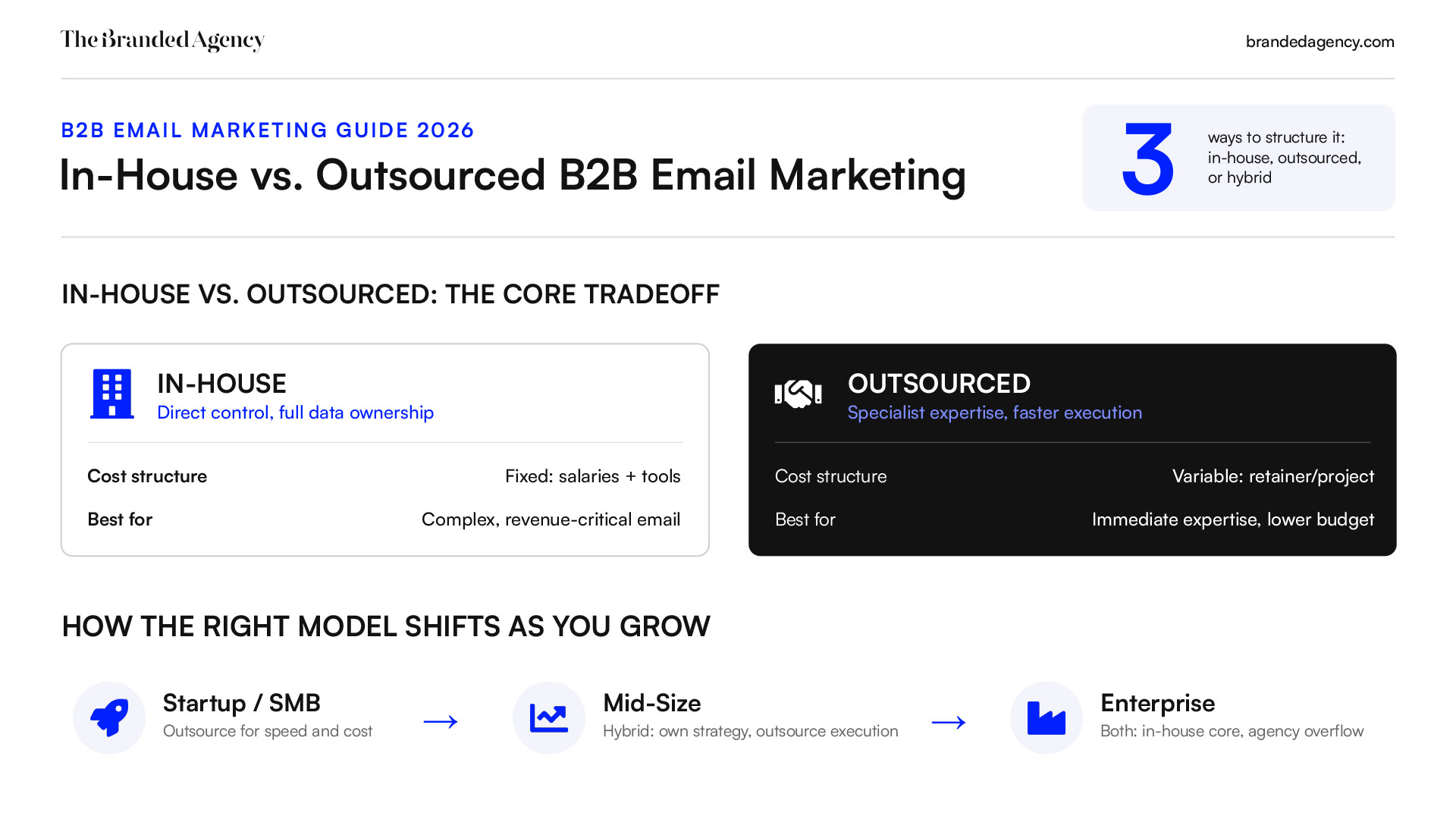
In-house B2B email marketing services are better when you need direct control, deep brand alignment and full ownership of customer data. Outsourced B2B email marketing services are better when you need specialist expertise, faster execution and lower upfront investment.
.png)
Choosing the Right B2B Email Marketing Model


The right choice depends on your budget, internal skills, sales funnel complexity, email volume and whether your email marketing strategy is central to revenue growth.
Below is a practical comparison of in-house vs outsourced B2B email marketing services.
In-House vs Outsourced B2B Email Marketing Services: Key Differences
The main difference comes down to control versus access to external expertise.
- In-house B2B email marketing means your internal team manages email campaigns, customer data, automation tools, reporting and strategy.
- Outsourced B2B email marketing means an external agency, consultant or specialist team handles part or all of your email marketing efforts.
- In-house services focus on direct team control, internal processes and closer alignment with sales teams.
- Outsourced services rely on established systems, proven workflows and specialist knowledge across multiple clients.
Both approaches can deliver strong campaign performance, but they require different levels of money, time and management attention.
Effective B2B email marketing services require deep CRM alignment, advanced segmentation and sophisticated automation workflows to manage complex client journeys. B2B email marketing platforms should also support lead nurturing, shorter sales cycles and stronger customer relationships.
This matters because B2B email marketing is different from B2C. B2B email marketing focuses on providing value through detailed content like whitepapers and case studies, while B2C emails often emphasize entertainment and emotional appeal. The B2B buying process is typically slower and involves multiple decision-makers, whereas B2C purchases are often made by individuals and can happen quickly, especially with promotions. B2B emails are generally sent less frequently and contain more in-depth information, while B2C emails are sent more often and have a casual tone aimed at quick engagement.
Cost and Budget Considerations


Cost structures differ significantly between in-house and outsourced email marketing. In-house teams usually carry higher fixed costs, while outsourced services are often easier to start but can become expensive as scope grows.
In-House B2B Email Marketing Costs
An in-house team usually requires salaries for an email marketing manager, copywriter, designer, email automation specialist and sometimes a deliverability or marketing operations expert.
You also need to pay for email marketing software, an email marketing platform, CRM capabilities, spam testing tools, analytics, landing pages, contact management systems and project management tools. Most email marketing platforms charge based on contact list size, email volume and advanced features.
The pricing for some B2B email marketing tools can start with free options but often scales significantly based on the number of contacts and professional features. A free forever plan may be enough for a small contact list, but businesses focused on advanced automation, dynamic content, detailed analytics and CRM data integration usually move into paid tiers quickly.
In-house costs may include:
- Full-time salaries and benefits
- Email marketing tool subscriptions
- Automation features and reporting upgrades
- Training on deliverability, compliance and segmentation
- Design resources for email templates and customizable templates
- Testing tools for subject lines, click through rates and spam reports
The benefit is predictability. Once your team and tools are in place, monthly costs are easier to forecast. The downside is the high initial investment in hiring, training and building reliable processes.
Outsourced B2B Email Marketing Costs
Outsourced services usually charge through agency retainers, project fees or performance-based pricing. A service may manage email marketing campaigns, automated campaigns, re engagement campaigns, event invitations, transactional emails or account based marketing sequences.
Agencies often spread the cost of tools across several clients. This can give you access to advanced features, visual workflow builder functionality, in depth analytics and email automation workflows without buying every system yourself.
Outsourcing can be more flexible because you may pay for:
- Monthly retainers
- Campaign-specific projects
- Email automation setup
- A/B testing and optimization
- Deliverability consulting
- Strategy sessions and reporting
- Performance-based lead generation work
These platforms and service models cater to different business needs, ranging from comprehensive enterprise solutions to budget-friendly automation. Lower upfront costs make outsourcing attractive, but long-term retainers, extra integrations, custom reporting and scope changes can increase total spend over time.
Control and Customization
Control is one of the biggest differences between in-house and outsourced B2B email marketing. The more complex your sales process, the more important campaign timing, messaging and data access become.
In-House Control and Customization
In-house teams give you direct oversight of email marketing strategy, campaign timing, subject lines, personalized content and audience segmentation.
Your team can make real-time changes when sales reps report new objections, product positioning changes or customer engagement patterns shift. This is useful for lead nurturing, customer retention and personalized marketing campaigns where the right message depends on user behavior and buying stage.
In-house teams also have complete access to customer data, CRM data, campaign performance, key metrics and subscriber behavior, making it easier to generate actionable insights that connect email results to deals, revenue and pipeline decisions. Robust reporting features in B2B email marketing platforms are essential for tracking campaign performance and understanding how emails influence deals, revenue and pipeline growth.
Segmentation allows you to divide your contact list into smaller segments based on preferred datasets, such as location, behavior or purchase history. Effective email segmentation can lead to higher engagement rates, as tailored content is more relevant to the specific interests and needs of each segment.
Personalization in B2B email marketing is crucial, as buyers expect relevant communication tailored to their specific needs and the stage of their buying journey.
Outsourced Control and Customization
Outsourced B2B email marketing works best when there is a strong collaborative process. Regular check-ins, shared dashboards, approval workflows and clear reporting help the agency understand your brand voice, customer experience and sales funnel.
The trade-off is dependency. You rely on the agency’s communication, responsiveness and availability. Standardized agency processes can also limit unique customization, especially if the provider uses fixed email templates, predefined automation workflows or a narrow campaign framework.
However, outsourcing can improve marketing efforts by bringing fresh external perspective. Agencies often see patterns across industries and can suggest better subject lines, advanced segmentation, dynamic content, drip campaigns or customer satisfaction campaigns based on proven experience.
Outsourced teams may also help you track key metrics more consistently, including open rates, click through rates, conversions, bounce rates, spam reports and pipeline contribution.
Expertise and Resources
Expertise varies sharply between the two models. In-house teams usually know your product better. Outsourced teams usually bring broader technical and campaign experience.
In-House Expertise and Resources
Hiring qualified email marketing professionals can be difficult. Strong B2B email marketing requires more than writing marketing emails. It requires robust automation, deep CRM integration and high deliverability.
A small internal team may have limits. One person may handle copywriting, email templates, list hygiene, A/B testing, reporting and email marketing automation. That can slow down optimization and reduce the quality of campaign performance.
In-house teams also need continuous training on:
- Advanced segmentation
- Deliverability and authentication
- Email automation
- CRM integration
- Data privacy
- Spam testing
- Personalized emails
- Revenue attribution
Email deliverability is the process of successfully reaching the inboxes of your mailing list, which can be affected by factors such as sender reputation, email authentication and spam complaints. The email deliverability rate indicates how many of the sent emails actually reach the recipients’ inboxes, and it is influenced by factors like bounce rates and spam complaints.
To improve email deliverability, it is essential to follow best practices such as maintaining list hygiene, using authentication protocols like DKIM, SPF and DMARC, and monitoring bounce and spam complaint rates.
The advantage of in-house expertise is context. Internal marketers usually understand the product, market, loyal customers, sales teams and customer relationships more deeply than an outside provider.
Outsourced Expertise and Resources
Outsourced providers often give immediate access to specialists in copywriting, design, deliverability, data management, automation, analytics and strategy.
A powerful B2B email marketing service should combine database management with email sequencing to allow for efficient lead generation and outreach. Advanced marketing automation, native CRM integration, deal tracking, A/B testing and AI-powered campaign generation are key features of B2B email marketing services.
Email marketing platforms often integrate with various tools such as CRMs, e-commerce platforms and analytics software to streamline workflows and improve efficiency. Seamless integration with other business tools is essential for optimizing email marketing performance and creating a cohesive customer experience. Many email marketing platforms offer RESTful API support and webhooks to facilitate data synchronization across different systems, enhancing integration capabilities.
Agencies may also know which popular email marketing platform or best email marketing software is a valuable tool for a specific use case, automation needs or personalization requirements. Some tools are better for newsletters with a drag and drop editor, customizable templates, landing pages, social media posts and sms marketing. Others are better for advanced automation, deal tracking, visual workflow builder functionality, transactional emails and account based marketing.
Effective B2B email marketing platforms offer advanced segmentation capabilities that allow marketers to target specific customer groups with highly relevant content based on behaviors, purchase history and engagement levels. Advanced segmentation tools allow marketers to target specific customer groups with highly relevant content, improving engagement rates and conversions.
Email automation allows marketers to send personalized emails based on predefined rules triggered by customer actions, such as subscribing or abandoning a cart. Effective email automation tools provide analytics that help marketers track campaign performance and subscriber behavior, allowing for data-driven decision-making.
The main limitation is that outsourced experts need time to learn your product, customer data, buyer personas and brand voice.
Want to learn more about brand platforms, Brand Strategy and Brand Identity? Keep reading!
If you need help with your companies brand strategy and identity, contact us for a free custom quote.
Expertise and Resources

Expertise varies sharply between the two models. In-house teams usually know your product better. Outsourced teams usually bring broader technical and campaign experience.
In-House Expertise and Resources
Hiring qualified email marketing professionals can be difficult. Strong B2B email marketing requires more than writing marketing emails. It requires robust automation, deep CRM integration and high deliverability.
A small internal team may have limits. One person may handle copywriting, email templates, list hygiene, A/B testing, reporting and email marketing automation. That can slow down optimization and reduce the quality of campaign performance.
In-house teams also need continuous training on:
- Advanced segmentation
- Deliverability and authentication
- Email automation
- CRM integration
- Data privacy
- Spam testing
- Personalized emails
- Revenue attribution
Email deliverability is the process of successfully reaching the inboxes of your mailing list, which can be affected by factors such as sender reputation, email authentication and spam complaints. The email deliverability rate indicates how many of the sent emails actually reach the recipients’ inboxes, and it is influenced by factors like bounce rates and spam complaints.
To improve email deliverability, it is essential to follow best practices such as maintaining list hygiene, using authentication protocols like DKIM, SPF and DMARC, and monitoring bounce and spam complaint rates.
The advantage of in-house expertise is context. Internal marketers usually understand the product, market, loyal customers, sales teams and customer relationships more deeply than an outside provider.
Outsourced Expertise and Resources
Outsourced providers often give immediate access to specialists in copywriting, design, deliverability, data management, automation, analytics and strategy.
A powerful B2B email marketing service should combine database management with email sequencing to allow for efficient lead generation and outreach. Advanced marketing automation, native CRM integration, deal tracking, A/B testing and AI-powered campaign generation are key features of B2B email marketing services.
Email marketing platforms often integrate with various tools such as CRMs, e-commerce platforms and analytics software to streamline workflows and improve efficiency. Seamless integration with other business tools is essential for optimizing email marketing performance and creating a cohesive customer experience. Many email marketing platforms offer RESTful API support and webhooks to facilitate data synchronization across different systems, enhancing integration capabilities.
Agencies may also know which popular email marketing platform or best email marketing software is a valuable tool for a specific use case, automation needs or personalization requirements. Some tools are better for newsletters with a drag and drop editor, customizable templates, landing pages, social media posts and sms marketing. Others are better for advanced automation, deal tracking, visual workflow builder functionality, transactional emails and account based marketing.
Effective B2B email marketing platforms offer advanced segmentation capabilities that allow marketers to target specific customer groups with highly relevant content based on behaviors, purchase history and engagement levels. Advanced segmentation tools allow marketers to target specific customer groups with highly relevant content, improving engagement rates and conversions.
Email automation allows marketers to send personalized emails based on predefined rules triggered by customer actions, such as subscribing or abandoning a cart. Effective email automation tools provide analytics that help marketers track campaign performance and subscriber behavior, allowing for data-driven decision-making.
The main limitation is that outsourced experts need time to learn your product, customer data, buyer personas and brand voice.
Email Automation, Time and Management Requirements
Time investment differs by model. In-house teams require more daily management. Outsourced teams reduce execution work but still need strategic direction.
In-House Time and Management
Managing email marketing in house means your team handles daily planning, campaign creation, testing, approvals, reporting and optimization.
This includes building email campaigns, writing subject lines, creating personalized content, checking deliverability, maintaining the contact list and reviewing detailed analytics. Your team also needs to automate tasks, monitor campaign performance and improve customer engagement over time.
Hiring and training take time. Even after the team is built, campaign quality depends on consistent oversight and coordination with sales reps, product teams and leadership.
Automated email workflows can include welcome emails, follow-ups and drip campaigns, which help nurture leads and maintain customer engagement over time. In-house teams control these workflows directly, but they must also maintain them continuously.
The benefit is full schedule control. Your team can launch email marketing campaigns when business priorities change, without waiting for an external production calendar.
Outsourced Time and Management
Outsourcing reduces daily execution work. The agency or consultant manages campaign builds, email automation workflows, reporting, testing and optimization.
You still need to provide strong input. Outsourced work requires briefings, reviews, strategy sessions and regular feedback. The agency must understand your business needs, customer experience, offer structure and sales funnel before it can send the right message to the right segment.
There can also be dependency on agency schedules. If you need urgent changes to marketing emails, the provider’s availability may affect turnaround time.
The main advantage is freed-up internal time. Your team can focus on sales enablement, product marketing, customer relationships or broader marketing strategy while the external partner handles execution.
Business Size and Growth Considerations

Company size often determines the most practical approach.
Startups and small businesses often benefit from outsourced B2B email marketing because they may not have the budget to hire specialists. For B2B small businesses, the best email marketing service depends on whether the outreach relies on warm newsletter campaigns or cold prospecting.
The ideal B2B email marketing service depends heavily on whether outreach is inbound or outbound. Warm inbound audiences usually fit permission-based email marketing platforms. Cold outbound prospecting may require different tools, stricter compliance controls and careful deliverability management.
These tools are built for managing contacts who have already given permission to be emailed, as sending unsolicited cold emails can lead to account bans. This is important when comparing tools like Constant Contact, a marketing hub, a sales engagement platform or other best email marketing platforms.
Mid-size companies often move toward hybrid models. They may keep marketing strategy, customer data and CRM ownership internally while outsourcing email automation, campaign design, spam testing or advanced segmentation.
Enterprise companies often use both. They may keep core email marketing strategy in house for brand, legal and data control, while using agencies for overflow work, specialized deliverability support, campaign production or testing.
Scalability matters. If email becomes a major revenue channel, internal capability may become more cost-effective. If campaign needs change month to month, outsourcing may provide more flexibility.
In-House vs Outsourced B2B Email Marketing Services: Which Should You Choose?
Choose in-house B2B email marketing if you need direct control, have enough budget to build a capable team and require highly customized campaigns tied closely to CRM data, sales teams and customer relationships.
Choose outsourced B2B email marketing if you need immediate expertise, proven processes, advanced tools and cost-effective execution without hiring and managing a full team.
A hybrid model is often the strongest option. Your company can own the email marketing strategy, customer data, brand voice and sales funnel while an outside specialist manages automation capabilities, campaign production, deliverability, A/B testing and reporting.
Both approaches can work when matched to the right business needs. The best choice is the one that helps you send relevant marketing emails, improve lead generation, track performance accurately and build stronger long-term customer relationships.

Quincy Samycia
As entrepreneurs, they’ve built and scaled their own ventures from zero to millions. They’ve been in the trenches, navigating the chaos of high-growth phases, making the hard calls, and learning firsthand what actually moves the needle. That’s what makes us different—we don’t just “consult,” we know what it takes because we’ve done it ourselves.
Want to learn more about brand platform?

If you need help with your companies brand strategy and identity, contact us for a free custom quote.
We do great work. And get great results.
+2.3xIncrease in revenue YoY
+126%Increase in repurchase rate YoY


+93%Revenue growth in first 90 days
+144% Increase in attributed revenue


+91%Increase in conversion rate
+46%Increase in AOV


+200%Increase in conversion rate
+688%Increase in attributed revenue