Partner Marketing Strategy: Drive B2B Growth in 2026
10/30/2026
Marketing Strategy
Learn how to build a partner marketing strategy that strengthens partnerships, generates qualified leads, and drives measurable revenue growth.

Make partner marketing measurable: MDF rules, PRM and CRM wiring, and a 2–4 partner pilot to scale ecosystem growth in 2026.


What Is Partner Marketing and Why It Matters Now



Partner marketing is the practice of two or more organizations combining audiences, content, or channels to reach shared goals. It overlaps with co-marketing (joint campaigns between equals), affiliate marketing (commission-based referrals), and channel marketing (enabling resellers to sell your product). Affiliate marketing is really a performance-based subset of the broader category. Partner marketing covers strategic collaborations, integrations, and joint campaigns where both sides invest, not just one side paying for clicks, according to a comparison of affiliate and partner marketing.
Three forces make this urgent heading into 2026:
• Fragmented buyer journeys: Buyers research across communities, peer recommendations, marketplaces, and professional networks before speaking with sales. A relevant partner can introduce a brand earlier in that journey.
• Pressure on acquisition efficiency: Shared distribution, content, and events can help teams reach qualified audiences without funding every touchpoint alone. Measure the total cost, including staff and partner incentives.
• Growing ecosystem complexity: Technology integrations, service partners, and co-selling relationships now influence opportunities across multiple touchpoints, making coordination and attribution essential.
The payoff shows up in three places: expanded reach without paying for every new impression, borrowed credibility that shortens sales cycles, and better lead quality because prospects arrive pre-vetted by someone they already trust.
Common Partner Marketing Types and Campaign Formats
Not every partnership format fits every goal. Picking the wrong one wastes budget and burns partner goodwill fast.
• Co-branded thought leadership: Joint reports, guides, and research reach overlapping audiences. Best for awareness and early-stage demand creation.
• Webinars and virtual events: A shared expert discussion with a registered audience. Best for education, lead generation, and follow-up meetings.
• Integration and marketplace partnerships: Product integrations, directory listings, and shared use cases. Best when a working product connection creates ongoing buyer value.
• Referral and affiliate partnerships: Tracked introductions or compensated referrals. Best when the partner is close to buyers making a purchase decision.
• Channel and reseller programs: Partners position, implement, or resell the product. Best when the buyer needs local presence or specialized implementation expertise.
• Co-selling and account-based marketing: Joint account planning, introductions, and sales plays. Best for complex B2B deals where both companies serve the same buying committee.
Adobe’s partnership marketing framework catalogs eleven distinct partnership types, and most fall into these buckets, according to Adobe’s guide to partnership marketing. The effort-to-quality tradeoff is straightforward: co-branded content and integrations take longer to build but compound in value, while influencer campaigns launch fast and fade fast.
Step-by-Step: Build a Partner Marketing Strategy
A partner marketing strategy fails most often because teams skip the internal groundwork and jump straight to signing partners. Sequence matters.
• Step 1 - Set a commercial objective: Define whether the pilot must generate sourced opportunities, influence target accounts, expand existing customers, or accelerate deals. Agree on one primary revenue outcome.
• Step 2 - Define the ICP and partner fit: Map buyer personas, priority industries, current technology stack, regional coverage, and the complementary value each party contributes.
• Step 3 - Establish ownership and budget: Name a program owner, assign Sales and RevOps responsibilities, approve a pilot budget, and document market development fund (MDF) rules.
• Step 4 - Instrument attribution: Standardize partner IDs, registration rules, CRM source fields, campaign UTMs, and sourced-versus-influenced definitions before launching.
• Step 5 - Build two joint plays: Create agreed campaign briefs, shared creative, landing pages, partner enablement materials, follow-up sequences, and launch dates.
• Step 6 - Launch and optimize: Review campaign activity and lead acceptance weekly. Document who follows up, by when, and what counts as a qualified opportunity.
• Step 7 - Evaluate after 90 days: Compare partner-sourced and partner-influenced pipeline, cost, conversion quality, and partner participation against targets; expand only where evidence supports it.
Pro Tip: Draft your MDF eligibility rules and your attribution model in the same week. Funding without measurement is just a marketing expense with extra paperwork.
Alignment with RevOps and Sales deserves special attention here. Programs that skip this step tend to generate leads nobody in Sales trusts, because the leads show up with no context and no clear credit trail, according to the Intercom partner marketing program breakdown. Fix that before your first campaign launches, not after your first quarterly review.
How to Identify, Score, and Vet Partners
Quality beats quantity in partner selection. A short list of high-fit partners consistently outperforms a long list of loosely aligned ones, according to Intercom’s own partner marketing program. Score every prospective partner against three pillars before you sign anything.
• Audience and ICP overlap (1-5): How closely do their active customers and prospects match your best-fit accounts? Look for shared use cases without complete competitive overlap.
• Complementary value and brand trust (1-5): Does the partner add a credible capability, trusted recommendation, or audience context you cannot easily create yourself?
• Execution readiness (1-5): Is there an accountable sponsor, reachable audience, campaign capacity, sales commitment, and willingness to share performance data?
Score each pillar on a simple 1 to 5 scale and set a minimum combined threshold, say 10 out of 15, before moving to outreach. Source candidates from your existing customer base, integration requests already in your product feedback queue, and adjacent vendors your sales team keeps hearing about from prospects.
Red flags that should end a conversation fast: a partner who wants funding before defining any deliverable, one whose audience skews wildly outside your ideal customer profile, or one who has churned through three points of contact in your outreach process already. When goal fit is unclear, ask directly what success looks like for them in 90 days. Vague answers are your answer.
Free Brand Health Audit
Make sure your brand is built to sell
Search has changed. Your customers aren't just Googling anymore. They're asking ChatGPT, Perplexity, Gemini and other AI platforms what to buy, who to trust and which brands they should consider.
If your brand isn't showing up clearly in those answers, you're already losing opportunities. Our free Brand Health Audit shows you where your brand stands across traditional search, AI search and brand positioning.

Sample brand audit
Live preview
Traditional search
72
AI search (GEO)
34
Brand positioning
58
Playbooks and Tactics: Campaign Templates That Work




Co-creating a campaign, rather than syndicating one partner’s existing asset to the other’s list, consistently produces stronger results and faster time-to-launch, according to the Partnership Marketing Guide for 2026. Four templates cover most partner marketing needs.
• Joint webinar: Agree on one buyer problem, recruit one expert from each brand, publish one registration page, split promotional responsibilities, and route registrants by documented consent and ownership rules.
• Co-branded research or guide: Combine original insights or customer examples into one asset, prepare separate partner-specific promotion links, and track downloads and opportunity creation.
• Integration launch: Publish a shared solution page, practical demo, marketplace listing, product documentation, and a joint sales one-pager that explains the buyer outcome.
• Co-selling account sprint: Agree on a short account list, match partners to accounts, document warm introductions, assign opportunity owners, and meet weekly to review progression.
Every playbook needs enablement assets ready before launch: a shared email template, a social kit with pre-written captions, and a one-page sales script explaining the partnership to reps who will field questions from prospects. Credibility holds up best when partner voices and real customer stories carry the campaign, not two marketing teams talking about each other in the abstract.
Measurement, Attribution, and Reporting for Partner Marketing
If you cannot attribute revenue to a partner, you cannot fund that partner intelligently, and the whole program becomes a guessing game dressed up as a strategy. Four KPIs matter most:
• Partner-sourced pipeline: Dollar value of qualified opportunities originating from a documented partner referral or registration. Separate it from raw lead counts.
• Partner-influenced pipeline: Opportunity value where a partner materially assisted an existing deal. Use a clear influence rule and do not add this to sourced pipeline without deduplicating.
• Opportunity-to-win rate: Share of partner-associated qualified opportunities that close, reviewed against non-partner opportunities and by individual partner.
• Partner program return: Closed-won revenue or gross profit relative to fully loaded campaign, incentive, technology, and staffing costs. Show the attribution method alongside the result.
CRM-integrated PRM systems and disciplined lead registration are the prerequisite for getting any of this right, according to the Ultimate Partnership Marketing Guide. Without consistent UTM tagging, a lead registration process partners actually use, and CRM fields that flag partner involvement, attribution collapses into spreadsheet guesswork within a quarter.
A useful default: run first-touch attribution for brand lift reporting and multi-touch attribution for pipeline and revenue reporting, since partner involvement rarely happens at just one point in a deal cycle.
Forrester’s research on B2B marketing points to a broader trend behind this urgency: partner ecosystems are becoming a growing revenue channel, with many organizations planning to increase investment in the technology that supports them, according to Forrester’s predictions for B2B marketing. Report on a monthly cadence internally and a quarterly cadence with partners directly, and keep the dashboard limited to the four KPIs above so executives can scan it in under a minute. For a deeper look at how to structure agency and vendor performance reviews generally, see this guide to measuring marketing agency performance.
Scaling, Governance, and MDF Best Practices
Moving from a two-partner pilot to a real program requires structure, or the whole thing collapses into ad-hoc favors and unbudgeted requests. Tiering solves most of this.
• Pilot partners: One or two campaigns, defined 90-day targets, shared tracking, and lightweight monthly reviews before further commitment.
• Growth partners: Proven audience fit and engagement; receive repeatable co-marketing packages, quarterly planning, and conditional MDF based on evidence.
• Strategic partners: Consistent contribution to revenue and product value; qualify for joint roadmaps, executive sponsorship, shared account planning, and deeper integration.
• Exit or reset criteria: Repeated missed commitments, poor lead quality, brand or compliance issues, or lack of a responsive owner trigger a documented improvement or closure decision.
MDF itself needs guardrails from day one. Effective programs pre-define eligible activities with standard reimbursement rates, require a written proposal projecting expected pipeline outcomes, and mandate a post-activity report before releasing any funds, according to best practices for market development funds. Partners consistently hitting or beating their projected pipeline should see their MDF allocation grow; underperformers get coaching first and reduced funding second, not an abrupt cutoff.
A basic partner portal, even a simple one, pays for itself once you cross five or six active partners. It should hold the current campaign templates, brand guidelines, MDF proposal forms, and a live view of co-marketing performance so partners aren’t emailing your team for the same asset every month.
Client Evidence and How The Branded Agency Executes Partner Marketing
Partner marketing rarely succeeds as a standalone tactic. It works best woven into a broader brand and performance system, which is exactly where The Branded Agency operates: branding that makes co-branded assets look credible, performance marketing that tracks partner-sourced pipeline, web development that supports integration pages and partner portals, and retention marketing that keeps partner-referred customers active long after the first sale.
A typical agency-run pilot scope looks like this: a 90-day engagement covering partner vetting criteria, two co-branded campaigns (a webinar and a joint asset), CRM field setup for attribution, and a final report measuring partner-sourced pipeline against the original projection.
[Case studies demonstrating measurable partner marketing results, client testimonials, and internal performance data will be added here.]
Legal and Compliance Considerations in Partner Marketing Agreements
A partner marketing relationship without a written agreement is a liability waiting to surface, usually at the worst possible moment. Every partnership needs a document covering scope, exclusivity (or the explicit absence of it), and duration before any co-branded asset goes live.
Data sharing deserves particular scrutiny. When you exchange lead data with a partner, both sides need clarity on what information gets shared, how it gets stored, and whether either brand’s privacy policy actually permits that transfer. This matters more than most marketers assume, especially when partners operate in different states or countries with different data protection standards.
Brand usage rights need explicit terms too. Spell out exactly how each party can use the other’s logo, product screenshots, and messaging, and set an expiration or review date so a partner doesn’t keep using your old logo two rebrands later. Revenue share or referral fee structures, if any exist in the arrangement, need to be documented in writing with clear payment terms and timing, not agreed to verbally on a call and forgotten.
Termination clauses matter more than most teams think about upfront. Define what happens to co-branded content, shared customer data, and any in-flight campaigns if either party exits the relationship. Legal review before signing isn’t optional bureaucracy here. It’s the difference between a partnership that can end cleanly and one that turns into a dispute over who owns a case study or a customer list six months later.
Want to learn more about Digital Marketing and Strategy? Keep reading!
If you need help with your company’s marketing, contact us for a free custom quote.
Strategies for Partner Marketing Communication and Relationship Management
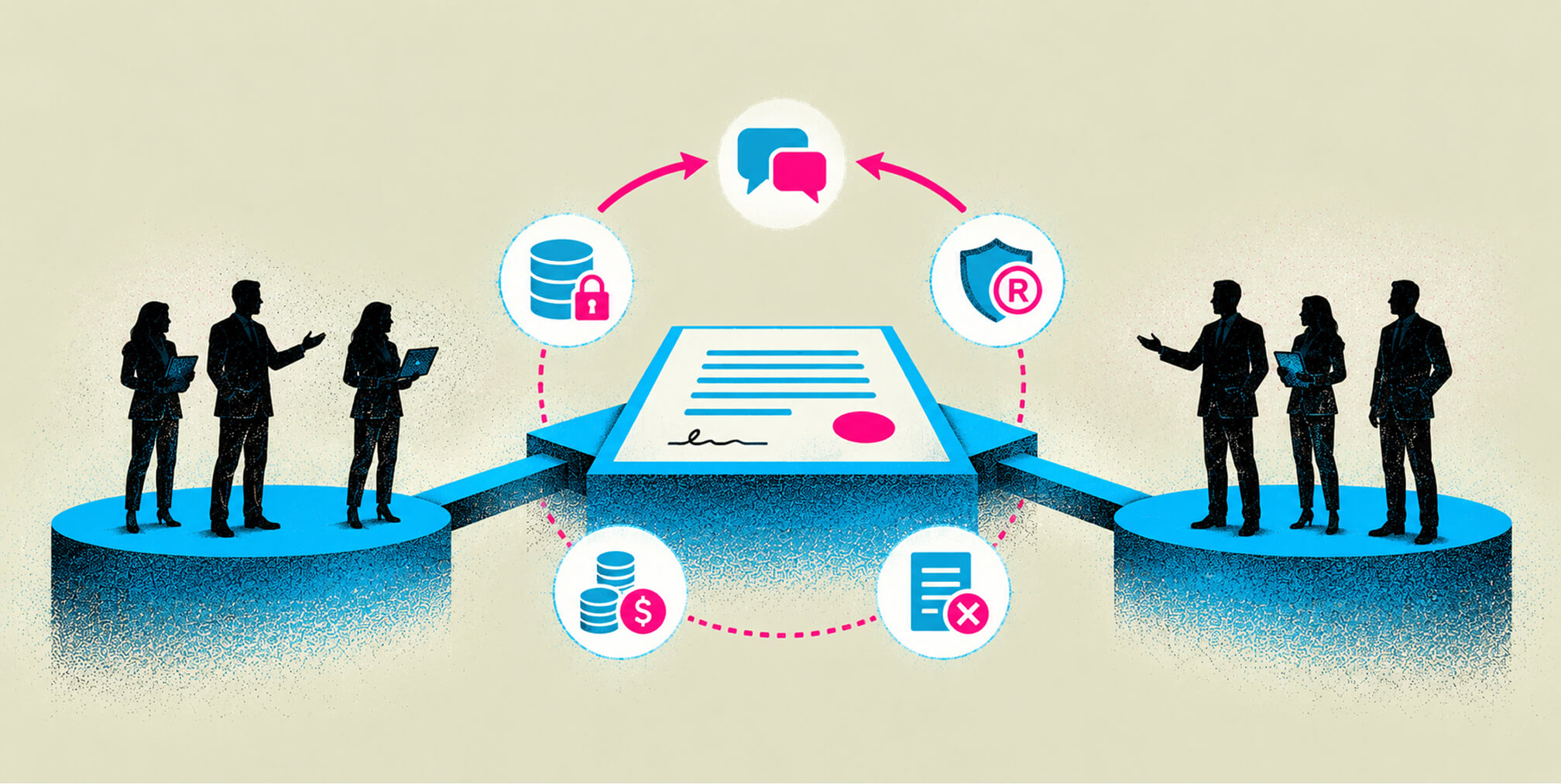
Partner relationships decay through neglect more often than through conflict. The fix is a communication cadence that doesn’t depend on someone remembering to reach out.
A recurring touchpoint, whether biweekly or monthly depending on partner tier, keeps both sides accountable to shared goals instead of drifting apart after the initial campaign launch. Use that time for a quick pipeline check, not a status theater meeting where nobody says anything useful.
Shared documentation matters more than it sounds like it should. A single living campaign brief, updated by both teams rather than passed back and forth as separate versions, cuts down on the miscommunication that kills momentum on joint projects. Assign a single point of contact on each side, because partnerships that route through multiple people on both teams tend to lose clarity fast, with each side assuming the other has the latest version of a plan.
Recognition goes further than most marketers expect. A partner who gets featured in your case studies, mentioned in your executive communications, or invited into your customer advisory conversations tends to invest more in the relationship than one who only hears from you when you need something. Long-term partner value depends on treating the relationship with the same care you’d apply to customer retention, an idea explored in this guide to relationship marketing and customer loyalty. Conflict, when it happens, resolves faster when both sides already have a habit of talking regularly rather than only during a crisis.
Technology Tools and Platforms to Support Partner Marketing
PRM and CRM integration form the backbone, but a handful of other tool categories fill in gaps that CRM alone can’t cover.
Co-marketing asset management platforms give partners self-serve access to approved logos, templates, and campaign briefs without a back-and-forth email chain every time someone needs a file. Partner portals, sometimes bundled with PRM software and sometimes standalone, centralize MDF requests, campaign registration, and performance dashboards in one place partners can check anytime.
UTM and link-tracking tools matter more in partner marketing than in almost any other channel, because attribution depends entirely on knowing which partner sent which visitor. Review platforms like G2 and Capterra are worth checking before selecting PRM or affiliate management software, since real user feedback on these categories tends to surface integration issues that vendor demos gloss over, based on product research collected through G2’s software evaluation surveys.
Content collaboration tools, whether that’s shared drives, a project management platform, or a dedicated co-marketing workspace, reduce the friction of building joint assets with a team outside your own systems. None of this replaces a well-integrated CRM and PRM setup. It supplements it, filling the operational gaps that pure sales pipeline tools were never built to solve.
What Separates Programs That Scale From Those That Stall
Programs that scale share three habits: they fund campaigns with real budget instead of promises, they wire attribution into the CRM before launch instead of after the first complaint about unclear results, and they choose two or three genuinely aligned partners over a dozen mediocre ones.
The failure modes are just as consistent. No attribution model means no one can defend the program’s budget at renewal time. Too many low-fit partners spread thin resources across relationships that never had a real chance to work. And underfunding, treating MDF as an afterthought instead of a line item, guarantees partners deprioritize your campaigns the moment something better-funded comes along.
If there’s one lesson worth acting on this quarter, it’s this: run a disciplined pilot with two partners, clear KPIs, and real measurement, before you scale to twenty.
Where The Branded Agency Fits Into Your Partner Program
The Branded Agency is the alternative to hiring three separate specialists for a job that actually needs one connected team. Partner marketing touches brand, web, paid media, and retention all at once, and most agencies only cover one of those lanes.
That’s the gap The Branded Agency was built to close: brand-backed performance™ that aligns creative, platforms, and campaign execution under one roof instead of forcing your team to stitch together three vendors who’ve never talked to each other. If you need help designing a partner marketing strategy, wiring up CRM attribution, or executing your first co-branded campaign, Growth Strategy engagements start at $8,500 per month and cover exactly this kind of go-to-market planning. Retention Marketing support, useful for keeping partner-referred customers active long after the first close, starts at $6,500 per month. If your partner program needs a stronger integration page or partner portal to support it, the team’s Webflow development work can get that built fast.
Full pricing and engagement details live on the pricing page. Reach out through the site to scope a pilot built around your first two or three partners.
Frequently Asked Questions

What Are Some Examples of Partner Marketing Strategies?
Common examples include co-branded eBooks, joint webinars, integration marketplace listings, ABM co-selling between two vendors targeting the same accounts, and referral programs where one partner sends qualified leads to the other. Each format fits a different stage of the buying journey, from awareness content through late-stage co-selling.
What Is the 3-3-3 Rule for Marketing?
Definitions of the 3-3-3 rule vary by source and context, and no single version applies universally to partner marketing specifically. Rather than force-fitting a generic framework, focus your partner strategy on the fundamentals that actually drive results: clear objectives, funded campaigns, and measured attribution.
What Are the 5 Main Marketing Strategies?
Marketing strategy frameworks typically group tactics into categories like content marketing, paid media, email and retention marketing, partner and affiliate marketing, and organic or social marketing. Partner marketing stands out because it borrows a second brand’s audience and credibility rather than building reach from scratch, which is why it functions as trust infrastructure in complex B2B buying journeys, according to research on partner-driven credibility.
What Are the 7 Principles of Partnership?
There’s no single universally cited “7 principles” framework specific to partner marketing, though most successful programs converge on similar fundamentals: aligned goals, audience fit, brand compatibility, clear funding rules, disciplined attribution, regular communication, and mutual accountability through scoring or tiering. Building a program around those fundamentals matters more than matching any specific numbered list.
How Much Does a Partner Marketing Program Cost to Build?
Costs vary widely depending on scope, partner count, and whether you’re building internal capability or working with outside help. The Branded Agency’s Growth Strategy service, which covers go-to-market planning including partner program design, starts at $8,500 per month, with full pricing details available on request.

Quincy Samycia
As entrepreneurs, they’ve built and scaled their own ventures from zero to millions. They’ve been in the trenches, navigating the chaos of high-growth phases, making the hard calls, and learning firsthand what actually moves the needle. That’s what makes us different—we don’t just “consult,” we know what it takes because we’ve done it ourselves.
Want to learn more about brand platform?
If you need help with your companies brand strategy and identity, contact us for a free custom quote.
We do great work. And get great results.
+2.3xIncrease in revenue YoY
+126%Increase in repurchase rate YoY



+93%Revenue growth in first 90 days
+144% Increase in attributed revenue




+91%Increase in conversion rate
+46%Increase in AOV




+200%Increase in conversion rate
+688%Increase in attributed revenue