Pragmatic Marketing: A Practical Guide to Turning Ideas Into Revenue
07/03/2026
Marketing Services / Marketing Strategies

.png)


The Meaning of Pragmatic Marketing



Free Brand Health Audit
Make sure your brand is built to sell

Core Principles of Pragmatic Marketing




The principles of pragmatic marketing advocate for understanding customer needs and market demands as the foundation for product strategy and decision-making. Here are the core tenets that guide this approach:
- Market-in, not product-out – Start with buyer and user problems identified through interviews and research, then decide what to build and how to message it. Products should only be built to solve urgent, pervasive problems that customers are willing to pay for.
- Evidence over opinion – Prioritize real customer interviews, win/loss analysis, and experiments over internal HiPPO (highest paid person’s opinion). Data-driven decisions are based on evidence such as win/loss analysis and customer interviews rather than internal enthusiasm.
- Focus on problems, not features – Define success as “problem solved for a specific segment” instead of “feature shipped.” This keeps teams concerned with customer outcomes rather than output metrics.
- Iteration and learning – Treat every launch, campaign, and piece of content as a test that should teach you something concrete. Each experiment generates insights that inform the next cycle.
- Cross-functional alignment – Ensure product, marketing, sales, and customer success share the same market facts and positioning. A common language within the framework aids in clearer strategy and positioning.
- Prioritization and trade-offs – Accept that you cannot do everything. Explicitly choose the few initiatives with highest expected impact, using frameworks like RICE scoring (Reach, Impact, Confidence, Effort) to make these decisions systematically. Pragmatic marketing evaluates both short-term and long-term impact when making these prioritization decisions.
These principles exist because marketing without discipline tends to drift toward opinions, politics, and whatever the loudest person in the room wants to build. Pragmatic marketing anchors teams in external reality and seeks to undermine untested assumptions and dogmatic practices in favor of evidence-based decisions.
Pragmatic Marketing Frameworks and Models
Frameworks turn the word pragmatic into repeatable practice. Without a structured model, teams often skip critical steps—launching products before validating demand, or scaling campaigns before testing messaging. A framework prevents these costly shortcuts.
The Pragmatic Marketing Framework organizes activities into seven key areas: Market, Focus, Business, Planning, Programs, Enablement, and Support. This structure maps the entire product lifecycle from market discovery through launch and ongoing optimization. The framework provides a standardized vocabulary for product, marketing, and sales teams to facilitate alignment, giving everyone a shared language for strategy discussions. By fostering a community of inquiry and collaboration among cross-functional teams, the framework encourages open dialogue and shared problem-solving.
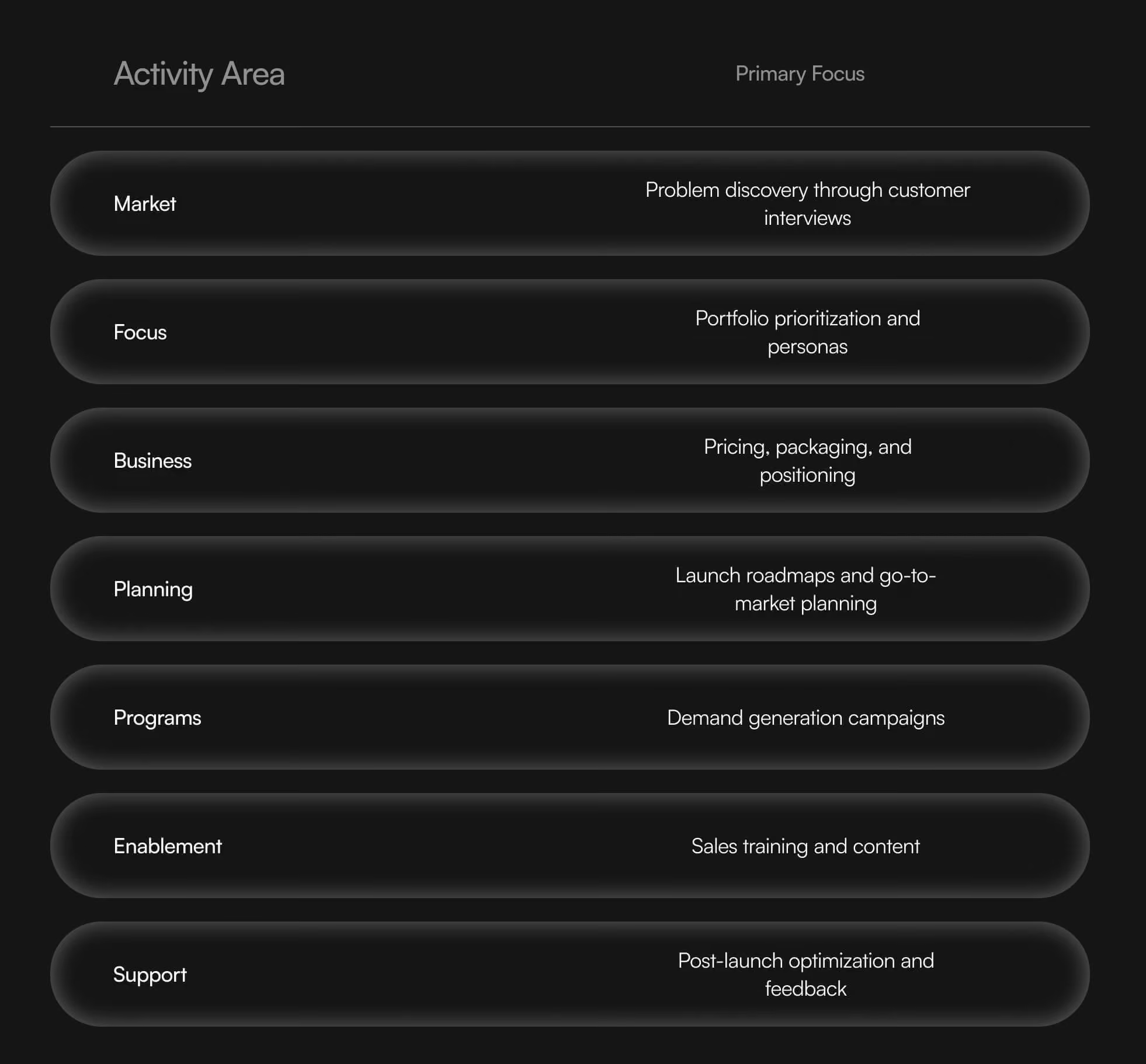
The framework focuses on discovering what the market actually needs before driving the product lifecycle. This prevents teams from building features nobody wants or launching campaigns that miss the mark.
The Pragmatic Marketing Framework helps align product management, marketing, sales, and development teams around common goals. Rather than each department operating from different assumptions, everyone works from the same market facts.
Pragmatic, in this context, means using frameworks as checklists and guides rather than rigid dogma. Startups might focus heavily on Market and Focus activities, while established enterprises layer in Programs and Support. The model adapts to company size, stage, and circumstances.
Want to learn more about Marketing? Keep reading!
Steps to Implement a Pragmatic Marketing Approach

Pragmatic marketing applications often involve iterative testing and feedback loops to refine products and marketing strategies based on actual user experiences. Here’s a chronological process your team can follow:
Step 1: Identify and document your target market segments
Use concrete characteristics: industry, company size, geography, job titles, and typical budgets. For example, “Mid-market SaaS companies with 50-200 employees, $5M-$20M ARR, with the VP of Marketing as primary buyer.” This specificity guides every subsequent decision.
Step 2: Conduct structured customer and prospect interviews
Focus on real problems, desired outcomes, and buying triggers—not on your product features. Ask open-ended questions like “What’s the most frustrating part of your current process?” Aim for 20-30 interviews per segment. Validating demand before development can lead to higher success rates and avoid resources being spent on unwanted products.
Step 3: Turn insights into problem statements and personas
Document patterns from your interviews. Create problem statements like: “Marketing directors at mid-market companies struggle to prove ROI on content investments, wasting 10+ hours monthly on manual reporting.” These statements guide product decisions, messaging, and channel selection.
Step 4: Develop and test positioning statements
Craft clear statements that articulate who the product is for, what problem it solves, and why it’s better than alternatives. Test these through landing pages, ads, or sales conversations. Measure which resonates based on click-through rates, demo requests, or deal progression.
Step 5: Prioritize initiatives based on expected impact and effort
Choose 3-5 experiments rather than maintaining a long wish list. For Q3 2026, your team might decide: “We’ll test LinkedIn thought leadership ads, launch a customer case study series, and pilot an account-based marketing program for enterprise prospects.”
Step 6: Launch small, measurable experiments
Run campaigns with predefined success metrics and timeframes. A reasonable experiment might involve a $5,000 budget over four weeks, targeting 5% click-through rate and 15% lead-to-demo conversion. Keep experiments contained enough to learn quickly.
Step 7: Measure results rigorously
Compare outcomes with your hypotheses. If you predicted a 15% reduction in customer acquisition cost from new messaging but saw only 3%, document why. Adjust budget and strategy based on what the data shows, not what you hoped would happen. Pragmatic marketers base their actions on believing in evidence and practical outcomes, rather than relying on assumptions or untested theories.
Step 8: Institutionalize learning
Document outcomes in shared wikis or playbooks. Share findings across product, sales, and leadership in regular reviews. Update your roadmap and messaging based on accumulated evidence. Managing these affairs effectively ensures organizational learning and adaptation. Pragmatic marketing encourages a continuous feedback loop between product teams and customers to ensure that products meet actual market needs and adapt to changing conditions.
How Pragmatic Marketing Differs from Traditional or Idealistic Marketing
Traditional marketing often starts with internal ideas—“we need a big brand campaign this quarter” or “leadership wants us to launch in three new markets.” The focus centers on outputs: ads produced, events attended, press releases distributed. Success is measured by activity rather than impact.
Pragmatic marketing starts with external reality: customer problems, competitive dynamics, and validated opportunities. The question isn’t “what do we want to say?” but “what do customers need to hear to solve their problem and choose us?”
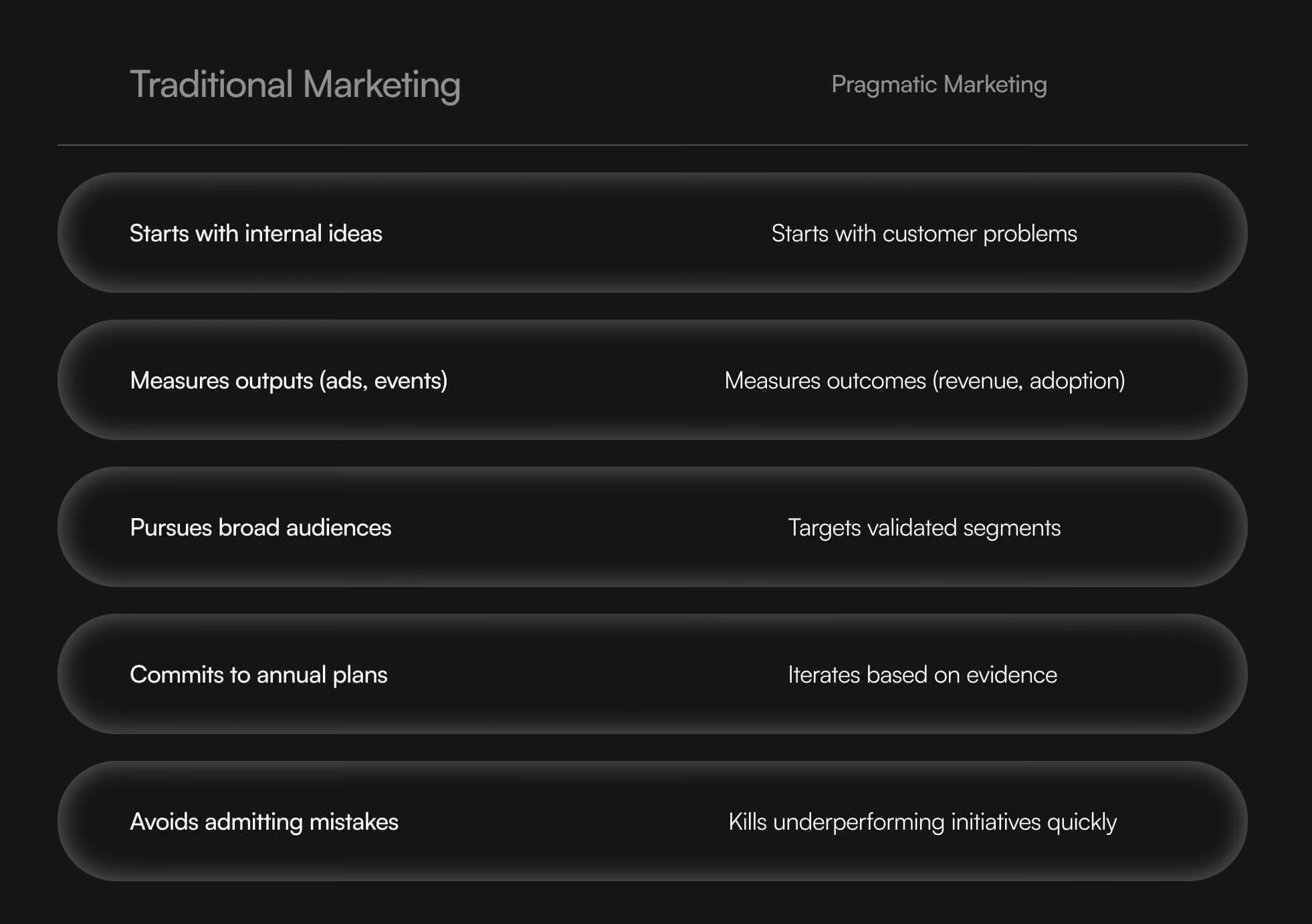
Pragmatic marketing is an outside-in, market-driven approach that prioritizes identifying and solving real market problems. Unlike approaches that are driven by ideological rigidity, pragmatic marketing favors practical adaptation to real-world challenges. In pragmatic marketing, the focus is on practical applications and real-world results rather than theoretical concepts, which helps businesses adapt to changing market conditions. This adaptability also enables marketing strategies to respond effectively to the evolving needs of society, ensuring relevance and impact within broader social contexts.
Idealistic approaches may chase perfect branding or pursue large, unvalidated audiences for pragmatic reasons that don’t hold up under scrutiny. A pragmatic view accepts that some markets aren’t worth pursuing, some messages won’t resonate, and some campaigns will fail—and that’s useful information.
While philosophical pragmatism questions abstract notions and absolute truths, pragmatic marketing questions untested assumptions about markets. It demands proof in the form of customer behavior: purchases, upgrades, referrals. Teams using this approach see 2.5x higher on-time launch rates and measurable market share improvements in competitive sectors.
The realistic approach means being comfortable revising or even cancelling initiatives mid-stream if data shows they aren’t working. This avoids the sunk-cost embarrassment that plagues many marketing organizations.
Examples and Use Cases of Pragmatic Marketing
Pragmatic marketing emphasizes the importance of understanding customer needs and market dynamics to create effective marketing strategies. Here are concrete examples of this approach in action:
- SaaS Feature Development (2024): A startup building analytics software interviewed 25 customers before committing development resources. They discovered users only needed 3 key reports, not the 10 originally planned. By shipping a smaller, focused solution in 8 weeks, they achieved 40% adoption versus the projected 15%—demonstrating real world application of customer evidence driving product decisions.
- B2B Launch Messaging (2026): A company preparing a product launch tested three different value propositions through targeted LinkedIn ads with a $5,000 budget. One message outperformed the others by 2x on click-through rate. They scaled that winner and improved lead conversion rates by 35%, adding $1.5M to their pipeline.
- E-commerce Budget Reallocation: An online brand invested heavily in influencer partnerships but tracked ROAS of only 0.8:1 after two months. Rather than pushing through for a full year, they stopped the program and shifted budget to search campaigns showing 4:1 returns, recapturing $300K in marketing efficiency.
- Budget Planning with Sales Alignment: A marketing leader used a pragmatic approach during annual planning, cutting vanity metrics like social impressions and tying spend directly to pipeline and revenue targets agreed with sales. This resulted in 25% efficiency gains and reduced sales-marketing friction by establishing shared accountability.
A pragmatic marketer is like a four year old at a birthday celebration filled with realistic expectations—focused on practical enjoyment rather than wishing for magical creatures. Just as children may hope for magical creatures at their birthday celebration, pragmatic marketers concentrate on what can actually be delivered. Knowing that a car passing by is simply a matter of fact, not fantasy, they prioritize actions that have real impact over idealistic wishes.
These examples share a common thread: teams made decisions based on evidence, not hope. They treated marketing as dealing with hypotheses rather than certainties.
Traits of a Pragmatic Person in Marketing Teams


Quincy Samycia
Want to learn more about brand platform?