Product Marketing vs. Brand Marketing: What Sets Them Apart
11/02/2026
Marketing Strategy
Learn the key differences between product and brand marketing to prioritize investments, strengthen positioning, and drive measurable business growth.

Product marketing explains a specific product: what it is, who it is for, and why it matters to them. Brand marketing shapes how the whole company is perceived over time. One drives understanding and adoption of an offer. The other builds the preference and trust that make every offer easier to sell. Growth-stage companies need both, and the real question is how much of each, and in what order.


Product marketing vs. brand marketing


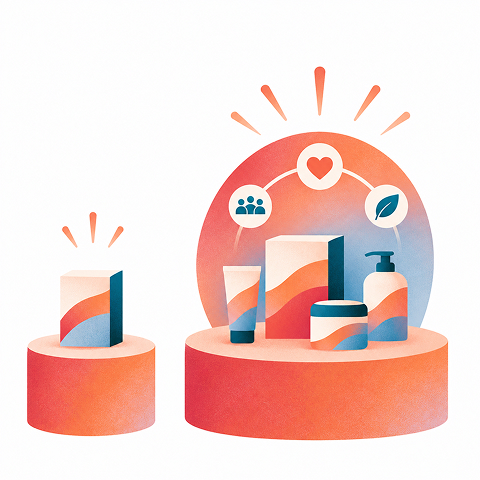
What is product marketing?
Product marketing explains a product in terms that are meaningful to its intended users. According to Santa Clara University’s Leavey School of Business, it clarifies what the product is, who it is for and why it is relevant, and it supports launches and ongoing product communication. Shopify’s definition is similar: identify the product’s unique value and communicate that value to the target audience.
In practice, a product marketer sits between product, sales and the market. GTM Playbook lists the typical responsibilities as positioning and messaging, launch management, sales enablement, competitive intelligence, and customer and market research. CXL adds go-to-market strategy, target-segment research, value propositions, and educating sales and customer-success teams.
The common thread is a clear commercial job: help the right buyer understand the offer and choose it.
What is brand marketing?
Brand marketing defines and maintains how an organization is perceived over time. The same Santa Clara University source says it sets positioning, voice, visual standards and narrative frameworks for outward-facing communication. Amazon Ads describes it as building the relationship between a brand and its consumers and promoting the brand as a whole, with products and services acting as proof points for the brand promise.
Brand marketing asks different questions from product marketing. What do we stand for? How should we sound? What should a stranger feel after thirty seconds with our website? If you want the foundations, our guides to what brand positioning is and how to build a brand strategy walk through them step by step.
Key differences
The cleanest way to separate them is by scope, audience, horizon and job. Forbes Communications Council contributor Jessica Wong frames it this way: product marketers usually support one product or a product family and emphasize features and benefits, while brand marketers influence how consumers and stakeholders perceive the entire company.
• Scope: Product marketing focuses on one product or family; brand marketing represents the entire company.
• Core question: Product asks why a buyer should select this offer; brand asks why people should trust and prefer the company.
• Message: Product communicates benefits, differentiation and use cases; brand communicates values, personality, story and promise.
• Audience: Product focuses on buyers evaluating a solution and internal sales or success teams; brand also reaches future customers, employees, partners and investors.
• Time horizon: Product typically plans around launches and quarters; brand builds reputation over years.
• Typical deliverables: Product produces messaging, launches, sales decks and competitive analysis; brand produces strategy, identity, voice, campaigns and guidelines.
• Commercial contribution: Product is measured more directly through adoption, win rates and pipeline; brand contributes to preference, consideration and pricing power.
Scope: one offer or the whole company
A product marketer for a SaaS analytics tool works on how that tool is described, sold and launched. A brand marketer works on what the company is known for, whether that tool is the only product or one of ten. When a company has a single product, the two scopes feel close. They still ask different questions.
Audience: the evaluator or everyone
Product marketing talks to someone who already has, or is forming, a need, and it equips the people who sell to them. CXL notes that product marketing partners with sales to close revenue and educates sales and customer-success teams. Brand marketing speaks to a wider circle, including buyers who are not in market yet, future hires and investors.
Time horizon: launches vs. reputation
Product marketing runs on launch calendars and quarterly numbers. Brand equity builds slowly and compounds. That mismatch is the reason brand work is often the first thing cut when budgets tighten, and the reason it is hard to rebuild.
Accountability: pipeline vs. perception
GTM Playbook frames product marketing’s accountability around win rates, product adoption, influenced pipeline and competitive displacement. Brand marketing answers for awareness, consideration and preference, which show up in revenue later and less directly.
Where they overlap
The two disciplines share positioning, messaging and customer insight, which is why they collide in practice. Both decide what the market should believe. They differ in the altitude at which they decide it.
CXL’s view is that product marketing establishes where to play and how to win, and brand marketing uses those insights to build durable relationships and preference. Wong makes a complementary point: branding creates associations and emotions, product marketing communicates concrete benefits, and together they support purchase decisions. Shopify likewise treats product claims and the brand’s visual and emotional story as complementary parts of a campaign.
Here is what that looks like in a real launch:
• Brand marketing sets the company promise: A fictional B2B analytics brand positions itself as the clearest way for decision-makers to understand their data, supported by a recognizable visual identity and voice.
• Product marketing sharpens the offer: The team explains how a newly launched forecasting tool reduces manual reporting and identifies the buyer, use cases and differentiation.
• Both teams align the touchpoints: The campaign, landing page, product demo and sales deck repeat the same overarching promise while tailoring proof to the product.
• Measurement closes the loop: Product marketing tracks qualified demos, adoption and win rates; brand marketing tracks recognition, consideration and message association.
When this breaks, buyers feel it. The homepage promises one thing, the product page another, and the sales deck a third. Our piece on brand strategy vs. marketing strategy explains why that fragmentation usually starts with an unclear strategic layer.
How each one is measured
This is where leadership teams most often talk past each other. Product marketing is judged on near-term commercial indicators. Brand marketing is judged on slower signals that are harder to attribute.
BCG’s 2025 marketing measurement guidance recommends shared KPIs that balance short-term outcomes such as sales, leads and ROI with long-term measures such as brand equity, awareness and consideration. It also reports that leading marketers separate tactical short-term outcomes from long-term brand building, and that half of them include both brand and performance KPIs in their measurement.
Nielsen’s September 2024 guidance points the same way: measure business outcomes, not only media consumption, including lead conversions, cost per lead, ROAS, long-term ROI and brand equity. It also argues for measuring the full funnel, since channels and activities perform differently at different stages.
A practical scorecard for a growth-stage company might look like this:
• Product performance (product marketing): Win rate, trial-to-paid conversion, feature adoption and influenced pipeline.
• Demand performance (performance and product marketing): Cost per lead, conversion rate and return on ad spend.
• Brand health (brand marketing): Awareness, consideration, share of search and sentiment.
• Business outcomes (shared): Revenue growth, customer acquisition cost, retention rate and long-term return on investment.
• Review cadence: Discuss demand and product signals monthly, brand health quarterly and shared business outcomes across the planning cycle. Agree on attribution limitations before assigning credit.
If you need to build the brand layer, start with how to measure brand awareness and our overview of brand health metrics. For the vocabulary, see our brand measurement definition.
Free Brand Health Audit
Make sure your brand is built to sell
Search has changed. Your customers aren't just Googling anymore. They're asking ChatGPT, Perplexity, Gemini and other AI platforms what to buy, who to trust and which brands they should consider.
If your brand isn't showing up clearly in those answers, you're already losing opportunities. Our free Brand Health Audit shows you where your brand stands across traditional search, AI search and brand positioning.

Sample brand audit
Live preview
Traditional search
72
AI search (GEO)
34
Brand positioning
58
How a growing company should balance the two
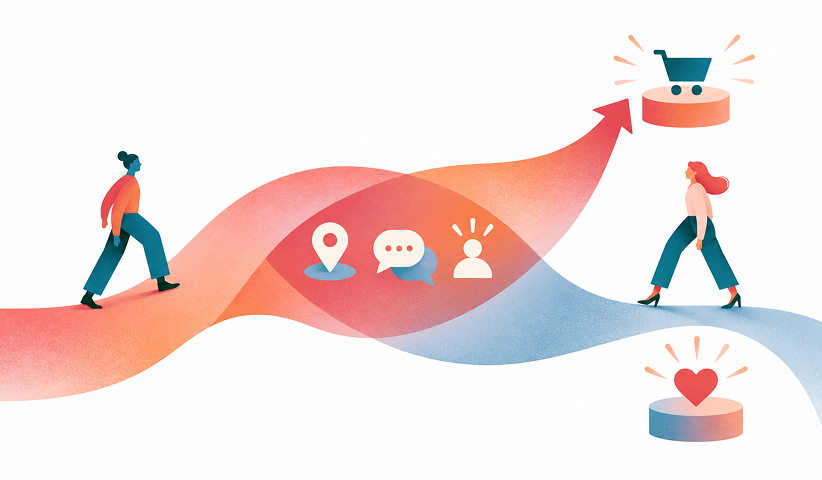
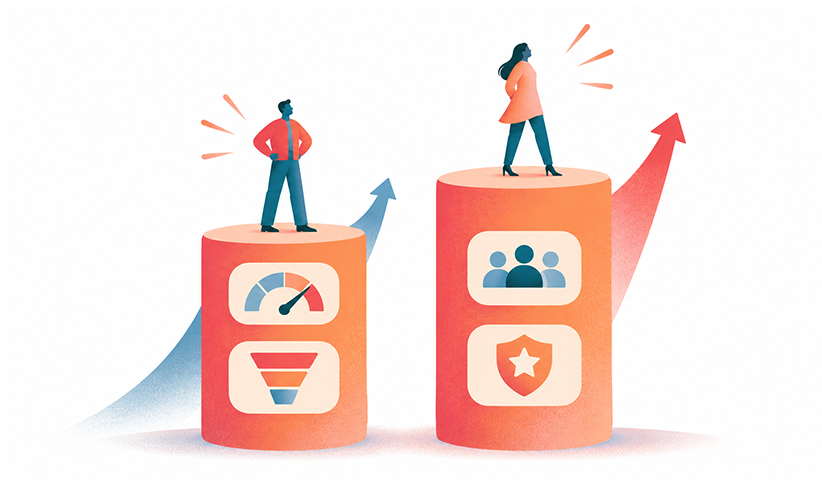


There is no universal ratio. Stage, category and team size decide it. Here is a sensible way to think about each phase.
Early stage: product marketing first, brand foundations in parallel
Before product-market fit is solid, you need to know your segment, your competitors and your pricing. CXL recommends leaning on product marketing for market research, competitor analysis, positioning, segmentation, sales strategy, pricing and product-market fit, with brand marketing building awareness and later deepening emotional connection and advocacy.
That does not mean ignoring brand. A clear name, positioning and visual identity done once, and done well, saves you from costly rework later.
Growth stage: invest in brand so product marketing works harder
Once you have repeatable sales, the constraint often shifts. Buyers you have never met must trust you before they talk to sales. This is where brand investment lifts everything downstream, from paid media efficiency to sales cycle length. It is also when a company’s identity often stops matching its ambition, which is the moment to consider a rebrand.
Scale and multi-product: coordinate formally
With several products and larger teams, the two functions need defined handoffs. Shopify notes that smaller companies may assign both to one marketing manager, while larger teams commonly coordinate the two functions for alignment.
For coordination, the American Marketing Association recommends designing brand and demand capabilities around a shared purpose, integrating annual plans, using the customer journey as a planning canvas, prioritizing initiatives jointly and reporting to executives as one marketing team with shared goals.
A simple decision test
Ask these five questions:
• Are prospects confused about what the product does or why it is different? Prioritize product positioning, sales messaging and proof.
• Do qualified buyers understand the offer but hesitate because the company lacks recognition or trust? Increase brand-building investment.
• Are launches strong but every new product requires rebuilding credibility from scratch? Strengthen company-level positioning and brand consistency.
• Do campaigns drive attention but fail to create qualified opportunities or adoption? Audit the product promise, audience fit, landing pages and enablement.
• Are multiple teams communicating conflicting messages? Set one brand narrative, then develop offer-specific messaging and shared KPIs.
Brand credibility in an ROI-driven culture
Many executives are skeptical of brand spend because its returns are indirect. Forbes Communications Council contributor Dee Blohm argues that brand marketing earns credibility when brand governance connects to product, content, demand, creative, social and communications, and when it is tracked with brand health metrics, PR dashboards and recurring market surveys.
The takeaway: give brand a measurement plan from day one, and connect it to the commercial work around it. Brand then stops being a cost center and becomes the thing that makes every other channel more efficient. For a wider view of how brand sits next to performance and growth disciplines, read our breakdown of brand, performance, growth and digital marketing.
Want to learn more about Digital Marketing and Strategy? Keep reading!
If you need help with your company’s marketing, contact us for a free custom quote.
Our perspective

We see the “product vs. brand” debate as a false choice, and the companies we work with grow faster when they stop treating it as one.
Product marketing answers the question a buyer asks when they are close to deciding. Brand answers the question they asked months earlier, usually without telling anyone: do I trust these people? If you only invest in the first, you pay full price for every click. If you only invest in the second, you earn attention you cannot convert.
That is why we build around what we call brand-backed performance™. Positioning, creative, website, paid media and retention work from one strategy, so the story a buyer sees in an ad is the story they find on the site and the story that keeps them after the first purchase. Every layer is traceable to a business outcome, and every outcome feeds back into the brand.
Our advice to founders and marketing leaders: settle positioning once, at the company level. Then let product marketing sharpen it for each offer, and let performance channels prove it. Measure awareness and consideration next to pipeline and retention rate, and review them in the same meeting.
- Quincy Samycia
Putting both to work with one partner
Most growth-stage teams do not have a brand strategist, a creative team, a web developer, a paid media lead and a lifecycle specialist on staff. We bring those capabilities together so positioning, creative, site and channels reinforce one another from the start.
Our branding practice works at the executive level on positioning and identity. Our website development turns that positioning into a conversion-focused experience. Paid media management and retention marketing carry it through acquisition and repeat purchase.
Engagements are structured as projects, monthly retainers or performance-linked agreements. As published on our pricing page, monthly retainers start from $4,000 for Creative Services, $5,500 for Paid Media Management, $6,500 for Retention Marketing and $8,500 for Growth Strategy. Branding and website work are scoped to the project. If you want to see how this would apply to your company, start from our homepage and tell us where you are.
Common mistakes to avoid
• Treating brand and product marketing as competing budgets: Define distinct responsibilities but review them against shared revenue and customer outcomes.
• Confusing product features with buyer value: Translate capabilities into outcomes, use cases and evidence that matter to a defined segment.
• Running brand campaigns without a clear positioning foundation: Establish a specific promise, proof and a consistent voice before scaling awareness.
• Letting every product team invent its own company story: Keep the brand narrative consistent while adapting messages for different buyers and products.
• Measuring both functions only by last-click conversions: Pair short-term commercial metrics with brand awareness, consideration and longer-term outcomes.
• Investing only in brand or only in demand capture: Rebalance as the company matures, rather than relying on a universal spending ratio.
Frequently Asked Questions

Is product marketing part of brand marketing?
Not exactly. They are separate disciplines that share positioning and customer insight. Product marketing focuses on one offer and its commercial results, while brand marketing covers how the whole company is perceived. In small companies one person often covers both, which can make them look like one function.
Which should a startup invest in first?
Usually product marketing, because you need clear segments, positioning and messaging to sell. Lay brand foundations at the same time: a name, a positioning statement and an identity that you will not need to redo at the next funding round. As sales become repeatable, shift more investment into brand to lower the cost of every channel.
Can brand marketing talk about the product?
Yes. Brand marketing promotes the company as a whole, and Amazon Ads notes that products serve as proof points for the brand promise. The best brand work uses product reality as evidence, so the promise feels believable rather than abstract.
How do you measure brand marketing compared to product marketing?
Product marketing is tracked with win rate, adoption and influenced pipeline. Brand marketing is tracked with awareness, consideration, sentiment and brand equity. BCG recommends combining short-term and long-term KPIs in one measurement framework.
Who should own each function in a growing company?
In a smaller company, one marketing manager can hold both, as Shopify points out. As you add products and headcount, separate the roles but keep shared goals, one planning cycle and one report to the executive team.

Quincy Samycia
As entrepreneurs, they’ve built and scaled their own ventures from zero to millions. They’ve been in the trenches, navigating the chaos of high-growth phases, making the hard calls, and learning firsthand what actually moves the needle. That’s what makes us different—we don’t just “consult,” we know what it takes because we’ve done it ourselves.
Want to learn more about brand platform?
If you need help with your companies brand strategy and identity, contact us for a free custom quote.
We do great work. And get great results.
+2.3xIncrease in revenue YoY
+126%Increase in repurchase rate YoY



+93%Revenue growth in first 90 days
+144% Increase in attributed revenue




+91%Increase in conversion rate
+46%Increase in AOV


+200%Increase in conversion rate
+688%Increase in attributed revenue