Small Businesses Email List: How to Reach Decision Makers and Grow Your Sales
08/13/2026
Business / Marketing Strategy

.png)


Why Small Business Email Lists Matter in 2026



Free Brand Health Audit
Make sure your brand is built to sell

Who Should Use a Small Business Email List?




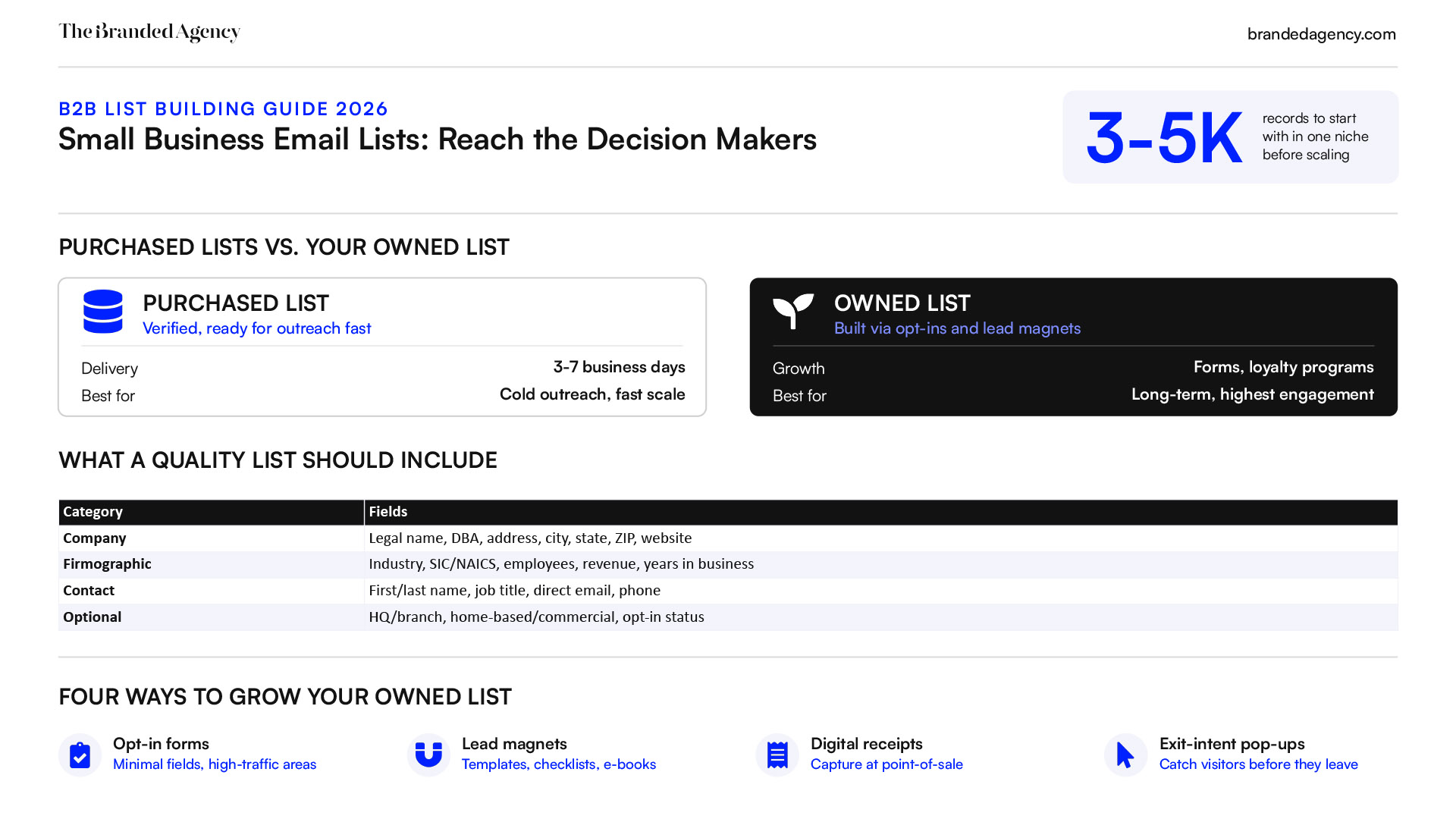
A small business email list can support organizations whose products or services meet a defined business need. The starting point is identifying relevant companies and contacts, then determining which communications are appropriate.
Potential users include:
- B2B software providers: Companies offering accounting, payroll, CRM, scheduling, or workflow tools to smaller organizations.
- Professional service firms: Accountants, agencies, consultants, and IT providers building relationships with businesses that fit their expertise.
- Manufacturers and wholesalers: Businesses identifying potential retail accounts, distributors, or trade partners.
- Partnership teams: Organizations researching suitable referral, franchise, or commercial relationships.
- Sales and marketing teams: Teams organizing inquiries, eligible prospects, customers, and opt-in subscribers within a shared CRM.
Being a potential buyer does not automatically make someone eligible for marketing emails. Keep audience research separate from the decision to send.
Define the Decision-Maker Before Building the List
Identify the responsibility connected to your offer rather than targeting the most senior title by default.
For example, a payroll service might be relevant to an owner, finance lead, or operations manager. A wholesale product offer may belong with a retail buyer. The appropriate contact depends on the business’s size and how purchasing decisions are made.
Document:
- The type of business you serve.
- The problem your offer addresses.
- The role responsible for that problem.
- Who evaluates the solution and approves spending.
- The evidence that makes the company a relevant fit.
Use those decisions to shape your message and segmentation before expanding the database.
What Email Verification Can—and Cannot—Improve
Email verification checks technical signals, such as address formatting and domain configuration. Depending on the service, it may also assess whether a mailbox appears able to accept messages.
These checks can help identify unusable or uncertain addresses. They do not establish that the recipient wants your email, still holds the listed role, or has authority to purchase.
Practical Benefits of Accurate Contact Data
A maintained database can help your team:
- Avoid known invalid addresses: Exclude records that fail relevant checks.
- Reduce duplicate outreach: Identify multiple records for the same person or company.
- Improve audience relevance: Use current role, location, and company information.
- Preserve relationship context: Keep inquiries and previous conversations available to the team.
- Apply exclusions consistently: Prevent opted-out or otherwise ineligible contacts from entering campaigns.
These are operational benefits, not guarantees of inbox placement, lower acquisition costs, or higher conversion rates. Performance also depends on sender reputation, audience expectations, the offer, and the message.
Treat “Verified” as a Limited Technical Label
Ask what a verification result means, when it was produced, and how uncertain results are handled. Some domains accept mail broadly, making individual mailbox status difficult to determine. An address marked “valid” can also become outdated later.
Keep verification separate from your email marketing strategy. A technically usable address should still pass relevance, permission, and suppression checks before it enters a sending audience.
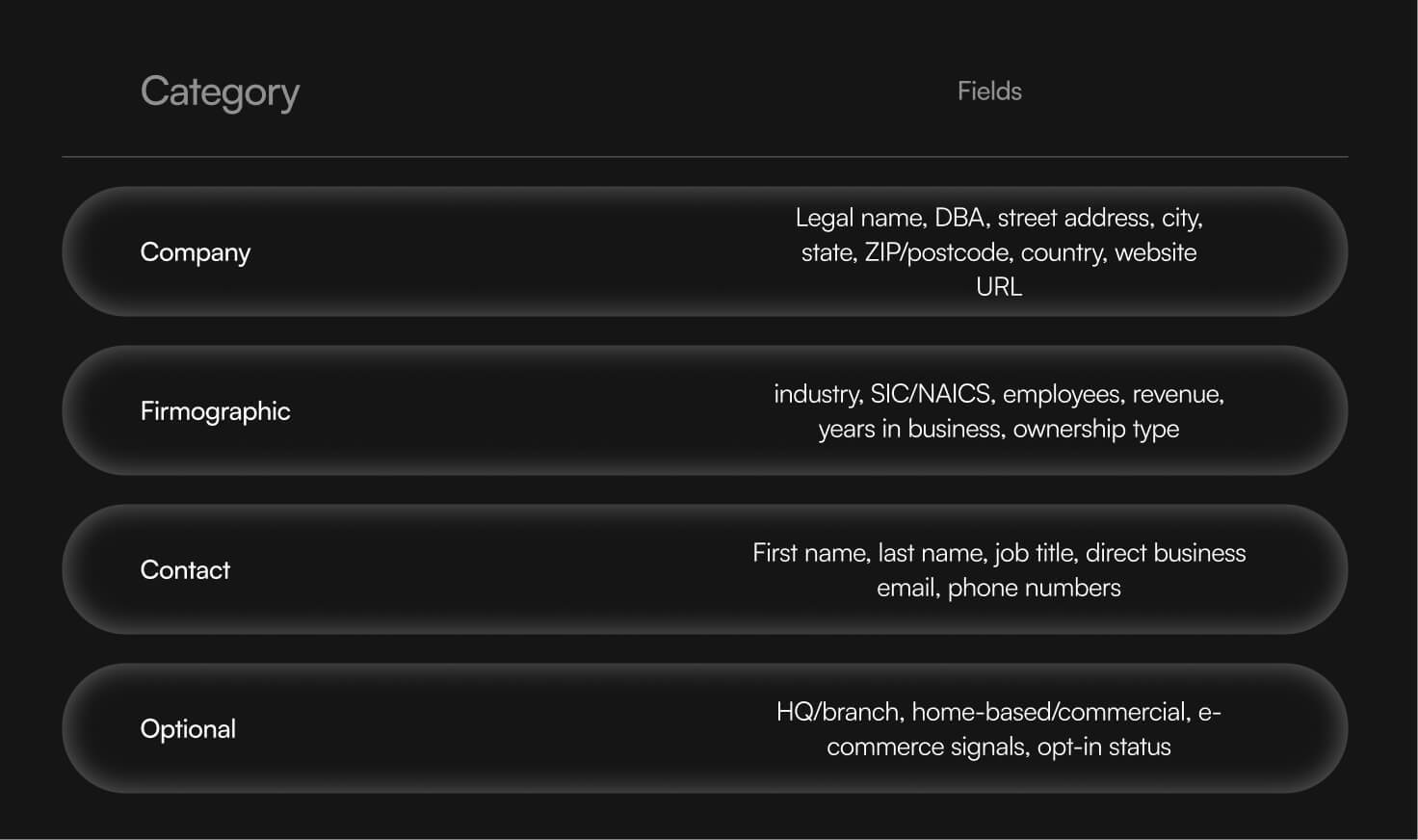
What Data Fields Should a Small Business Email List Include?
A useful contact record should explain who the contact is, why they are relevant, where the information came from, and whether they can receive the intended message.
Collect only the information needed for your defined purpose. Organize the fields into the following groups.
Company and Contact Details
- Business name and website.
- Contact name and current job role.
- Business email address.
- Industry and relevant company-size range.
- Business location and contact jurisdiction, where known.
- Date the company and role details were last checked.
Mark estimates and unknown values clearly. A company’s headquarters or email domain alone may not establish where a particular recipient is located.
Audience Fit and Relationship History
- Relevant product, service, or use case.
- Decision-making responsibility.
- Prospect, customer, partner, or subscriber status.
- Source and date of any inquiry.
- Previous conversations and agreed next steps.
- Assigned account owner.
These fields help distinguish a research prospect from someone who requested information or already has an active relationship with your team.
Data Source and Consent Evidence
- Original source, such as a signup form, inquiry, or documented business interaction.
- Collection date and method.
- The organization and communications covered by any consent.
- The wording or form version shown when consent was obtained.
- A reference to supporting evidence.
- Any applicable expiry date or review requirement.
Consent provenance means the record of how, when, and for whom consent was obtained. A supplier’s general assurance that a list is “compliant” does not replace evidence applicable to your intended use.
For Canadian outreach, the CRTC’s guidance on implied consent and recordkeeping explains that senders must be able to prove the consent they rely on, including when addresses come from a third party. Assess other jurisdictions separately.
Verification and Suppression Fields
- Most recent verification date and result.
- Verification method or provider.
- Invalid, uncertain, or other relevant technical status.
- Unsubscribe or objection date.
- Suppression reason and scope.
- Date the suppression was applied across connected systems.
Check suppression records whenever you import or refresh data. A newly obtained copy of an address should not overwrite an earlier opt-out.
Preferences and Campaign Eligibility
- Topics the person requested.
- Selected communication frequency, if offered.
- Preferred language.
- Relevant geography or service area.
- Eligibility for the specific campaign.
- Reason for exclusion where eligibility cannot be established.
For example, restaurant operators, dental practice managers, and construction business owners may need different information. Their industry helps shape the message; their relationship, preferences, and applicable permission determine whether it should be sent.
Want to learn more about brand platforms, Brand Strategy and Brand Identity? Keep reading!
How Small Business Email Lists Are Built and Verified

How to Format and Manage a Small Business Email List


Quincy Samycia
Want to learn more about brand platform?