Brand Teams: Sustainable Packaging Design Wins When Reuse Tops 80%
11/09/2026
Print & Packaging
Discover how to reduce packaging waste, protect your brand’s shelf appeal, and test whether reusable packaging can deliver measurable savings before you invest in a full redesign.
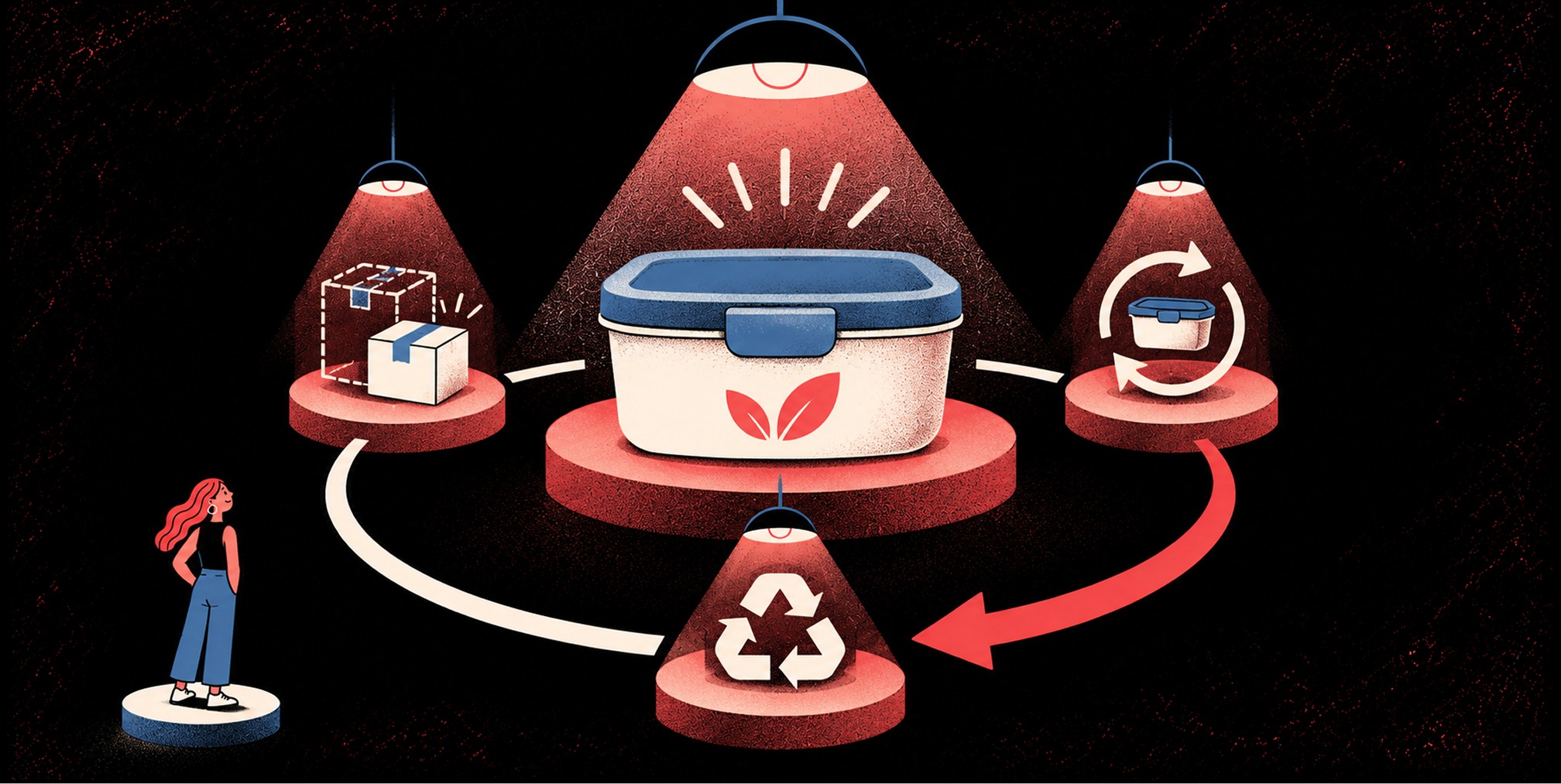
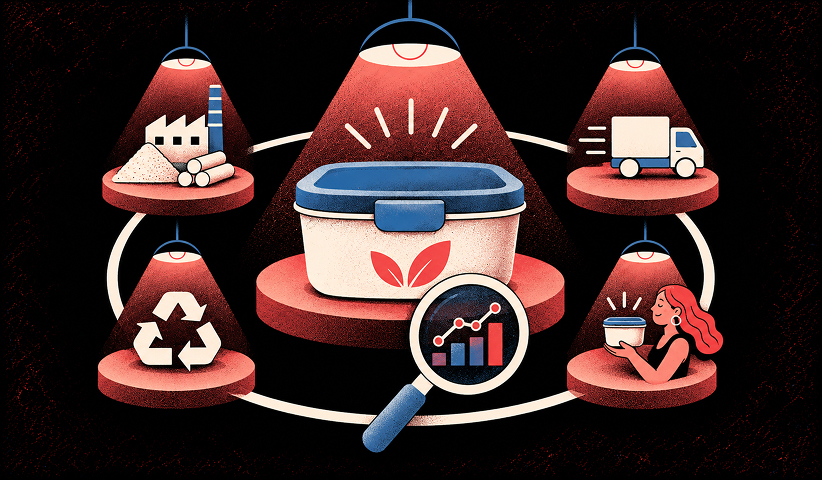
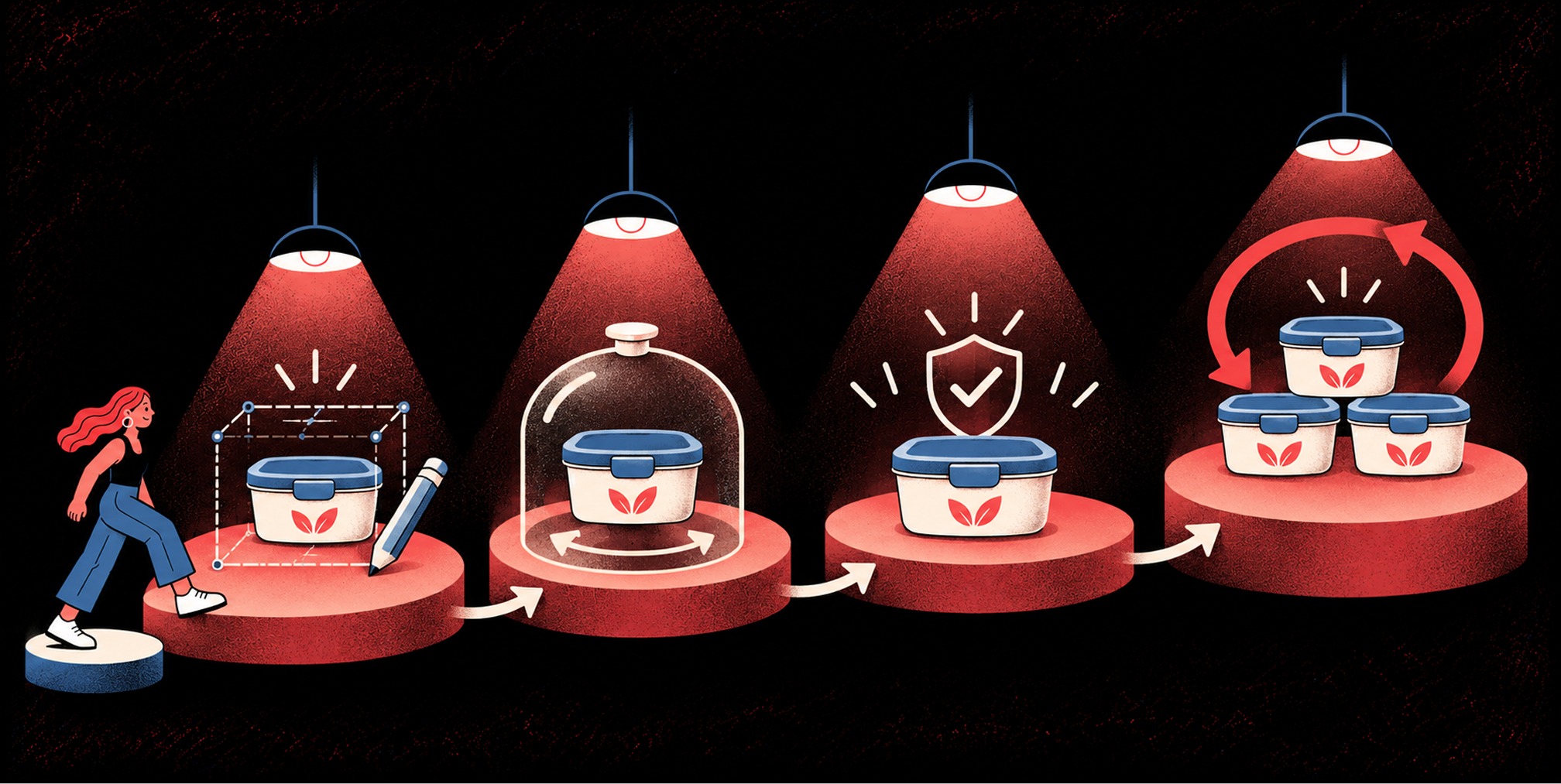
Sustainable packaging design means treating packaging and product as one system, then applying a strict priority order: eliminate what you can, build reuse or refill where volume supports it, and only then optimize materials for recycled content and recyclability. Done right, it protects the product, cuts total environmental footprint across the full system, and holds up under real recovery infrastructure, not theoretical claims.


What Is Sustainable Packaging Design? Core Principles and Frameworks

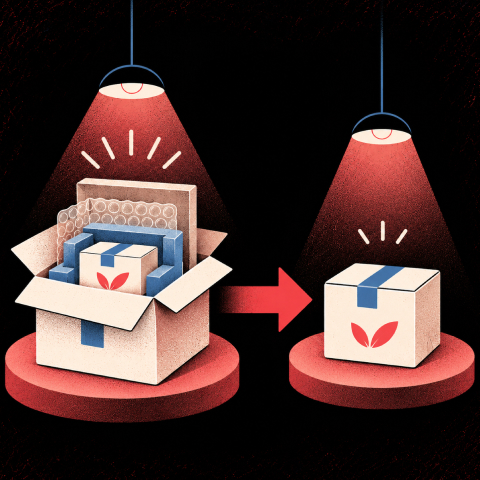
Most packaging teams still evaluate materials one attribute at a time: is it recyclable, is it plastic-free, is it made from recycled content? That approach produces packaging that scores well on a single metric and poorly on the system it lives in. A compostable mailer that arrives crushed and forces the customer to reorder the product has not helped anyone. Sustainable packaging design fixes that by evaluating the product and package together, because decisions made without accounting for product protection can actually increase total system footprint when damaged goods get replaced or discarded.
The Sustainable Packaging Coalition frames this through SMART design, a five-part lens that keeps decisions consistent across every project:
- Use the SMART framework as a documented screening tool, not a single sustainability score: establish the relevant criteria from the current SPC guidance, agree on project-specific targets, and record evidence for every decision.
- Start with elimination and material reduction. Compare options on product protection, transport efficiency, sourcing, end-of-life pathways, and actual consumer participation.
- Escalate conflicting results to a life-cycle assessment instead of declaring a winner based on one attribute such as recycled content.
The SPHERE framework pushes the same logic further with a six-principle model built around one target: maximum circularity paired with minimum footprint. It’s a useful cross-check because it forces you to score a design on both axes at once rather than trading one for the other. A package can be highly circular and still carry a heavy carbon footprint if it requires long-haul transport for return; SPHERE catches that tension before it reaches production.
Life-cycle thinking is what prevents the most common false start in packaging redesign: chasing a single flashy metric. Teams that optimize for “percent recycled content” alone can end up increasing weight, shipping cost, or breakage rates. Teams that optimize for “lightest possible package” alone can increase product damage and returns. The EPA’s waste hierarchy exists precisely to rank these trade-offs: prevention and reduction sit above reuse, which sits above recycling, which sits above disposal. Any framework you adopt should mirror that order, not invert it.
Practical Sustainable Packaging Design Strategies You Can Pilot Now
Frameworks tell you what to prioritize. These are the tactics that turn priority into a shipped SKU.
1. Eliminate before you optimize. Audit every component against one question: does this piece protect the product, inform the customer, or comply with a regulation? If the answer is no to all three, it’s a candidate for removal. Common targets include secondary cartons wrapping an already-protective primary container, excess void fill, and printed inserts nobody reads. Weigh and photograph your current pack, then challenge each layer individually rather than assuming the whole assembly is load-bearing.
2. Right-size for the product and the pallet, not just the shelf. Oversized boxes create two costs at once: wasted material and wasted cube space in transport, which means fewer units per truck and more trucks per order. Run a void-fill analysis on your top-selling SKUs first, since that’s where volume multiplies the savings. Palletization studies often reveal that shaving a half-inch off a carton’s height changes how many layers fit per pallet, which changes freight economics more than the material swap ever would.
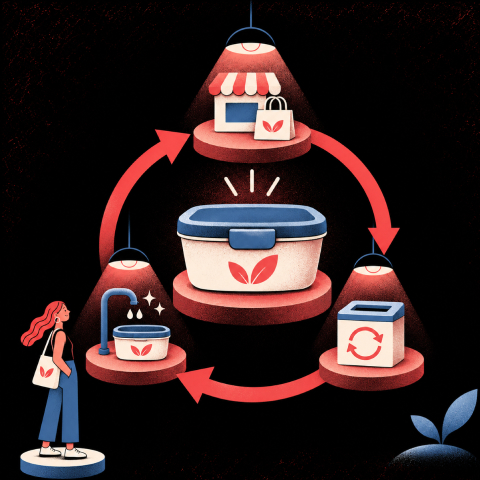
3. Build reuse and refill only where the logistics actually support it. Reuse looks appealing on a slide deck and falls apart in the field when return logistics aren’t solved first. The Sustainable Packaging Coalition identifies return rates of at least 80%, and preferably closer to 90%, as a useful program-design benchmark. It is not a universal environmental break-even point: the result depends on container design, actual reuse cycles, cleaning, transport, and product loss. Before committing to refill, model your realistic return rate using existing customer behavior data, not aspirational targets.
4. Move toward mono-materials wherever performance allows. Multi-material laminates, foil-lined pouches, and mixed-substrate labels are recycling’s biggest saboteur because sorting facilities can’t separate bonded layers economically. A single-polymer pouch, a single-substrate label, and an adhesive compatible with the base material turn a “technically recyclable” claim into an “actually recycled” outcome. This is also where creative teams push back hardest, since mono-material substrates sometimes limit finish options; work with your design partner early so brand equity and material simplicity get resolved together rather than in a late-stage standoff. The Branded Agency’s packaging design guide covers how to prototype these trade-offs before committing to tooling.
5. Put end-of-life instructions on the pack, not on a website. A recycling symbol without context leaves the decision to guesswork, and guesswork drives contamination in recycling streams. Clear, plain-language disposal instructions printed directly on the package, keyed to how the specific material is actually collected in major markets, close that gap.
Pro Tip: Run your elimination audit before your material audit. Every gram you remove is a gram you never have to justify, source, certify, or explain to a sustainability auditor later.
Design decisions about finish and color deserve the same rigor. Simplifying substrates doesn’t have to mean simplifying brand presence; the psychology of color in packaging shows how a disciplined palette can carry premium positioning even on a stripped-down mono-material structure.
Free Brand Health Audit
Make sure your brand is built to sell
Search has changed. Your customers aren't just Googling anymore. They're asking ChatGPT, Perplexity, Gemini and other AI platforms what to buy, who to trust and which brands they should consider.
If your brand isn't showing up clearly in those answers, you're already losing opportunities. Our free Brand Health Audit shows you where your brand stands across traditional search, AI search and brand positioning.

Sample brand audit
Live preview
Traditional search
72
AI search (GEO)
34
Brand positioning
58
Material Trade-Offs: Avoiding Regrettable Substitution
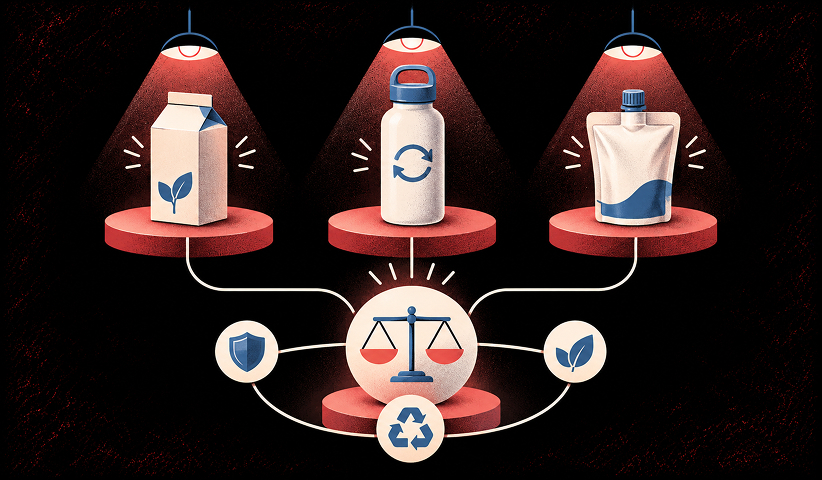
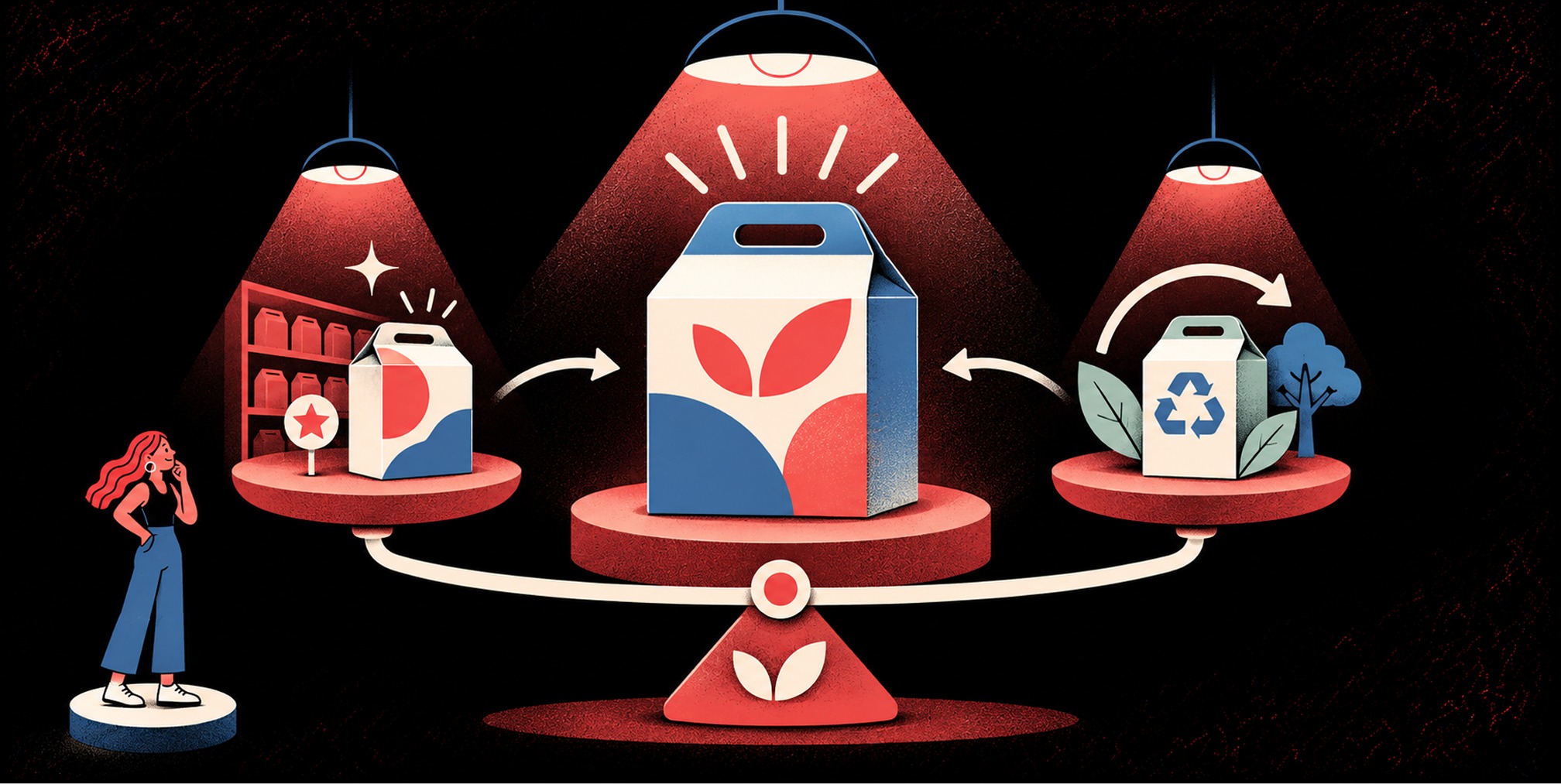
Swapping plastic for paper, or virgin material for a compostable alternative, feels like progress. It often isn’t. Regrettable substitution happens when a material change reduces one impact category while quietly increasing another, or when the “better” material has no realistic path to recovery in the markets where it’s sold. Research on packaging substitution documents this pattern repeatedly: a compostable film that requires industrial composting infrastructure most municipalities don’t have ends up in a landfill anyway, performing no better than the plastic it replaced.
Material families carry genuinely different profiles on protection, circularity, and recovery, and none of them wins on every axis:
- Paper and fiber: Often familiar to consumers and collected through established systems, but coatings, adhesives, moisture exposure, and added mass can limit real-world performance and recovery.
- Rigid plastics: Can offer low weight and strong protection; assess resin type, recycled-content availability, local acceptance, labels, and whether a refill or return model is viable.
- Flexible films: Usually efficient by weight and shipping volume, but multi-layer structures and limited collection access can undermine end-of-life claims.
- Glass: Offers product protection and reuse potential, but weight, breakage, cleaning, and reverse transport must be evaluated across repeated trips.
- Metals: Often highly recoverable where collection systems exist, but production energy, protective coatings, and the full product-packaging system still matter.
- Certified compostable materials: Evaluate whether the target market has suitable collection and processing infrastructure, and whether the package meets local labeling requirements.
Before locking in a material, run it against a short validation checklist: Does the material perform to spec at scale, not just in a lab sample? Is there documented recovery infrastructure in the ZIP codes where most of your customers live? Does switching this material shift weight or volume enough to change freight impact? And critically, does the claim on the package match what actually happens to it after disposal? Reporting on the state of plastic recycling makes clear that a recyclability claim only holds up if the collection and sorting systems in your market can act on it.
Choosing the Right Decision Tool: LCA, MCDA, and Kano
Not every packaging decision needs a full life-cycle assessment, and treating every choice as if it does slows teams down without improving outcomes. The scale of the decision should set the depth of analysis.
Life-cycle assessment (LCA) is the right tool when you’re comparing fundamentally different material systems, launching a new format at scale, or need defensible numbers for a sustainability disclosure. LCAs are demanding, though: good LCA practice requires defining a functional unit and system boundary up front, and results are highly sensitive to those choices. Skip the sensitivity analysis and you get a number that looks precise and means very little. Common LCA software includes SimaPro, GaBi, and OpenLCA, each built around the same core requirement: garbage boundaries in, garbage comparisons out.
Kano analysis answers a different question: which packaging attributes actually move customer satisfaction, versus which ones are invisible to the buyer entirely? Pairing it with MCDA (multi-criteria decision analysis) or its common variant TOPSIS lets teams weigh sustainability, cost, and performance criteria side by side instead of debating them in the abstract. Combining these methods with LCA data has produced validated, defensible packaging redesigns in published case studies, largely because the combination forces trade-offs into a shared scoring structure rather than a subjective argument in a conference room.
For quick screening between two or three near-equivalent options, a simplified scorecard weighing weight, recyclability, cost, and protection is often enough. Escalate to a full LCA and outside specialists when the decision affects your entire portfolio or feeds a public sustainability claim.
A threshold worth testing: the Sustainable Packaging Coalition recommends high return rates, at least 80% and ideally around 90%, for reusable packaging programs. Confirm your own environmental break-even point with real return data and system-level analysis rather than treating the threshold as universal.
Want to learn more about Design, Print, and Packaging? Keep reading!
If you need help with your companies print and packaging design, contact us for a free custom quote.
Sustainable Packaging Design in Practice: Three Mini Case Patterns
Concepts land differently once you can see how they play out against real KPIs.
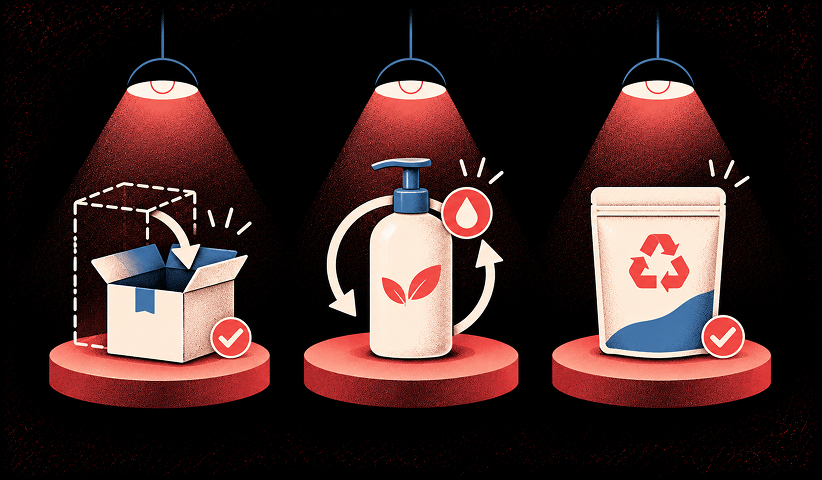
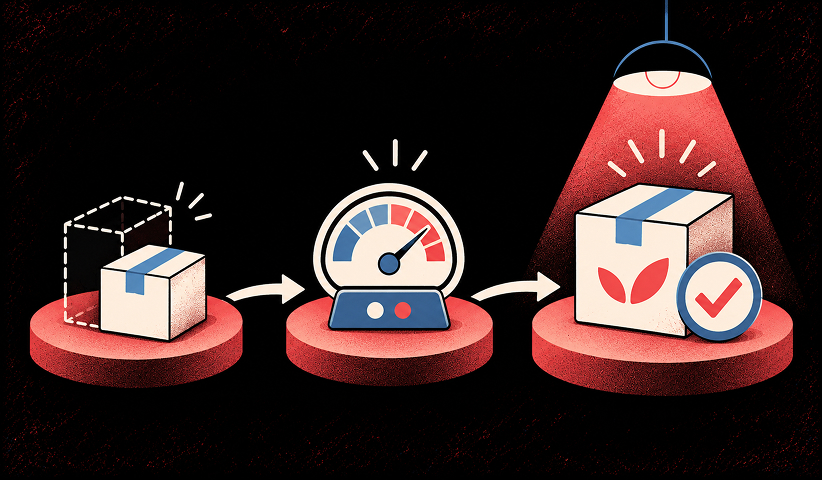
- Pattern 1 - E-commerce right-sizing (illustrative): Replace oversized shipping cartons with fewer sizes matched to the highest-volume orders. Measure grams of packaging per shipment, damage rate, freight cube, and cost per delivered undamaged order.
- Pattern 2 - Refillable personal-care container (illustrative): Pilot a durable primary pack with refill supply and a convenient return or refill pathway. Track verified return rate, average uses per container, cleaning and reverse-logistics impacts, and repeat purchase behavior.
- Pattern 3 - Mono-material food pouch (illustrative): Compare a redesigned pouch with the original laminate, using barrier and shelf-life tests before making recyclability claims. Measure spoilage, packaging weight, cost, and recovery access in the sales market.
Each pattern shares a common thread: the win shows up somewhere other than the material swap itself, whether that’s freight, recovery rate, or customer behavior.
The Implementation Checklist: From Pilot to Scaled Rollout
- Baseline the current system: record packaging mass, materials, damage and return rates, shipment cube, cost, and end-of-life access by market.
- Set a functional unit: compare alternatives for the same delivered product quantity and equivalent protection, shelf life, and customer experience.
- Identify highest-impact changes: eliminate nonessential pieces first; then evaluate right-sizing, reuse, refill, and material redesign.
- Screen supplier and regulatory constraints: confirm barrier performance, compatibility, food-contact requirements when applicable, print quality, and substantiation for environmental claims.
- Prototype and stress-test: run transit, leakage, shelf-life, usability, and disposal-instruction tests using production-representative samples.
- Model system-level impacts: include transport, cleaning, returns, product loss, waste infrastructure, and actual reuse cycles; use LCA when trade-offs are material.
- Run a limited pilot: define customers, geography, timeline, baseline, success thresholds, and a way to collect return or recovery data before launch.
- Decide and scale: compare pilot KPIs with the baseline, verify claims, document exceptions, update artwork and operations, and monitor performance after rollout.
Pro Tip: Set your KPI targets before the pilot starts, not after you see the results. Retrofitting a success metric to match whatever number you got is how sustainability claims fall apart under scrutiny.
How We Approach Sustainable Packaging Design at The Branded Agency
We treat packaging as a brand asset first and a compliance checkbox never. Every project starts with the same question we’d ask about a logo or a landing page: does this reinforce what the brand stands for while performing under real-world conditions? That means our creative teams and strategists work the SMART and SPHERE frameworks into the same room where color, typography, and structural design decisions happen, so sustainability isn’t bolted on after the fact.
Our engagements typically move through a discovery phase, a scoping workshop that maps constraints and KPIs, then a pilot before any full-scale tooling commitment. That sequencing protects budget and catches regrettable substitutions before they reach production. It’s the same discipline we bring to broader packaging strategy work: positioning and performance, evaluated together, not separately.
Ready to Redesign Your Packaging System?
If you’ve read this far, you already know the gap between a Pinterest-worthy concept and a package that survives freight, satisfies a sustainability audit, and still looks premium on shelf. That gap is exactly where a traditional design studio hands you renderings and walks away, and where an in-house team without LCA experience burns months on a redesign that fails a recyclability check late in the process.
The Branded Agency runs packaging as part of a full brand system: strategy, creative execution, and go-to-market planning under one roof, so a sustainable redesign doesn’t stall waiting for three separate vendors to sync up. We’ve built out custom packaging solutions that pair eco-design principles with the kind of shelf presence that protects pricing power, not just the environment. If your team is weighing a pilot LCA, a mono-material redesign, or a full eco-design sprint, book a discovery call to scope your project and see where the fastest wins are hiding in your current pack.
Frequently Asked Questions
What is sustainable packaging design?
It is the process of reducing the total environmental impact of a package while preserving product protection, usability, brand recognition, and realistic recovery or reuse. The product and its packaging must be evaluated as one system.
Is an 80% return rate enough to make reusable packaging sustainable?
Not automatically. The Sustainable Packaging Coalition points to at least 80%, preferably around 90%, as a high-return benchmark, but the break-even point depends on how many times packs are actually reused and the impact of manufacturing, cleaning, transport, and product loss.
What should brands change first when redesigning packaging?
Start by removing unnecessary components and right-sizing the packaging. Then evaluate refill, reuse, and material alternatives against product protection and cost before making new environmental claims.
Are paper and compostable packages always better than plastic?
No. Every format has trade-offs in weight, barrier performance, food or product waste, collection access, and processing. A life-cycle comparison is more reliable than choosing by material label alone.
How do you measure sustainable packaging performance?
Track packaging mass per delivered unit, product damage, shipping efficiency, verified collection or return rates, actual reuse cycles, unit cost, and life-cycle indicators such as greenhouse-gas emissions where measured.
When does packaging redesign require a life-cycle assessment?
Use an LCA for major material-system changes, large-scale rollouts, or public comparative environmental claims. For smaller pilots, a documented screening scorecard can help prioritize what needs deeper analysis.
Sources
- Sustainable Packaging Coalition, Packaging Design: https://sustainablepackaging.org/our-pillars/packaging-design/
- Sustainable Packaging Coalition, Position Statement on Reuse: https://sustainablepackaging.org/wp-content/uploads/2023/10/SPC-Position-Statement_Reuse.pdf
- Sustainable Packaging Coalition, Designing More Successful Reusable Packaging Programs: https://sustainablepackaging.org/wp-content/uploads/2023/07/Guidance-for-Reusable-Packaging.pdf
- US EPA, Sustainable Materials Management and Waste Hierarchy: https://www.epa.gov/smm/sustainable-materials-management-non-hazardous-materials-and-waste-management-hierarchy
- ISO 14040, Life Cycle Assessment principles and framework: https://www.iso.org/standard/37456.html

Quincy Samycia
As entrepreneurs, they’ve built and scaled their own ventures from zero to millions. They’ve been in the trenches, navigating the chaos of high-growth phases, making the hard calls, and learning firsthand what actually moves the needle. That’s what makes us different—we don’t just “consult,” we know what it takes because we’ve done it ourselves.
Want to learn more about brand platform?
If you need help with your companies brand strategy and identity, contact us for a free custom quote.
We do great work. And get great results.
+2.3xIncrease in revenue YoY
+126%Increase in repurchase rate YoY



+93%Revenue growth in first 90 days
+144% Increase in attributed revenue




+91%Increase in conversion rate
+46%Increase in AOV




+200%Increase in conversion rate
+688%Increase in attributed revenue