HubSpot vs Salesforce: Which CRM Fits a Growing Company?
10/23/2026
Marketing Services
Compare HubSpot vs Salesforce to find the right CRM for your business, reduce costs, streamline marketing, and support long-term growth.

HubSpot is the faster, simpler choice for teams that want sales and marketing working from one system within weeks. Salesforce is the stronger choice when your data model, approval flows or reporting needs are complex enough to justify dedicated admin resources.


HubSpot vs Salesforce: Choosing the Right CRM for Growth


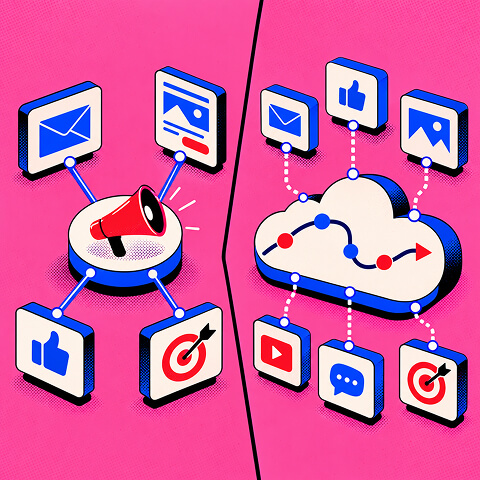
Most growth-stage companies land on one side of that line quickly once they look at three things: who will run the system, how complicated their sales motion is, and what the full cost looks like after seats, contacts and implementation.
This guide compares the two platforms the way a CMO or founder has to decide: on cost, marketing depth, ease of use, customization and scale. It also covers the Marketing Cloud question, since many readers searching this comparison are really asking about marketing automation.
The Branded Agency
Make Your CRM Part of a Stronger Funnel
The Branded Agency aligns branding, creative, digital platforms and performance marketing to support growth beyond the CRM itself.
What each platform actually is ?
Both are broad cloud CRM platforms, but they were built around different ideas. HubSpot’s products cover marketing, sales, content management, customer service and operations. Salesforce’s suite centers on sales, marketing, customer service and commerce. HubSpot’s own comparison guide describes Marketing Hub as its full-featured marketing automation software and Marketing Cloud as Salesforce’s equivalent.
The practical difference is architecture and philosophy. HubSpot attributes its ease of deployment to a single-database foundation and contrasts that with Salesforce’s growth through multiple products and acquisitions. That is a vendor’s view, so treat it as a description of intent rather than a verdict. What you can verify in practice is how each feels on day one: HubSpot is built so a marketer can configure most of it, while Salesforce is built so an admin or developer can shape almost anything.
HubSpot’s product catalog describes Smart CRM as the system of record that connects its products, included with paid Starter, Professional or Enterprise plans. It lists Smart CRM at $20 per core seat per month for Starter, $50 for Professional and $75 for Enterprise.
Pricing: what you pay beyond the sticker
Pricing is where most comparisons mislead, because the two companies price in different shapes. HubSpot publishes most of its numbers and charges by seats, tiers and marketing contacts. Salesforce publishes an entry edition and asks you to talk to sales for the rest.
Salesforce
Salesforce’s Sales Cloud page lists Starter Suite from $25 per user per month. Higher editions and detailed pricing require contacting Salesforce. The same page says implementation can run through Salesforce consultants or its AgentExchange partners, which is a budget line you should plan for early. Advanced AI, analytics, security and data capacity are positioned as differentiators across higher editions, so the features you want may push you above the entry tier.
HubSpot
HubSpot’s Sales Hub pricing guide lists Sales Hub Starter at $9 per seat per month billed annually or $15 billed monthly, Professional at $90 annually or $100 monthly, and Enterprise at $150 per seat per month. The same guide lists one-time onboarding fees of $1,500 for Professional and $3,500 for Enterprise. It also notes extra costs from additional seats, marketing contact capacity, other Hubs and outside implementation help.
On the marketing side, HubSpot’s Marketing Hub pricing guide shows Professional at $800 per month with three seats included. Marketing Hub costs also rise with the size of your contact list, so a database that doubles will change your bill.
Marketing automation cost
At the marketing-automation level the gap widens. SelectHub reports Salesforce Marketing Cloud starting at $1,250 monthly and warns that Salesforce may add other costs, while noting that HubSpot costs rise with contact-list size.
Cost factorHubSpotSalesforceEntry paid CRMSmart CRM Starter at $20 per core seat/monthStarter Suite from $25 per user/monthSales tiersSales Hub $9 to $150 per seat/month, by tierHigher editions by quoteMarketing automationMarketing Hub Professional at $800/month with three seatsMarketing Cloud from $1,250/month (third-party report)One-time fees$1,500 (Professional) or $3,500 (Enterprise) onboarding for Sales HubImplementation via consultants or partnersWhat scales the billSeats, marketing contacts, extra HubsEditions, add-ons, products, services
Prices change, so confirm the current figures on each vendor’s page before budgeting. The more useful exercise is to model your total cost over 24 months: licenses at your expected headcount, onboarding, an admin or partner, and the integrations you will need.
Free Brand Health Audit
Make sure your brand is built to sell
Search has changed. Your customers aren't just Googling anymore. They're asking ChatGPT, Perplexity, Gemini and other AI platforms what to buy, who to trust and which brands they should consider.
If your brand isn't showing up clearly in those answers, you're already losing opportunities. Our free Brand Health Audit shows you where your brand stands across traditional search, AI search and brand positioning.

Sample brand audit
Live preview
Traditional search
72
AI search (GEO)
34
Brand positioning
58
Marketing: Marketing Hub vs Marketing Cloud
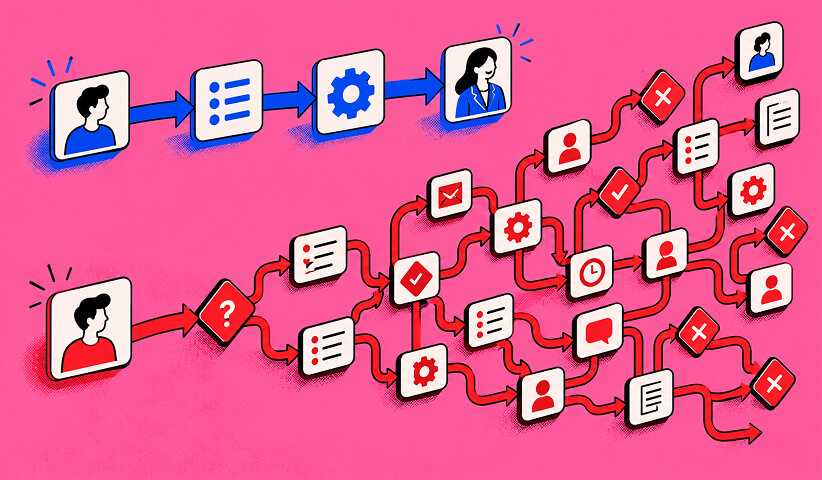

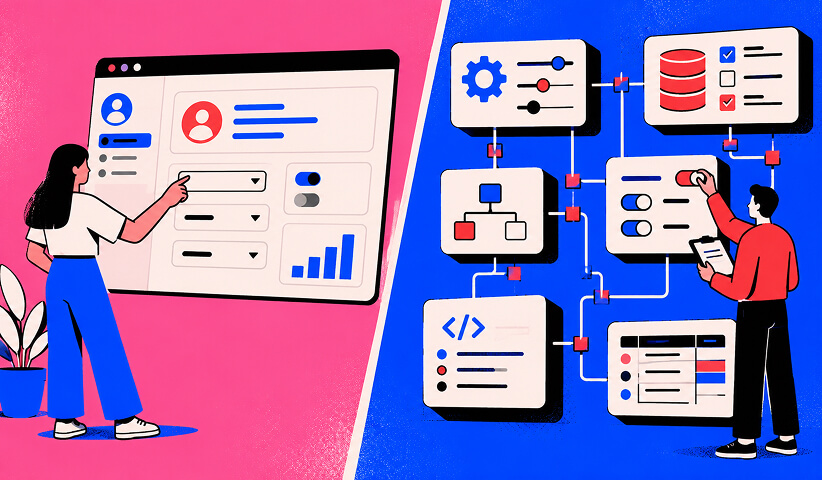

If your question is about marketing, the comparison is really Marketing Hub against Marketing Cloud, and they differ in structure more than in features.
HubSpot describes Marketing Hub as one unified platform. HubSpot’s comparison page says Salesforce’s marketing offering spans distinct products, namely Engagement, Account Engagement and Marketing Cloud Next, that need separate purchase, setup and administration. Check Salesforce’s current product lineup when you evaluate, because naming and packaging shift.
Labnify observes that HubSpot treats campaigns as unified efforts across emails, landing pages, social posts and ads. Marketing Cloud organizes work more by channel and relies on Journey Builder for more sophisticated multi-channel sequences. MarCloud Consulting adds that HubSpot leans on drag-and-drop builders, reusable templates and A/B testing, while Marketing Cloud offers more advanced dynamic content, custom HTML and multivariate testing, at the cost of more setup complexity.
Peer reviews point the same direction. PeerSpot’s 2026 comparison says reviewers favor Salesforce for comprehensive tools and HubSpot for user-friendly, all-in-one functionality, and describes Salesforce as generally more expensive. Capterra reports Marketing Cloud review scores of 4.3 for functionality, but 3.8 for value for money and 3.8 for ease of use.
The takeaway is not that one is better. It is that Marketing Cloud rewards teams who can specify detailed technical journeys, and Marketing Hub rewards teams who think in campaigns and want to launch them quickly.
Designing workflows either way
Whichever platform you pick, the automation logic is where projects stall: lead routing, lifecycle stages, handoffs between sales and marketing. Before you build, map the workflow on paper. A primer on CRM workflow automation is a good place to pressure-test how much complexity you actually need, because a tool that can model forty branches is only an advantage if you will maintain forty branches.
Sales, reporting, AI and data
Salesforce has long held the edge for depth: complex data models, deeper analytics and advanced customization. MarCloud Consulting notes that these strengths typically come with more configuration and technical knowledge. HubSpot emphasizes native CRM alignment, accessible AI, built-in data-quality tools and straightforward lead scoring and nurturing.
Ease of use, customization and integrations
Capterra reviewers describe HubSpot as accessible and user-friendly, especially for small businesses and startups. They value Salesforce for customization but note a steeper learning curve and higher costs that can limit its appeal for smaller businesses.
On ecosystem, Salesforce’s comparison page claims more than 150,000 businesses use Salesforce, over 7,000 app integrations, and over 900 consulting and implementation partners. Those are vendor-reported figures, but they point to a real advantage: if you need a niche integration or a specialist partner, Salesforce’s ecosystem is vast.
The two platforms also coexist. HubSpot’s catalog documents a Salesforce integration: Professional and Enterprise Smart CRM tiers support up to 500 field mappings per object and one Salesforce account at a time, and Enterprise adds custom-object sync. That matters if a sales team stays on Salesforce while marketing runs on HubSpot, a setup we see often when a company is mid-transition.
Want to learn more about brand platforms, Brand Strategy and Brand Identity? Keep reading!
If you need help with your companies brand strategy and identity, contact us for a free custom quote.
Which one fits a startup or scale-up

For a seed to Series B company, the deciding factor is usually operating capacity, not feature count. Capterra reviewers see HubSpot as the accessible option for small businesses and startups, and Salesforce as scalable and customizable with a learning curve that can weigh on smaller teams. PeerSpot reviewers likewise see Salesforce’s marketing stack as better suited to larger organizations with the resources to learn and run it.
On the question people often ask, whether HubSpot is replacing Salesforce: the evidence does not support a replacement story. The two serve overlapping but different needs, and the reasons to choose each remain distinct.
Our perspective: the CRM is infrastructure, not strategy
We work with growth-stage and VC-backed companies that reach this decision at an awkward moment: pipeline is growing, the team is stretched, and the pressure to pick a platform is high. Our view is simple. Pick the system your team will actually keep clean and use daily, then put your energy into what flows through it.
In our experience, a CRM does not create demand, sharpen positioning or fix a weak conversion path. It records and routes what your brand and marketing already produce. Companies that win with either platform tend to have a clear market position, creative that earns attention, and a traceable path from first touch to revenue. That is what we mean by brand-backed performance: the brand and the performance engine designed as one system, so the data in your CRM reflects real buying intent.
So we advise teams to decide on operating reality first. If speed and marketing ownership matter, HubSpot usually gets you there sooner. If complexity and control matter, Salesforce earns its overhead. Either way, define lifecycle stages, lead scoring and handoff rules before you configure a single workflow.
Where we fit in
Choosing a platform is one decision. Making it produce pipeline is another. We help ambitious companies connect brand, creative, web and paid and retention programs to the CRM they choose, so reporting ties spend to revenue. Our Growth Strategy engagement starts from $8,500 per month, and you can see the rest of our published retainers, including Retention Marketing from $6,500 per month, on our pricing page. If you are still shaping your go-to-market plan, our SaaS marketing agency guide explains what to expect from a partner.
Frequently Asked Questions

Which is better, HubSpot or Salesforce?
Neither wins in every case. HubSpot is generally better for teams that want quick setup, integrated marketing and lower technical overhead. Salesforce is better when you need complex data models, deep customization and advanced analytics, and have the resources to administer it.
Is HubSpot cheaper than Salesforce?
At entry level the sticker prices are close: Salesforce Starter Suite starts at $25 per user per month, and HubSpot Smart CRM Starter is listed at $20 per core seat per month. The gap tends to open in marketing automation and implementation. Compare total cost over two years, not list price.
Can HubSpot and Salesforce work together?
Yes. HubSpot documents a Salesforce integration with field mapping on its Professional and Enterprise tiers, and custom-object sync on Enterprise. Many companies run marketing in HubSpot while sales stays in Salesforce, at least during a transition.
Is Salesforce Marketing Cloud the same as HubSpot Marketing Hub?
Not quite. Marketing Hub is one unified marketing platform, while Salesforce’s marketing offering spans several distinct products that are bought and administered separately. Marketing Cloud tends to offer deeper technical control and Marketing Hub tends to be faster to launch.

Quincy Samycia
As entrepreneurs, they’ve built and scaled their own ventures from zero to millions. They’ve been in the trenches, navigating the chaos of high-growth phases, making the hard calls, and learning firsthand what actually moves the needle. That’s what makes us different—we don’t just “consult,” we know what it takes because we’ve done it ourselves.
Want to learn more about brand platform?
If you need help with your companies brand strategy and identity, contact us for a free custom quote.
We do great work. And get great results.
+2.3xIncrease in revenue YoY
+126%Increase in repurchase rate YoY




+93%Revenue growth in first 90 days
+144% Increase in attributed revenue




+91%Increase in conversion rate
+46%Increase in AOV



+200%Increase in conversion rate
+688%Increase in attributed revenue