Strategic Marketing Development: Building a Competitive Marketing Strategy for 2026 and Beyond
08/05/2026
Marketing Strategy
Learn how strategic marketing development helps business leaders align strategy, optimize marketing investments, and build a lasting competitive advantage in an evolving market.

Strategic marketing development turns disconnected campaigns into a structured system for sustainable growth. It connects business goals with market research, positioning, channel planning, resource allocation, execution, and performance measurement so every marketing decision supports a clear long-term direction. In 2026, this disciplined approach is especially important as companies navigate tighter budgets, changing customer behaviour, privacy requirements, and growing pressure to prove measurable results.
.png)


How Strategic Marketing Development Drives Long-Term Growth



Key Takeaways
- Strategic marketing development is a structured, data-driven discipline for designing a long-term marketing strategy and marketing plan-not just running ad-hoc campaigns. Companies with documented marketing strategies are 414% more likely to report success.
- The strategic marketing process follows clear stages: situational analysis, market research, strategy formulation, marketing mix design, implementation, and performance optimization-each stage feeding the next in a continuous loop.
- Tools like swot analysis, STP (segmentation, targeting, positioning), and the 7Ps marketing mix help organizations gain sustainable competitive advantage and guide resource allocation across marketing channels.
- Brands like Tesla, Patagonia, and Unilever demonstrate how embedding purpose, innovation, and consistency into strategic marketing decisions creates durable market positions.
- This article provides a practical step-by-step framework, real brand examples, and an FAQ section covering budget, B2B vs B2C differences, and getting started from scratch.
Introduction to Strategic Marketing Development
The marketing landscape in 2026 looks nothing like it did five years ago. Post-pandemic consumer behavior has permanently shifted toward digital-first experiences. Privacy regulations like GDPR and CCPA continue tightening. AI has moved from experiment to expectation. And marketing budgets have flatlined-hovering around 7.7% of company revenue according to Gartner's 2025 CMO Spend Survey-while pressure to deliver measurable results has never been higher.
Strategic marketing development is the structured, end-to-end discipline of designing, testing, and evolving a long-term marketing strategy and plan that connects business goals to concrete marketing campaigns. It builds sustainable competitive advantage by aligning research, positioning, resource allocation, and execution, rather than chasing short-term wins. Compare this to reactive, tactics-only marketing-say, running some social media ads without a clear marketing strategy-and the difference becomes obvious fast.
For marketing professionals, business leaders, and organizations trying to improve long-term, data-driven decision-making, this is the work that turns scattered activity into a coherent system for growth. The strategic marketing process covered here includes situational analysis, market research, strategy formulation, marketing mix design, implementation, performance measurement, and adapting marketing plans over time, with practical frameworks and brand examples to show how the pieces fit together.
Free Brand Health Audit
Make sure your brand is built to sell
Search has changed. Your customers aren't just Googling anymore. They're asking ChatGPT, Perplexity, Gemini and other AI platforms what to buy, who to trust and which brands they should consider.
If your brand isn't showing up clearly in those answers, you're already losing opportunities. Our free Brand Health Audit shows you where your brand stands across traditional search, AI search and brand positioning.

Sample brand audit
Live preview
Traditional search
72
AI search (GEO)
34
Brand positioning
58
What Is Strategic Marketing Development?



Think of strategic marketing development as three layers working together. Strategic marketing is the overarching orientation connecting markets, customers, and competitive positioning to company strategy. A marketing strategy outlines how to promote products effectively within specific segments or time periods. And the marketing plan is the documented playbook that details execution.
Development means both creating a new strategic marketing plan from scratch and continuously improving it based on data driven insights and market conditions. Strategic marketing analyzes market opportunities and identifies target audiences, then turns those insights into positioning, messaging, and channel decisions.
Consider how Nike evolves its strategic marketing every year-refreshing campaigns, entering new markets, adjusting its pricing strategy-while keeping its core positioning around athletic empowerment consistent for decades. That consistency-plus-evolution is the hallmark of effective strategic marketing.
Strategic Marketing vs Marketing Strategy vs Tactical Marketing
These three terms get used interchangeably, but they represent different layers. Strategic marketing differs from tactical marketing in its focus, time horizon, and scope of decision-making.
| Dimension | Strategic Marketing | Marketing Strategy | Tactical Marketing |
|---|---|---|---|
| Focus | Long-term market orientation and competitive advantage | Specific plan for a market, product, or period | Day-to-day execution |
| Time Horizon | 3 to 5+ years | 1 to 3 years | Weeks to months |
| Example | "We will lead in sustainable fashion for Gen Z globally" | "2026 to 2028 EU expansion for our SaaS platform" | Email campaigns, social media posts, PPC ads |
| KPIs | Market share, brand equity, customer lifetime value | Revenue targets, segment penetration | Click-through rates, impressions, cost-per-click |
Strategic marketing sets the direction. A marketing strategy operationalizes it for a defined scope. And marketing tactics-content marketing, digital marketing, social media management, traditional marketing-are the daily activities that bring it to life.
Why Strategic Marketing Development Matters in 2026
Organizations excelling at strategic marketing outperform competitors consistently, and the data backs this up. Organizations with strategic marketing outperform competitors by 20%, and companies with documented marketing strategies are 414% more likely to succeed. Data-driven planning enhances decision-making and market responsiveness, especially in a year when cookie deprecation, rising customer acquisition cost, and global economic uncertainty demand precision.
The 2026 environment rewards companies that invest in structured strategic marketing with several compounding benefits: sustainable competitive advantage that resists price wars, better resource allocation across marketing resources, stronger brand positioning that survives market shocks, and resilience when competitors scramble during downturns.
Sustainable Competitive Advantage Through Strategic Marketing
Sustainable competitive advantage means holding advantages that rivals cannot easily copy within several years. Strategic marketing development identifies durable sources of differentiation-proprietary data, strong brand identity, unique service models, community ecosystems, or purpose-driven operations.
Tesla's positioning around innovation and sustainability is a textbook example. Its Supercharger network, vertical integration, and direct distribution model create barriers competitors struggle to replicate. Patagonia's sustainability-driven brand-donating 1% of revenue (not profit) to environmental causes, totaling over $140 million by 2024-generates customer loyalty that no advertising budget can buy. Apple's ecosystem lock-in makes switching costs high for users across devices.
Understanding competitors allows companies to create unique value propositions. The key is using competitive analysis to compare rivals' features, pricing, and marketing approaches, then translating those findings into differentiated marketing strategies-where your competitive strategy shapes everything from messaging to channel selection to pricing.
Want to learn more about brand platforms, Brand Strategy and Brand Identity? Keep reading!
If you need help with your companies brand strategy and identity, contact us for a free custom quote.
Foundations of the Strategic Marketing Process

The strategic marketing process typically breaks into five to seven stages: diagnose the situation, conduct market research, formulate strategy and positioning, design the marketing mix, implement with governance, measure results, and refine. Strategic marketing involves continuous market research and environmental scanning at every stage.
These stages aren't one-off exercises. They should be revisited annually or semi-annually to keep your strategic marketing plan responsive to shifting market conditions. The following sections walk through each stage in detail.
Stage 1: Situational Analysis (SWOT, PESTEL, and Market Context)
Every sound marketing strategy starts with understanding where you stand today. Swot analysis evaluates internal strengths and weaknesses as well as external opportunities and threats-specifically for marketing capabilities like brand equity, channel reach, data infrastructure, and organizational capabilities.
PESTEL analysis layers on macro forces: political factors (AI regulation, privacy laws), economic pressures (inflation, currency volatility), sociocultural shifts (demand for sustainability), technological disruption (generative AI, cookie deprecation), environmental regulation, and legal enforcement trends.
Consider a European fintech in 2025 facing rising interest rates and tightening EU regulations. Its SWOT might highlight digital agility as a strength, compliance burden as a weakness, cross-border expansion as an opportunity, and regulatory divergence as a threat. That analysis directly shapes where the firm invests its marketing budget and which new market segments to pursue.
Stage 2: Market Research and Customer Insight
Effective strategic marketing starts with deep customer understanding. Market research informs strategic marketing decisions with validated insights, replacing assumptions with evidence. Effective market research helps identify customer preferences and behaviors across your target market.
Quantitative methods include analytics tools, CRM data, web analytics, market sizing reports, and surveys. Qualitative methods-interviews, focus groups, user testing, social listening-detect unarticulated needs and emotional drivers. Market research enhances understanding of the competitive landscape and trends shaping current and future demand.
Consider how Peloton used thorough market research during 2020–2023 when health and well-being demand spiked. By 2025, sentiment analysis and user feedback drove a pivot toward mental health content, accessibility features, and more affordable subscription tiers. That's the power of letting research guide strategic marketing decisions and customer insights rather than gut instinct.
Stage 3: Defining Target Markets and Segmentation (STP)
STP stands for segmentation, targeting, and positioning-the framework that ensures your marketing efforts reach the right people with the right message. Common segmentation bases include demographics, psychographics, behavioral patterns (usage frequency, loyalty), firmographics for B2B, and value tiers based on customer lifetime value.
The discipline here is selection. Choose two to three priority segments where you can dominate rather than spreading thin across many. Customer segmentation forces difficult but necessary trade-offs.
For example, consider two buyer personas: "Remote Manager Ryan," a mid-40s leader managing distributed teams who values productivity tools and seamless digital experiences, and "Eco-conscious Emma," an early-30s professional willing to pay premium prices for brands aligned with environmental mission. Each persona shapes a different strategic marketing plan-from channel selection to content themes to pricing strategy.
Stage 4: Strategy Formulation and Market Positioning
At this stage, leadership chooses where to play and how to win. A marketing strategy should include clear, measurable objectives-ideally SMART goals that help track marketing progress and adjustments. Positioning differentiates products or services from competitors and gives your target audience a reason to choose you, and mastering brand positioning strategy is central to making those choices stick in the market.
A compelling value proposition is essential for effective messaging. Craft a brand positioning statement that links benefits, audience, and proof: "For eco-aware urban professionals who demand style and environmental integrity, our apparel blends fashion and sustainable materials, proven by third-party certifications and lifetime repair services."
High-level strategic choices include premium vs value, niche vs mass market, innovation leader vs fast follower. Porter's generic strategies and the resource-based view help frame these decisions practically. Your unique value proposition should emerge from the intersection of what customers want, what you do better than key competitors, and what the market will reward.
Stage 5: Designing the Strategic Marketing Mix (4Ps / 7Ps)
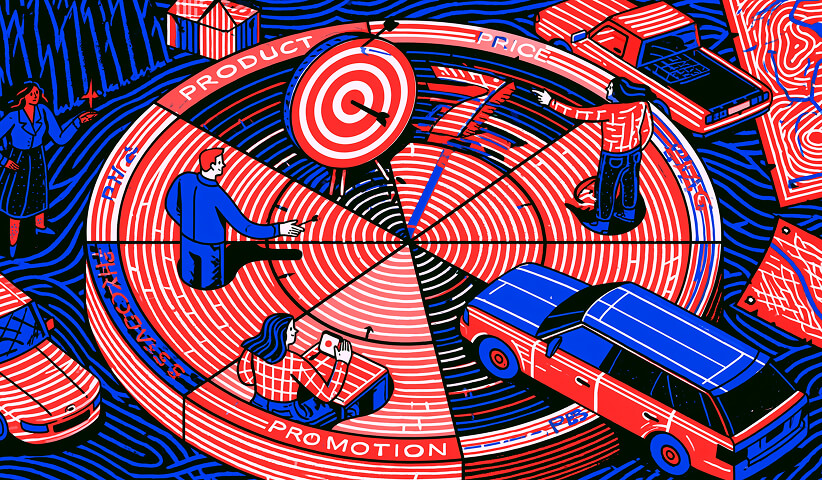
The marketing mix bridges strategy and execution. The 4 Ps are product, price, place, and promotion. For services, extend to 7Ps by adding People, Process, and Physical Evidence. The marketing mix includes product, price, place, and promotion as its foundational elements, and each must align with your broader brand strategy framework.
Premium pricing supports luxury brand positioning. Direct distribution supports a controlled customer experience. Every element of the mix must tell the same story. Consistency in messaging enhances brand recognition and positioning across all touchpoints.
Starbucks customizes its product offerings, store layouts (place), local promotions, and tiered pricing across markets-all while maintaining a consistent brand experience. Netflix adjusts pricing and promotion across countries but keeps its core value proposition of unlimited, personalized entertainment. These brands demonstrate that the marketing mix is where your products or services meet your target audience in practice.
Stage 6: Resource Allocation, Budgeting, and Prioritization
Even the best marketing strategies fail without disciplined resource allocation. Marketing budget allocation is based on potential return on investment (ROI), and strategic marketing improves resource allocation efficiency by 30%. As AI-generated content scales, using a consistent marketing prompt structure helps teams get more reliable, on-brand outputs for the channels they fund.
Translate strategic priorities into concrete budget splits. A common framework: allocate roughly 60% to always-on foundational programs (brand building, content marketing, product quality) and 40% to experimental or campaign-based marketing initiatives. Use portfolio thinking-invest more in high-potential products, segments, and market opportunities while pruning underperforming ones.
Link marketing budgets to revenue targets, CAC/LTV expectations, and ROI thresholds. Email marketing returns $36–$42 for every $1 spent in many sectors, while paid social returns approximately $1.75. These benchmarks should inform where you concentrate your marketing resources for maximum impact.
Stage 7: Implementation Planning and Governance
Convert your strategic marketing plan into a 12-month or 24-month roadmap with milestones and clear ownership. A simple cadence might look like: Q1 for research and planning, Q2 for campaign launches and market development, Q3 for optimization based on early data, Q4 for evaluation and planning for next year.
Cross-functional alignment is crucial for strategic marketing success. Strategic marketing fosters alignment across sales, product, and operations teams through shared dashboards, joint planning sessions, and integrated metrics. Governance mechanisms-quarterly strategy reviews, monthly performance meetings, campaign approval workflows-keep execution on track.
Measurement, KPIs, and Optimization in Strategic Marketing

Monitoring key performance indicators is crucial for analyzing marketing effectiveness. Key performance indicators KPIs measure progress toward marketing goals and close the strategic marketing process loop. Performance measurement is essential to determine if objectives are achieved.
Strategic KPIs include market share changes, customer lifetime value, brand awareness, Net Promoter Score, channel ROI, and retention rates. Tactical metrics like click-through rates and impressions matter too, but they shouldn't be confused with strategic marketing performance. Effective strategic marketing leads to higher customer lifetime value by 25%, especially when paired with a regular strategic brand audit to uncover gaps and opportunities.
Data-driven insights should guide strategic marketing decisions. Consider an e-commerce retailer that analyzed 2024–2025 campaign data using multi-touch attribution and discovered that content marketing drove 40% of assisted conversions despite generating modest direct clicks. That insight reshaped its 2026 marketing strategy, shifting budget from paid social to content and SEO-a decision that only strategic measurement could reveal.
Integrating Content Marketing into Strategic Marketing Development
Content marketing should be embedded into the strategic marketing plan as a long-term asset, not treated as isolated blog posts. Tie content themes to target personas, buyer journey stages, and competitive positioning. Educational content works for complex B2B products; lifestyle storytelling and brand marketing campaigns resonate with consumer brands.
In 2026, effective content formats include SEO blog hubs, YouTube series, LinkedIn thought leadership, podcasts, interactive tools, and AI-assisted personalization, often led by specialized roles like an AI content strategist. About 85% of marketing teams now use generative AI for content creation and personalization, and 93% of CMOs report strong ROI from those investments.
Measure the strategic impact of content through lead quality, assisted conversions, and brand lift-not just surface metrics like page views.
Strategic Marketing in Practice: Examples from Leading Brands
Tesla built a market development strategy around innovation, sustainability, and direct distribution. With virtually zero traditional advertising spend, Tesla relies on product launches, media coverage, and its founder's public presence. Its Supercharger network and vertical integration in battery technology create switching costs for customers and barriers for competitors. Brand value reached approximately $71.9 billion in 2024.
Patagonia demonstrates that purpose-driven strategic marketing helps create lasting competitive advantage. By consistently donating 1% of sales to environmental causes and maintaining activism even during unprofitable periods, Patagonia commands premium pricing and exceptional customer loyalty among eco-conscious consumers.
Unilever aligned its multi-brand portfolio-Dove, Knorr, Hellmann's-around environmental and social performance through its Sustainable Living Plan. The longevity and operational depth of that commitment builds credibility in a market increasingly skeptical of surface-level sustainability claims.
For smaller companies, the lesson is clear: you don't need Tesla's budget to build a successful marketing strategy. You need consistency, a clear positioning, and the discipline to align every marketing program with your strategic marketing plan.
Strategic Marketing Development for Different Business Sizes
The strategic marketing process applies regardless of company size, but the level of formality scales appropriately.
Small businesses (1–50 employees) should focus on one to two segments, build a lean marketing plan, and choose a narrow channel mix-perhaps SEO, email, and one social media platform-with clear key performance indicators. Simplicity is the advantage here.
Mid-market firms (50–500 employees) benefit from introducing formal market research, multi-segment strategies, structured resource allocation, and a dedicated marketing program with defined marketing objectives across channels.
Large enterprises require cross-country coordination, portfolio management across product lines, advanced analytics tools, and a diversification strategy for entering new markets. The challenge is avoiding bureaucracy and maintaining speed of adaptation-strategic marketing management at scale demands governance without gridlock.
Common Strategic Marketing Challenges (and How to Overcome Them)
Most organizations struggle not with planning but with consistent execution and adaptation. Here are five frequent issues:
Insufficient market research. Teams rely on internal assumptions and past success instead of validated data. The fix: budget for external business research, customer interviews, and social listening. Conduct market research regularly, not just at planning time.
Strategy-execution gap. A polished strategic marketing plan sits in a slide deck while teams default to old habits. Counter this with roadmaps, clear accountability, milestones, and quarterly reviews.
Siloed teams. Marketing operates disconnected from sales, product, and finance. Joint planning, integrated metrics, and shared dashboards break down walls.
Short-termism. A SaaS firm over-rotates to paid ads chasing quarterly lead targets while ignoring long-term brand building. Balance the scorecard: dual-track budgets covering core programs and experimental campaigns, with long-term KPIs built into evaluation.
Underinvestment in measurement. Only about 28–36% of marketers have robust systems to measure ROI across channels. Invest in multi-touch attribution, marketing mix modeling, and AI-powered analytics to close this gap.
Best Practices for Successful Strategic Marketing Development
Customer-centricity should guide every decision. Build strategies around buyer personas, journey maps, and emotional drivers-not internal assumptions about what potential customers want.
Use data-driven insights at every stage. Combine first-party data, external reports, and predictive modeling to identify target audiences and validate positioning. Continuous market research enables proactive adaptation to market changes rather than reactive scrambling.
Maintain strategic consistency over years. Consistent brand messaging reinforces brand identity and value, even as tactics evolve. Don't clone competitors-authentic voice is more defensible.
Balance experimentation with core programs. Allocate a portion of budget to testing new marketing channels, social media platforms, and content formats while protecting investment in proven marketing campaigns, including next-generation AI creative services that blend automation with human-led design and storytelling.
Align marketing strategy with company vision and mission. Document decisions in an accessible strategic marketing plan that the entire organization can reference.
Institutionalize learning loops. Post-campaign reviews, annual strategy retrospectives, and competitor analysis should feed directly into planning so your marketing strategy evolves rather than resets each year.
How to Build Your Own Strategic Marketing Plan in 10 Steps
Creating a marketing strategy involves a structured sequence of decisions tied to business goals, research, targeting, and execution:
- Define business goals. Clarify what business success looks like for the next 12–24 months-revenue, market share, new market entry, customer retention.
- Conduct situational analysis. Run a swot analysis and PESTEL scan to understand your existing market and competitive landscape.
- Conduct market research. Gather internal data (CRM, web analytics) and external reports to validate assumptions about customer preferences.
- Identify target audiences. Use STP to segment your market and select two to three priority segments with clear personas.
- Craft positioning and value proposition. Define how your products or services are different, better, and relevant to your target audience.
- Design your marketing mix. Map product, price, place, and promotion decisions to your positioning. Ensure consistency across all elements.
- Set marketing objectives and KPIs. Establish SMART goals that help track marketing progress and adjustments across key performance indicators.
- Allocate budget and resources. Split your marketing budget by channel, initiative, and segment based on expected ROI.
- Build an implementation roadmap. Create a 12-month timeline with milestones, ownership, and governance checkpoints.
- Launch, measure, and optimize. Execute your marketing campaigns, track marketing performance against KPIs, and refine based on results.
Set a realistic timeline of four to eight weeks for completing your first strategic marketing plan, then iterate annually.
Adapting Your Strategic Marketing Plan Over Time
A strategic marketing plan should be a living document, not a static artifact. Review it quarterly at the KPI level, conduct semi-annual strategic check-ins, and perform a full refresh every 12–24 months.
Triggers for revisiting the strategy include major regulatory shifts, new competitors entering your market, significant technology changes like generative AI adoption, or consistent performance shortfalls against marketing objectives. Successful strategies require this kind of ongoing attention.
Consider how many retailers successfully pivoted from offline to digital-first marketing during 2020–2022 without losing brand coherence-by updating their market development strategy while keeping their core positioning intact. That's the model: evolve the how while protecting the why.
Conclusion: Turning Strategic Marketing Development into a Competitive Habit
Strategic marketing development is an ongoing capability, not a one-time project. The organizations that treat it as a continuous discipline-anchored in thorough market research, clear positioning, disciplined resource allocation, and honest measurement-build resilient brand equity and achieve business goals more consistently.
Start small. A simple SWOT, a clear unique value proposition, and a focused marketing mix are enough to create a marketing strategy that outperforms improvisation. Then build sophistication over 12–24 months by adding formal customer segmentation, advanced analytics, and cross-functional governance.
Looking ahead, data, AI, and evolving customer expectations will reward companies that make strategic marketing a habit. An effective marketing strategy isn't about predicting the future perfectly-it's about building the systems that let you adapt faster and more intelligently than your competitors. That's how a successful market development strategy becomes the foundation for sustainable growth and long term success.
Frequently Asked Questions About Strategic Marketing Development
The following questions address common, practical concerns not fully covered in the sections above.
How often should a strategic marketing plan be updated?
Most organizations should review their strategic marketing plan quarterly at the KPI level and perform a deeper refresh every 12 months. High-volatility industries like tech and digital services may need semi-annual strategic reviews, while companies in stable sectors can sometimes extend to 18–24 months between full overhauls. Link your updates to major events-market entries, product launches, or significant performance gaps. The goal is to keep your plan responsive without creating planning fatigue.
What is a realistic marketing budget for a growing company?
Budget levels vary by growth stage and sector, but growth-oriented companies often invest 5–15% of projected annual revenue in marketing. Startups seeking rapid growth may invest 12–20%, while mature firms focused on efficiency typically allocate closer to 5–8%. Gartner's 2025 data shows the average at 7.7%, with 59% of CMOs saying that isn't enough. Split your budget between brand-building and performance marketing, and adjust allocations based on measured ROI and your overall business objectives.
How does strategic marketing differ for B2B and B2C companies?
B2B strategic marketing typically involves longer buying cycles, multiple decision-makers, and emphasis on account-based marketing, thought leadership content, and customer relationships built over months. B2C strategies focus more on emotional branding, mass reach, and higher-frequency purchases through marketing channels like social media, retail, and marketplaces. However, both require a structured strategic marketing process, clear competitive positioning, consistent measurement, and a documented effective market development strategy-even when the specific marketing tactics differ significantly.
What are the first three steps if we have no formal marketing strategy today?
Start with a quick situational analysis: a mini-SWOT and brief competitor scan to understand your current position. Then define two to three clear business and marketing objectives for the next 12 months-whether that's revenue growth, lead generation, or retention improvements. Finally, identify one to two priority target segments and draft a basic value proposition before expanding into a full strategic marketing plan. Even these three steps put you ahead of the majority of companies operating without a documented strategy.
Which tools are most useful for managing the strategic marketing process?
Think in categories rather than specific products. You need analytics platforms (Google Analytics 4, CRM dashboards) for tracking marketing performance. Project management tools (Asana, Trello, Monday.com) keep implementation on schedule. Marketing automation platforms (HubSpot, Mailchimp) handle execution at scale across social media management, email, and beyond. Choose tools that integrate well so data flows across sales, marketing, and finance. Most importantly, remember that tools should support-not replace-the underlying strategic thinking, market research, and planning disciplines that drive a successful marketing strategy.

Quincy Samycia
As entrepreneurs, they’ve built and scaled their own ventures from zero to millions. They’ve been in the trenches, navigating the chaos of high-growth phases, making the hard calls, and learning firsthand what actually moves the needle. That’s what makes us different—we don’t just “consult,” we know what it takes because we’ve done it ourselves.
Want to learn more about brand platform?
If you need help with your companies brand strategy and identity, contact us for a free custom quote.
We do great work. And get great results.
+2.3xIncrease in revenue YoY
+126%Increase in repurchase rate YoY




+93%Revenue growth in first 90 days
+144% Increase in attributed revenue




+91%Increase in conversion rate
+46%Increase in AOV




+200%Increase in conversion rate
+688%Increase in attributed revenue