The Perfect Marketing Prompt in 2026: A Simple 5-Part Structure That Actually Works
03/04/2026
Marketing Strategy / Technology
Learn the simple 5-part marketing prompt structure high-performing teams use in 2026 to generate reliable, brand-aligned AI outputs that scale across campaigns, channels, and teams. Marketing AI prompts have emerged as a key innovation for marketing teams in 2026, helping streamline workflows and boost creativity.
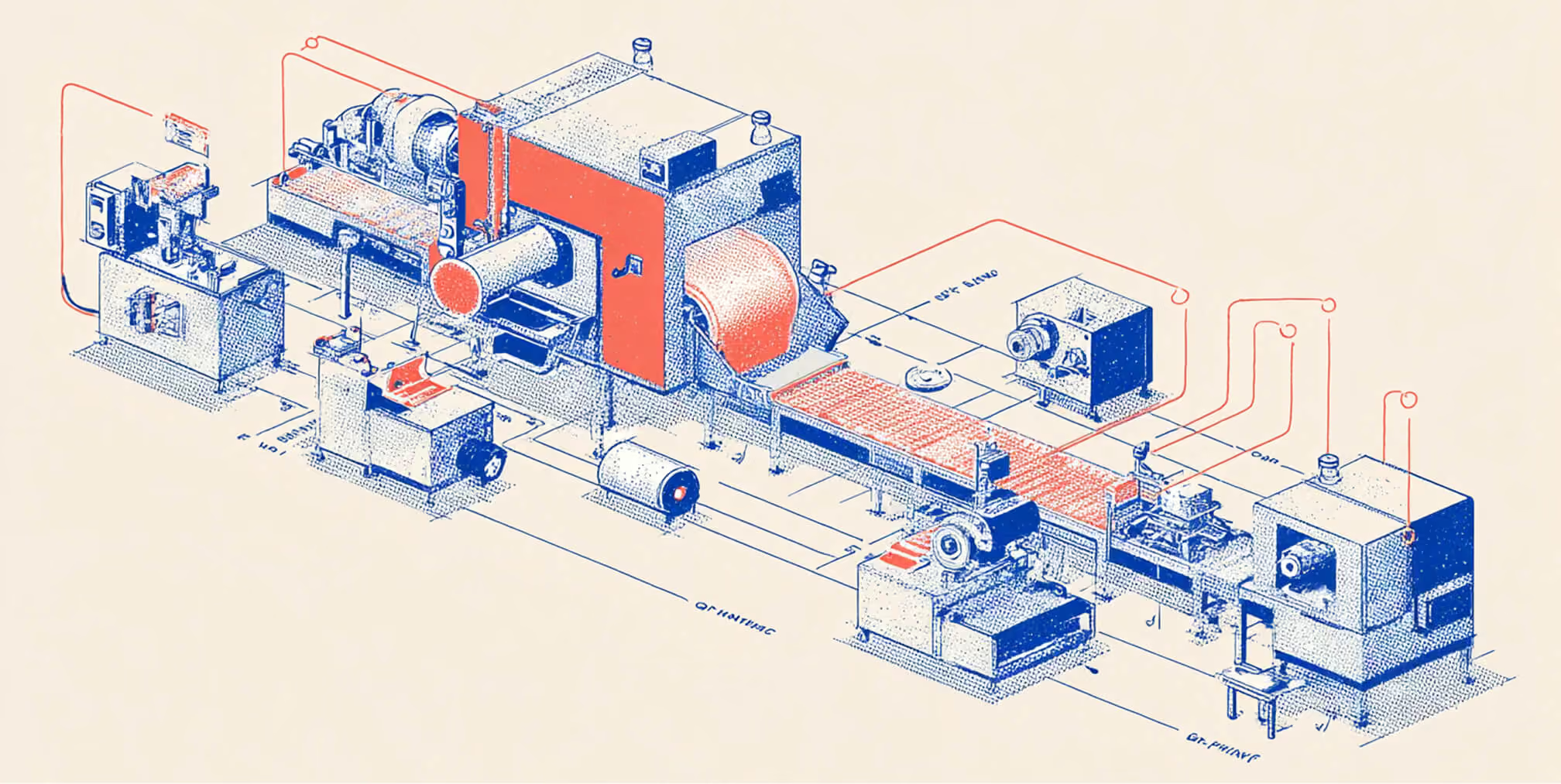
A durable way to get reliable, on-brand outputs from AI—across tools, teams, and workflows, ChatGPT is a powerful tool for marketing teams looking to enhance efficiency and creativity. About 77% of marketers already use AI to some degree in their tasks, and this number is expected to grow as more marketing teams integrate AI into their processes.



Why Structure Beats Cleverness in AI Prompting



By 2026, prompting is no longer a novelty skill or something handled by a single “AI person” on the team.
It’s now embedded in:
- content production
- campaign planning
- brand development
- research and synthesis
- experimentation and optimization
The problem most teams face isn’t access to AI—it’s inconsistency. Outputs vary wildly depending on who wrote the prompt, which tool they used, and how much context happened to be included. Using ai prompts helps streamline marketing workflows by automating repetitive tasks, reducing manual effort and improving consistency across teams.
High-performing teams solve this with structure, not clever phrasing.
The most reliable prompts in 2026 follow a simple, repeatable five-part structure—because it mirrors how good marketing work has always been briefed.
Why structure matters more than cleverness in 2026
Modern AI models are powerful, but they still depend on human input to:
- frame the problem
- set priorities
- define boundaries
- signal what “good” looks like
Without structure, models default to:
- generic language
- safe averages
- over-explanation
- brand drift
This happens regardless of the platform.
The solution isn’t longer prompts—it’s better-designed prompts. Effective ChatGPT prompts are structured to generate valuable marketing content, such as social media posts, email subject lines, and ad copy, by ensuring the AI produces clear, specific, and creative responses.
Free Brand Health Audit
Make sure your brand is built to sell
Search has changed. Your customers aren't just Googling anymore. They're asking ChatGPT, Perplexity, Gemini and other AI platforms what to buy, who to trust and which brands they should consider.
If your brand isn't showing up clearly in those answers, you're already losing opportunities. Our free Brand Health Audit shows you where your brand stands across traditional search, AI search and brand positioning.

Sample brand audit
Live preview
Traditional search
72
AI search (GEO)
34
Brand positioning
58
Why structure matters more than cleverness in 2026


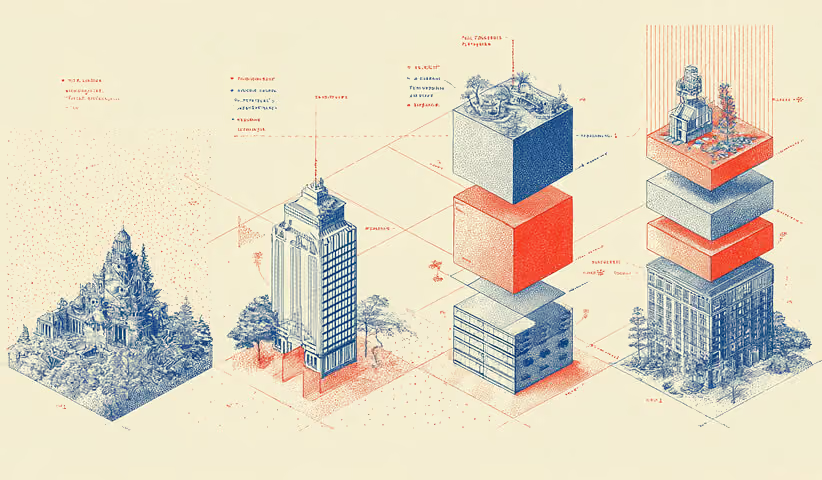

This structure works because it reduces ambiguity at every decision point the model has to make. Structured prompts support better decision making and data driven decision making in marketing by ensuring that AI tools can analyze data efficiently and provide actionable insights. AI helps marketers analyze large volumes of data to identify customer behaviors and preferences, leading to more effective marketing strategies. Data-driven decision making is crucial for effective marketing optimization, as it allows teams to identify trends and act on insights, combining customer feedback with sales data for better campaign performance.
Market Research and Analysis: The Foundation of Effective Prompts
Before you can create prompts that truly move the needle in your marketing efforts, you need a deep understanding of your target audience. Market research and analysis are the bedrock of effective prompts for marketing—without them, even the most sophisticated AI tools will generate content that misses the mark.
By investing in thorough market research, marketing teams can uncover what motivates their audience, what pain points they experience, and what language resonates with them. This insight allows you to craft prompts for marketing that are not only relevant but also highly engaging, ensuring your messaging stands out in a crowded digital landscape.
Effective market research goes beyond surface-level demographics. It dives into user behavior, purchase history, and engagement patterns across marketing channels. By analyzing this data, you can identify the topics, formats, and tones that will best connect with your audience—whether you’re planning a new blog post, launching a product, or optimizing your social media marketing strategy.
In 2026, the most successful marketing teams treat market research as a continuous process, using it to inform every stage of prompt development and content creation. This approach ensures that every prompt is grounded in real audience insights, driving better results across all your marketing camp
Gathering Customer Feedback for Prompt Precision
Customer feedback is one of the most valuable resources for refining your marketing strategy and ensuring your prompts deliver results. By actively collecting and analyzing feedback, you gain direct insight into what resonates with your audience—and what doesn’t.
AI tools now make it easier than ever to sift through large volumes of customer feedback, extracting key benefits and recurring themes that can inform your next round of content creation. Whether you’re writing ad copy, crafting compelling meta descriptions, or developing new campaign messaging, this feedback loop helps you continuously optimize your marketing efforts.
For example, if customers consistently mention a specific feature as a reason for their purchase, you can highlight that benefit in your ad copy or meta description to boost conversions. Similarly, negative feedback can reveal areas where your messaging may be unclear or misaligned with audience expectations, allowing you to adjust your prompts for greater precision.
By integrating customer feedback into your prompt development process, you ensure that your marketing materials are always evolving to meet the needs and preferences of your target audience—leading to more effective campaigns and stronger brand loyalty.
Conducting Market Research to Inform Your Prompts
Market research is not just a one-time task—it’s an ongoing process that fuels every aspect of your marketing strategy. By leveraging predictive analytics and AI-driven insights, marketers can identify emerging trends, key features, and unique selling points that truly matter to their target audience.
Conducting thorough market research allows you to segment your audience into distinct groups based on demographics, previous purchases, browsing history, and engagement patterns. This segmentation enables you to create highly targeted chatgpt prompts that speak directly to each group’s interests and needs, resulting in more personalized and effective marketing campaigns.
For instance, analyzing market trends can reveal which product features are gaining traction, allowing you to highlight these in your ad copy or social media post. Predictive analytics can also help you anticipate shifts in user behavior, so you can proactively adjust your prompts and content strategy to stay ahead of the competition.
By grounding your prompt development in robust market research, you empower your marketing team to generate ideas that resonate, plan campaigns with confidence, and create marketing materials that drive engagement and boost conversions. In 2026, the best chatgpt prompts are those informed by real data—ensuring your marketing efforts are always one step ahead.
1. Role — Who the model should act as
Defining a role shapes:
- tone
- level of strategic thinking
- vocabulary
- confidence of recommendations
Without a role, the model behaves like a general assistant. With one, it behaves like a collaborator.
Example
“Act as a senior growth marketer for a B2B SaaS company.”
Use roles that imply judgment and responsibility, not just expertise.
2. Task — What you want produced (precisely)
Avoid vague instructions.
Strong tasks:
- name the deliverable
- imply quality expectations
- reflect the stage of work
Weak
“Help me with messaging.”
Strong
“Draft three positioning directions for a new analytics product entering a crowded market.”
This tells the model what kind of thinking is required—not just what to write.
3. Target Audience & Context — Who it's for and what they already know
In 2026, audiences are more informed, more skeptical, and more fatigued by generic marketing language.
Effective prompts specify:
- who the audience is
- what they already understand
- what they’re skeptical of
- what emotional or situational context they’re in
Example
“Audience: operations leaders at mid-market companies who have already tried multiple tools and are wary of exaggerated claims.”
This single section dramatically changes the output’s relevance.
4. Constraints — The rules that prevent generic output
Constraints are the most powerful—and most overlooked—part of prompting.
They:
- reduce fluff
- eliminate hedging
- protect brand voice
- speed up review cycles
High-impact constraints include:
- word or character limits
- banned phrases
- tone boundaries
- claim restrictions
- structural rules
Example
“Constraints:
– Max 100 words
– No buzzwords or hype language
– Avoid fear-based framing
– Assume a skeptical reader
– Short sentences only”
In 2026, constraints function as brand and quality guardrails, not creative limitations.
5. Output Format — How the response should be delivered
Even strong content fails if it’s hard to use.
Explicit formats turn AI output into something teams can immediately act on.
Examples
- “Provide 10 headline options grouped into 3 themes.”
- “Return a table with columns for message, audience insight, and rationale.”
- “Give three versions: conservative, balanced, bold.”
This step alone often cuts revision time dramatically.
Want to learn more about AI and Marketing? Keep reading!
If you need help with your company’s branding and marketing, contact us for a free custom quote.
A complete example prompt (assembled)

Role: Act as a senior brand strategist for B2B software companies.
Task: Generate homepage headline options for a workflow automation platform.
Audience & Context: Operations leaders at growing companies who are overwhelmed by tools and skeptical of efficiency claims.
Constraints:
– Headlines under 8 words
– No jargon or acronyms
– Avoid “AI-powered,” “revolutionary,” or “game-changing”
– Emphasize clarity and control
Output Format:
– 12 headline options
– Grouped into 3 strategic angles
– Include a one-line rationale for each angle
Including a clear call to action in your marketing prompt is essential to drive user engagement and encourage your audience to take the next step, such as making a purchase or signing up for more information.
When creating content, starting with a blog outline helps organize your main points, ensures all key elements—including a call to action—are covered, and improves readability. Structuring your content around target keywords not only enhances SEO but also increases your visibility in search engine results. In fact, creating a structured outline for a blog post, including an introduction, key points, and a call to action, can significantly enhance SEO by organizing content around target keywords.
This doesn’t guarantee perfection—but it consistently produces usable work.
Why this structure still holds up in 2026
Despite rapid advances in models and interfaces, three things remain true:
- AI still optimizes for what you specify
- Ambiguity still produces generic output
- Scale increases risk without guardrails
This structure works because it:
- is tool-agnostic
- mirrors existing marketing briefs
- distributes prompting safely across teams
- reduces dependence on individual “prompt talent”
While the structure is tool-agnostic, choosing the appropriate AI model, such as ChatGPT's o3 model, can further improve the quality of marketing prompt outputs by generating more customized and relevant content.
It’s durable because it’s conceptual, not tactical.
How teams use this structure and AI tools at scale in 2026
Mature teams don’t rewrite this structure every time.
They:
- standardize Role and Audience blocks by brand or segment
- reuse Constraints by channel (ads, email, site, SEO)
- vary only the Task and Output Format
This turns prompting into an operational system, not an individual skill. By systematizing prompts, teams can efficiently streamline marketing tasks such as campaign planning, content creation, A/B testing, and market research.
In 2026, this matters because prompting is done by:
- marketers
- strategists
- designers
- product teams
- leadership
Structure creates consistency without slowing teams down.
Common content creation mistakes (even with a good structure)
- Overloading every prompt with unnecessary detail
- Forgetting to update audience context as strategy evolves
- Treating constraints as optional
- Expecting first outputs to be final
The structure works best when it’s edited thoughtfully, not blindly reused.
How this fits into the series
- Blog 1: The Ultimate Guide to Prompting for Marketing & Branding
- Blog 2: Why Marketing Prompts Break Down in Practice
- Blog 4: Role-Based Prompting: How to Get AI to Think Like a Marketer
- Blog 5: How to Prompt for Brand Voice, Tone, and Messaging
- Don't miss our latest blog post, which highlights the importance of content promotion and distribution to maximize the visibility and engagement of your new blog articles and ebooks.
Those posts go deeper into individual components of the structure.
The takeaway

In 2026, great prompting isn’t about tricks.
It’s about briefing clearly, constraining intelligently, and designing for scale.
When you consistently define:
- who the AI is
- what it’s doing
- who it’s for
- what rules it must follow
- how the output should look
A well-structured marketing prompt is essential for effective marketing, especially when integrated into a comprehensive marketing plan that targets your audience strategically. Ai prompts are now integral to successful marketing plans, helping teams generate ideas, personalize content, and automate tasks for greater efficiency. By aligning AI tools and ai prompts with specific marketing objectives and key performance indicators (KPIs), you ensure your marketing strategies drive meaningful impact—improving customer engagement and increasing conversions.
AI stops feeling unpredictable—and starts behaving like a reliable part of your marketing system.

Quincy Samycia
As entrepreneurs, they’ve built and scaled their own ventures from zero to millions. They’ve been in the trenches, navigating the chaos of high-growth phases, making the hard calls, and learning firsthand what actually moves the needle. That’s what makes us different—we don’t just “consult,” we know what it takes because we’ve done it ourselves.
Want to learn more about brand platform?
If you need help with your companies brand strategy and identity, contact us for a free custom quote.
We do great work. And get great results.
+2.3xIncrease in revenue YoY
+126%Increase in repurchase rate YoY




+93%Revenue growth in first 90 days
+144% Increase in attributed revenue




+91%Increase in conversion rate
+46%Increase in AOV




+200%Increase in conversion rate
+688%Increase in attributed revenue