Brand Building: A Practical Guide to Creating a Strong, Consistent Brand
08/11/2026
Branding
Build a brand that stands out, earns customer trust, and compounds business growth with a practical framework for strategy, identity, positioning, and execution.
Brand building is not something that happens overnight. It's the deliberate, ongoing process of shaping how people think and feel about your company through strategy, identity, and marketing. Whether you're launching a new brand or refining an existing one, this guide walks you through the entire process with practical steps you can act on right away.
.png)


What Brand Building Really Means


Key Takeaways
- Brand building is a long-term process that combines brand strategy, brand identity, and ongoing marketing campaigns to shape how a target audience perceives a business. Successful brand building includes a clear mission and consistent visual identity.
- Clarity on your target audience, brand positioning, and brand story should come before logos, colors, or taglines. Strategy first, visuals second.
- Brand consistency across all customer touchpoints (website, social media, email, phone, in-store, support) is what turns a recognizable brand into a successful brand with loyalty and equity.
- Even a small business can build a powerful brand by following a simple brand development process: research, define, design, document, then execute and refine.
- Strong brand governance through guidelines, templates, and simple rules keeps marketing teams and partners aligned as the brand scales.
What Is Brand Building? (And What It Isn't)
Brand building is the deliberate, multi-year process of shaping how people think and feel about your company. It combines strategy, identity, and marketing execution into a coherent system. It's not just a logo. A brand exists in the minds of your customers, while branding is the toolkit you use to shape that perception.
Consider Apple in 2025–2026: its brand conveys premium innovation. That perception comes not from one element, but from consistent product naming, minimalist packaging, pristine store layouts, and a confident brand voice. Compare that to a generic laptop maker using similar specs but lacking strategic positioning or emotional connection. A strong brand identity helps differentiate from competitors in exactly this way.
The three main components:
- Brand strategy - your purpose, vision, values, and positioning. Brand strategy defines how a company should look and behave.
- Brand identity - your visual elements, voice, and messaging. Brand identity includes visual assets and messaging elements.
- Brand marketing - how you communicate and execute campaigns, content, and customer experiences across channels.
Why Brand Building Matters in 2026
Digital markets are more crowded than ever. Thousands of DTC brands compete on Instagram and TikTok, SaaS tools launch weekly, and consumers have less patience for brands that feel unclear or inauthentic. A significant majority of business professionals agree that brand awareness marketing is critical for long-term success, and that trend is accelerating.
Strong branding helps establish a business as a legitimate entity. A strong brand can drive trust and easier customer acquisition by reducing the friction that comes with unfamiliarity by directly influencing customer behaviour. Consider a small e-commerce brand focused on sustainability: by maintaining consistent messaging around eco-friendly packaging, carbon offsets, and product stories across every social media channel, it grew through repeat purchases and word-of-mouth rather than heavy ad budgets.
Key business benefits of building a brand are backed by data that shows why branding by the numbers is so powerful:
- Companies with strong brand strategies see a 23% revenue increase compared to those with inconsistent presentation.
- 57% of customers spend more with brands they feel loyal to, making customer loyalty a direct revenue driver.
- Lower customer acquisition cost through trust and recognition.
- Higher customer lifetime value as existing customers return and refer.
- Resilience during economic turbulence: brands that held consistent identity during 2022–2023 inflation maintained margins better.
Free Brand Health Audit
Make sure your brand is built to sell
Search has changed. Your customers aren't just Googling anymore. They're asking ChatGPT, Perplexity, Gemini and other AI platforms what to buy, who to trust and which brands they should consider.
If your brand isn't showing up clearly in those answers, you're already losing opportunities. Our free Brand Health Audit shows you where your brand stands across traditional search, AI search and brand positioning.

Sample brand audit
Live preview
Traditional search
72
AI search (GEO)
34
Brand positioning
58
Clarify Your Core: Purpose, Vision, and Brand Strategy


Effective brand building starts with a clear brand strategy. Before touching a single design element, define why your company exists, what future it's building toward, and how it will win. A clear brand strategy helps differentiate from competitors. Brand strategy involves identifying target demographics and goals, then translating those into guardrails for every decision.
- Purpose - the problem you exist to solve. Not "we sell coffee" but "we make ethically sourced coffee accessible to every neighborhood." Your brand's purpose is the anchor for everything else.
- Vision - where you aim to be by a specific year. Example: "By 2030, become the most trusted sustainable beverage brand in the US." This makes your mission statement concrete and measurable.
- Values - 3–5 non-negotiable behaviors (e.g., transparency, craftsmanship, inclusion). Shared values are the primary reason for brand relationships for 64% of consumers, so these aren't just internal slogans; they sit alongside other core brand pillars that keep your identity coherent over time.
These elements become decision filters. When a partnership opportunity or marketing campaign comes up, ask: does this align with our purpose, move us toward our vision, and reflect our brand values? If not, pass.
Define Your Target Audience: Finding Your "Right" Customers
"Everyone" is not a target audience. Trying to appeal to all people dilutes your brand positioning and weakens your marketing messaging. Identifying your target audience is crucial for brand building because focus improves every downstream decision.
Practical steps to find your right customers:
- Analyze existing customers: who buys most, who stays longest, who refers others? Your current data is your best starting point.
- Use customer surveys to understand your target market demographics. Even a simple 5-question survey reveals patterns you'd miss otherwise.
- Review support tickets and online reviews to understand audience pain points, which enhances brand connection.
- Create 2–3 buyer personas. Buyer personas should include age, location, and income details, plus role, needs, and media habits. For example: "Maya, 32, product manager in Austin, earns $95K, spends time on LinkedIn and podcasts, needs tools that simplify team collaboration."
- Specific targeting helps create messaging that resonates with audiences. Knowing Maya exists helps you write copy she actually cares about.
Connect this research to later decisions: your brand voice, content marketing topics, and channel selection (LinkedIn for B2B professionals like Maya, TikTok for Gen Z consumers) all flow from audience clarity.
Craft Distinctive Brand Positioning
Brand positioning is the unique place your brand occupies in the customer's mind compared with competitors in the same industry. It's not what you say about yourself; it's the mental shortcut people use when deciding between you and alternatives, and mastering brand positioning gives those shortcuts a clear, intentional shape.
Use this simple positioning formula:
"For [target audience], [Brand] is the [category] that [key benefit] because [reason to believe]."
Example: "For eco-conscious young professionals, GreenSip is the beverage brand that provides refreshment without environmental harm because every bottle is made from 100% recycled materials."
How to craft and pressure-test your statement:
- Identify 1–2 core differentiators. Don't list ten benefits. Pick the ones you can consistently deliver that competitors can't easily copy.
- Test against real competitors. If your positioning statement could describe three other companies in the same way, it's not specific enough.
- Validate with actual customers. Ask your target market: "When you think of us, what comes to mind?" If the answer doesn't match your positioning, iterate.
Build a Brand Story That Actually Resonates
A brand story is more than a founder bio on your About page. It's a narrative that links your audience's problem, your brand's origin, and your mission into an emotional arc. A strong brand story explains why your brand exists and gives people a reason to care.
Authentic storytelling creates emotional connections with customers. In fact, 64% of consumers want brands to connect with them emotionally, and compelling brand stories connect emotionally with customers more effectively than any product feature list.
Simple story structure to follow:
- Problem in the world - ground it in a specific moment. "During the 2020 lockdowns, our founder watched local supply chains collapse while food waste skyrocketed."
- Founder insight - the turning point. "She realized neighborhoods needed hyper-local sourcing, not bigger warehouses."
- Promise to the customer - "Taste with integrity. Every product sourced within 50 miles."
- Impact - "Happier farmers, less waste, fresher food."
A compelling brand story can differentiate you from competitors. Storytelling can enhance customer loyalty and engagement when repeated consistently across your website About page, pitch decks, social media bios, investor documents, and recruitment materials.
Design an Authentic Brand Voice and Tone
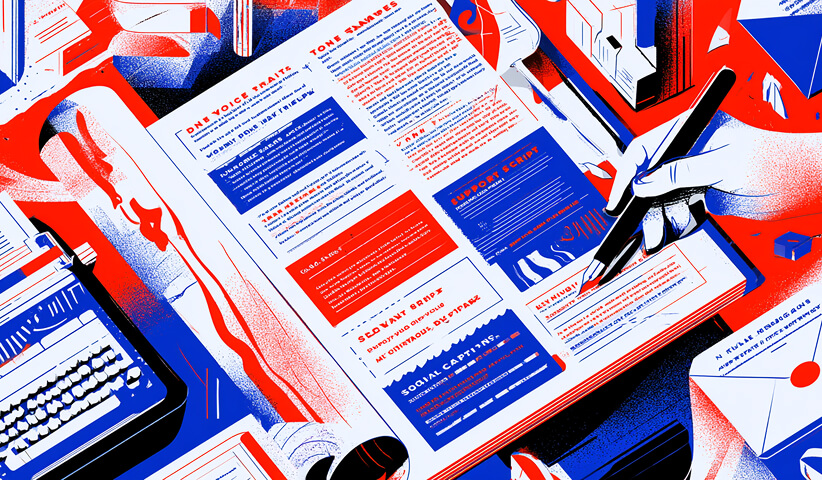
Your brand voice is the consistent way your brand speaks (its personality), while tone is how that voice adjusts to context. A support email sounds different from an Instagram caption, but both should feel unmistakably like your brand, which is why step-by-step brand voice guidelines are so useful.
Brand voice should align with your brand story. Developing a brand voice requires understanding your audience's preferences first, then translating those insights into specific traits.
- Define 3–5 voice traits with do/don't examples. If your brand is "curious, plain-spoken, optimistic": DO say "Here's what we found." DON'T say "Pursuant to our investigation, the results herein suggest..."
- A consistent brand voice increases customer trust and a strong brand voice can differentiate you from competitors.
- Reference real brand voices: Mailchimp's friendly clarity (short sentences, conversational, warm) vs. Apple's confident minimalism (declarative, spare, authoritative).
- Brand voice influences customer engagement across all channels - so your voice guide should support the marketing team, customer support scripts, and even automated touchpoints like chatbots and IVR systems, backed by clear brand tone guidelines.
64% of consumers want brands to connect with them, and voice is one of the most immediate ways to make that connection feel real.
Want to learn more about brand platforms, Brand Strategy and Brand Identity? Keep reading!
If you need help with your companies brand strategy and identity, contact us for a free custom quote.
Translate Strategy into Visual Identity

Visuals should be consequences of strategy, not arbitrary decoration. Your logo design, brand colors, typography, and imagery need to express the brand personality you've already defined. Brand identity involves deciding on colors, logos, and typography that align with your positioning.
Visual identity must be consistently recognizable across platforms. In 2026, tools like Figma, Canva, and AI-assisted generators make execution easier, but they can't replace strategic direction. Effective brand building includes consistent messaging and visual identity working together.
Brand Logo
Your logo is often the first visual brand identity element people encounter. Keep it simple, scalable, and recognizable.
- Prepare multiple formats: full logo (for website headers, letterheads), icon mark (for app icons, social avatars), and wordmark (for minimal contexts).
- Test for grayscale legibility, 16×16 favicon clarity, and visibility on both light and dark backgrounds.
- Define spacing rules and prohibited modifications (no stretching, no unapproved color scheme changes, no drop shadows) to protect brand recognition.
Remember: logo design matters, but a great logo with bad customer experience erodes trust. Your brand is not just a logo.
Typography
Typography carries more personality than most people realize. A limited palette keeps things cohesive.
- Choose 1–2 primary typefaces plus 1 accent font. Example: a humanist sans-serif for body text paired with a serif for headings.
- Define hierarchy: H1, H2, body, captions. Specify minimum sizes and line spacing for accessibility.
- Match type to brand personality: tech startups lean toward geometric sans-serifs; wellness brands may use humanist or serif styles.
- Ensure consistency across web, app, print, and slide decks through your style guide.
Brand Color Palette
Your color palette should align with brand personality and the cultural expectations of your target market.
- Select a primary color, secondary palette (2–3 supporting colors), and neutrals. Deep blues signal B2B trust; earthy greens reinforce sustainability; pastels often work for DTC wellness brands.
- Document HEX, RGB, and CMYK codes for every color. Define accessibility contrast ratios to meet WCAG standards.
- Apply the palette consistently across website, packaging, social posts, and all marketing materials. A small business selling handmade candles, for example, could use warm amber and cream across every touchpoint for instant recognition.
Images and Illustration Style
Consistent imagery reinforces your visual brand identity as much as logos and colors.
- Define 3–5 visual rules: lighting style, color treatment, diversity of people, environments, level of realism.
- Decide between candid vs. staged photography, flat icons vs. 3D renders, hand-drawn illustrations vs. polished vector art. In 2026, hand-made textures and imperfect illustration are trending as a counter to AI-generated perfection.
- Address AI-generated images directly: if using them, apply strict identity constraints so generic AI style doesn't dilute your creative assets.
- Brief photographers and designers with visual examples, do's and don'ts, and reference shots so new visual assets stay on brand.
Systematize Brand Consistency Across Channels
Brand consistency turns one-off impressions into a coherent mental picture. Building trust and authority requires consistent delivery on promises at every customer touchpoint. Consistent brand presentation increases revenue by up to 23%, and inconsistent branding can reduce recognition by roughly 40%.
Primary touchpoints to align:
- Website, product UI, social media channels, email sequences, ads, sales decks, customer support, and offline materials like packaging and signage.
- Create a simple channel checklist covering voice, visuals, and key messages that teams can use before publishing anything.
- Keep automated touchpoints (chatbots, phone scripts, drip emails) aligned with the same brand voice and tone rules.
- Brand consistency helps improve brand recognition across platforms when every interaction reinforces the same way your brand looks and feels.
Effective brand strategies require consistent messaging across channels. This is where brand operations become critical: someone on the team needs to own the checklist.
Create a Practical Brand Kit
A brand kit is a centralized collection of brand assets: logos, fonts, color codes, image examples, and headline snippets that anyone creating materials can access.
What to include:
- Logo files in SVG, PNG, and vector formats, plus a favicon version.
- Webfonts and desktop font files, or links to licensed type libraries.
- Color swatches with HEX/RGB/CMYK values.
- Sample imagery and illustration examples showing approved style.
- Template links for frequent marketing materials: social posts, slide decks, email headers.
- Store everything in a shared drive or DAM (digital asset management tool) that both internal marketers and external partners (freelancers, printers, media buyers) can access.
A brand kit reduces back-and-forth and guesswork in marketing campaigns, especially for small teams scaling quickly.
Write and Maintain Brand Guidelines
Brand guidelines are the single source of truth for how the brand looks, sounds, and behaves. Clear brand guidelines ensure consistent messaging and visuals across every touchpoint. Brand guidelines ensure consistent use of brand identity elements regardless of who creates the content.
Core sections to include (and document clearly in your brand guidelines):
- Brand purpose, positioning, and mission statement.
- Target audience overview with persona summaries.
- Voice and tone rules with do/don't examples.
- Visual identity rules: logo usage, typography, color palette, imagery.
- Examples of correct vs. incorrect use (these are more helpful than rules alone).
- Channel-specific guidance for social media presence, email, print, and campaign messaging.
Keep guidelines concise and example-rich. A dense 80-page PDF that nobody reads is worse than a clean 20-page document everyone follows. Set a review cadence - every 6–12 months - to update as the brand and market evolve.
Plan Brand-Led Marketing Campaigns
Brand building and performance marketing reinforce each other. Some marketing campaigns optimize for awareness and memory (brand), others for direct response (performance). The best marketing strategies blend both.
- Choose 2–3 primary channels based on your target audience. LinkedIn and webinars for B2B; TikTok and Instagram Reels for Gen Z DTC. Don't try everything at once.
- Cohesive branding improves advertising effectiveness and recognition. Even a direct-response ad should use your brand colors, voice, and consistent messaging.
- Simple branded campaign ideas: a 30-day content marketing series, a seasonal email campaign, or a limited-time product drop that emphasizes your brand story visually and verbally.
- Track a small set of KPIs: brand search volume, direct traffic, email signups, repeat purchase rate. These connect brand marketing to more sales over time.
Content Marketing as a Brand-Building Engine
Content marketing - articles, videos, podcasts, newsletters - lets you repeatedly deliver your brand's promise and expertise to the same audience. Investing in valuable content positions the brand as an expert, building trust that ads alone can't replicate.
- Choose formats aligned with resources: weekly blog plus monthly deep-dive guide for B2B; short-form video plus email newsletter for consumer brands.
- Map core brand topics (based on positioning and audience pain points) into a content calendar for 3–6 months.
Example 4-week plan for a B2B SaaS brand:
- Week 1: Blog post addressing top audience pain point.
- Week 2: Short LinkedIn video with a customer story.
- Week 3: In-depth guide (gated for email capture).
- Week 4: Newsletter roundup with industry insights and product update.
Maintain consistent brand voice and visual identity within content, not just on the homepage or in paid ads. This is how you create messaging that sticks.
Internal Brand Building: Turn Employees into Ambassadors
Every customer interaction shapes the brand experience, and many of those interactions happen through employees, not marketing materials. If your team doesn't understand or believe in the brand, customers will notice.
- Include brand story and values in onboarding for every new hire. Make it practical, not a corporate video nobody remembers.
- Create simple playbooks for email signatures, presentations, and the business name usage.
- Share customer stories and wins internally to reinforce what "on-brand" behavior looks like in practice.
- Empower frontline teams (sales, support) with clear brand voice guidelines. This directly improves customer experience and helps build customer loyalty.
- 69% of employees want more ownership in brand development. Give them that ownership through involvement, not just top-down directives.
Brand Building for Small Businesses and Startups
You don't need a Fortune 500 budget to build a powerful brand. A small business or startup can punch above its weight by focusing on clarity and consistency rather than complexity, applying the same principles covered in our guide to branding for small businesses.
- Start with a minimum viable brand kit: 1 logo, 3–4 brand colors, 2 fonts, 3 voice traits, and 1–2 core messages. This is enough to launch with a coherent informal brand that can mature over time, or you can use an all-in-one solution like a small business branding package to accelerate the process.
- Local businesses - a café, a freelance designer, a neighborhood gym - can use social proof, community involvement, and consistent visuals across signage and social media channels to build brand visibility quickly.
- For early-stage companies, product quality and customer support are the fastest drivers of brand equity. Marketing amplifies what already works; it can't fix what's broken.
- Personal branding matters too. Founders who show up consistently on LinkedIn or at local events become extensions of the brand and increase brand visibility organically.
Measure, Learn, and Evolve Your Brand
Brand building is iterative. No brand development strategy survives unchanged after a year of real-world contact with customers. Tracking brand awareness and customer satisfaction metrics is essential for brand improvement.
Simple measurement framework:
- Awareness: brand search volume, direct traffic, social mentions. These tell you if building brand awareness efforts are working.
- Perception: NPS scores, brand surveys, review text analysis. Are people describing your brand the same way you intend?
- Behavior: repeat purchases, referrals, customer journey length. Strong branding helps transition customers from one-time buyers to loyal fans.
Run lightweight brand perception checks yearly or after major campaigns. Adjust messaging, visuals, or channels based on what you learn. For example, the State of Brand Design 2026 report found that evolutionary rebrands (small tweaks guided by data) preserve equity better than radical overhauls.
Common Brand-Building Mistakes to Avoid
- Changing visuals too often - frequent logo or color scheme swaps confuse customers and erode brand recognition. Set a minimum 18-month period before major changes unless driven by strategic need.
- Copying competitors - if your corporate branding looks like everyone else in your category, you've lost before you start. Differentiation is the point.
- Chasing design elements trends that don't fit - adopting retro aesthetics for a tech-forward B2B brand creates a mismatch that harms trust.
- Neglecting internal adoption - brand guidelines that only the marketing team reads will be broken daily by sales, support, and partners.
- Over-focusing on logos instead of experience - a beautiful logo with poor customer support tells people your priorities are wrong.
- Inconsistent brand voice across channels - inconsistent branding can reduce recognition by roughly 40%, directly undermining purchase decisions.
Building Brand Equity Over the Long Term
Brand equity is the financial and strategic value created when customers are willing to pay more, stay longer, and recommend you because of the brand. Building brand equity increases customer recognition and revenue growth. Think of Coca Cola: decades of consistent positioning, emotional storytelling, and product experience created equity that makes its brand name worth more than its physical assets.
Strong branding helps transition customers from one-time buyers to loyal fans. 57% of customers spend more with brands they feel loyal to, which means brand loyalty directly translates into revenue. Consistent brand identity increases customer recognition by 23%, compounding over years.
- Brand equity is built through repeated, positive experiences anchored in a clear brand promise over 3–10+ years.
- It gives you pricing power: customers accept higher prices from a trusted brand.
- It provides resilience during crises: brand managers at companies with high equity navigate downturns better.
- It's an asset in fundraising, M&A, and recruiting. Investors and talent both gravitate toward a brand they recognize and respect.
Step-By-Step Brand Development Process
Here's a practical brand development process you can use as a project checklist:
- Research - audit competitors, survey customers, review market positioning. Output: competitive analysis and audience insights document.
- Strategy - define purpose, vision, values, and target audience. Output: brand strategy brief.
- Positioning - craft and validate your positioning statement. Output: finalized positioning statement.
- Identity design - create logo, color palette, typography, imagery direction, and brand voice. Output: approved logo, palette, and voice traits.
- Documentation - compile brand guidelines and brand kit. Output: guidelines document and shared asset library.
- Rollout - apply identity across website, social media presence, packaging, marketing materials, and all your customer touchpoints. Output: updated channels and templates.
- Optimization - measure awareness, perception, and behavior; refine based on data. Output: quarterly brand health report.
Realistic timeline for small teams: 8–12 weeks for initial brand build, several months for full rollout across all channels. Don't promise overnight transformation. Building a brand is a marathon.
FAQ
How long does it usually take to build a recognizable brand?
Initial brand setup (strategy, identity, guidelines) can take 2–3 months. But noticeable market recognition typically takes 1–3 years depending on your industry, investment level, and how frequently your target market encounters your brand. Consistency and frequency of exposure matter far more than trying to rush the process with a single splashy campaign. A new brand should focus on steady repetition across a few channels rather than sporadic bursts across many.
How much should a small business budget for branding?
You can build a minimum viable brand DIY for a few hundred dollars using tools like Canva and free font libraries. Professional brand strategy and design typically costs several thousand dollars (ranging from $3,000 to $15,000+ depending on scope), and understanding how much branding should cost helps you budget realistically. Prioritize investing in customer research and strategy before sinking budget into visual redesigns or large ad spends. A well-researched strategy with simple visuals outperforms expensive design with no strategic foundation.
When is it time to consider a rebrand or brand refresh?
Common triggers include: entering a new target market, merger or acquisition, major shift in audience demographics, an outdated or confusing identity, or serious reputation issues. Before committing to a full rebrand, run surveys and review perception data to confirm whether genuine gaps exist between how you want to be seen and how customers actually perceive you. Often, a focused brand refresh (updated typography, refined messaging, modernized color palette) achieves the goal without the risk of losing existing brand equity.
Can a strong product succeed without intentional brand building?
Initially, yes. Some products grow through word-of-mouth alone. But deliberate brand building multiplies and stabilizes that growth over time. Competitors with similar products and stronger branding will eventually capture the right customers and outpace an unbranded offering. Brand building makes the difference between a product people buy once and a trusted brand people return to.
What's the difference between brand strategy and marketing strategy?
Brand strategy defines who you are, what you stand for, and how you should be perceived. It shapes your brand name, brand personality, and business strategy at a foundational level. Marketing strategy decides how and where to communicate that positioning to hit specific goals (leads, sales, awareness). Marketing strategies should flow from brand strategy, not the other way around. When the two are misaligned, even the best marketing campaigns will feel disjointed and confuse your audience.

Quincy Samycia
As entrepreneurs, they’ve built and scaled their own ventures from zero to millions. They’ve been in the trenches, navigating the chaos of high-growth phases, making the hard calls, and learning firsthand what actually moves the needle. That’s what makes us different—we don’t just “consult,” we know what it takes because we’ve done it ourselves.
Want to learn more about brand platform?
If you need help with your companies brand strategy and identity, contact us for a free custom quote.
We do great work. And get great results.
+2.3xIncrease in revenue YoY
+126%Increase in repurchase rate YoY



+93%Revenue growth in first 90 days
+144% Increase in attributed revenue




+91%Increase in conversion rate
+46%Increase in AOV


+200%Increase in conversion rate
+688%Increase in attributed revenue