Global Brand: How Strong Brands Win Worldwide
07/23/2026
Branding

.png)


How Global Brands Build Recognition, Trust, and Growth


Free Brand Health Audit
Make sure your brand is built to sell

Core Elements of Global Branding




What Are the Core Elements of Global Branding?
The core elements of global branding are strategy, positioning, visual identity, verbal identity, brand architecture, customer experience, governance, and measurement. These elements create a consistent global foundation while allowing regional teams to adapt the brand for local markets.
A global brand cannot be managed through visual consistency alone. The products, services, customer support, operations, and employee behaviour must also deliver the same underlying promise.
1. Global Brand Strategy
A global brand strategy defines how the brand will create value, differentiate itself, and remain relevant across countries.
It should establish:
- Target customer segments
- Customer needs and motivations
- Competitive frame of reference
- Brand purpose
- Brand promise
- Value proposition
- Positioning
- Reasons to believe
- Brand personality
- Messaging pillars
- Customer-experience principles
- Global and local decision rights
A complete brand strategy framework gives teams a shared foundation for making decisions across products, marketing, partnerships, hiring, and customer experience.
The strongest global strategies focus on human needs that can travel across cultures—such as security, belonging, progress, convenience, status, health, or self-expression—without assuming those needs will be expressed identically in every market.
2. Brand Positioning
Global brand positioning defines the distinctive space the brand intends to occupy relative to competitors across international markets.
Positioning should answer:
- Who is the brand for?
- What category does it compete in?
- What meaningful benefit does it provide?
- How is it different from alternatives?
- Why should customers believe its promise?
- Which elements of that position can be localized?
A useful brand positioning framework helps leadership document these choices before local teams begin adapting campaigns.
The wording may change by language and market, but the central strategic position should remain recognizable. If one country presents the brand as affordable, another presents it as premium, and another presents it as highly specialized, the global meaning can become fragmented.
3. Brand Platform
A brand platform documents the strategic ideas that should guide the organization across markets.
It commonly includes:
- Purpose
- Mission
- Vision
- Promise
- Positioning
- Values
- Personality
- Brand pillars
- Customer value proposition
- Messaging framework
A documented brand platform gives leadership, employees, agencies, distributors, and regional teams a common source of truth.
The platform should distinguish between fixed elements and flexible elements. This allows local teams to adapt the brand without changing what it fundamentally represents.
4. Visual Identity
A global visual identity includes the logo system, colours, typography, iconography, photography, illustration, layouts, motion, and digital behaviour used across markets.
The system must work across:
- Languages and writing systems
- Websites and applications
- Packaging
- Retail environments
- Social platforms
- Presentations
- Advertising
- Events
- Signage
- Product interfaces
- Printed materials
International typography may require support for Latin, Arabic, Cyrillic, Chinese, Japanese, Korean, and other scripts. Directly substituting a font without testing its proportions, weights, spacing, and cultural associations can make different language versions feel unrelated.
A thoughtful brand design and development process should test the identity across representative markets and applications before global rollout.
Detailed visual brand guidelines should then explain how regional teams and production partners can use the system correctly.
5. Verbal Identity and Messaging
A global verbal identity defines how the brand communicates across languages, channels, and situations.
It may include:
- Brand voice
- Tone principles
- Key messages
- Tagline guidance
- Product and service naming
- Vocabulary
- Claims
- Calls to action
- Translation principles
- Words and phrases to avoid
- Market-specific messaging rules
Translation should preserve meaning, not simply reproduce words. Humour, idioms, emotional language, and cultural references may require transcreation: adapting the idea so it creates a comparable effect in another market.
A documented brand communication strategy helps teams determine which messages must remain consistent and which can be adapted.
6. Brand Architecture
Brand architecture is the system that organizes a company’s corporate brand, masterbrand, sub-brands, products, services, and regional brands.
The four common models are:
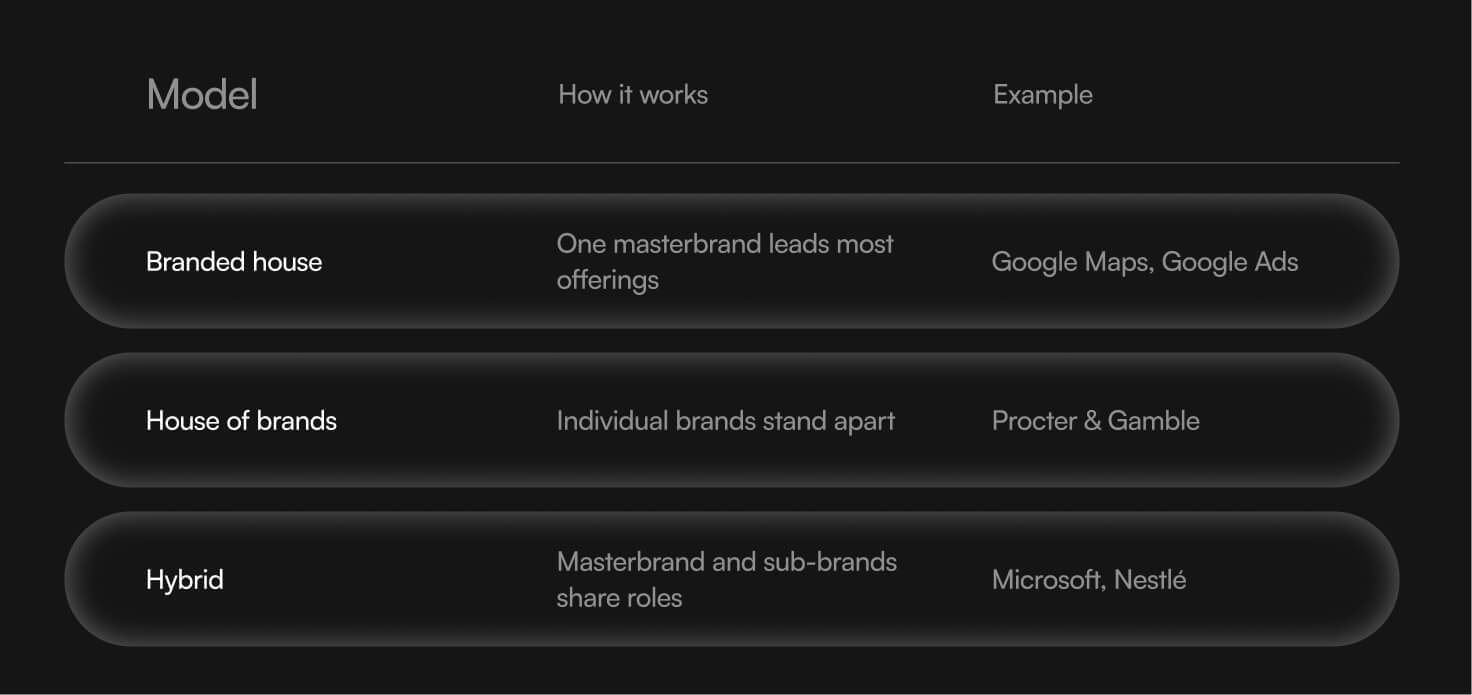
Branded House
One masterbrand leads most products and services.
This model can build concentrated recognition and make new offerings easier to connect to the parent brand. However, problems affecting one part of the business may influence the entire portfolio.
House of Brands
The parent company owns multiple independent brands with separate names, identities, audiences, and positions.
This allows each brand to target a specific market but requires greater investment because each identity must build recognition separately.
Endorsed Brand Architecture
Individual brands maintain their own identities while receiving visible support from a parent or masterbrand.
The endorsement can transfer credibility while allowing each offering to retain some independence.
Hybrid Brand Architecture
The company combines several models. Some products use the masterbrand, while others remain independent or endorsed.
This is common in organizations that have grown through acquisitions or serve very different markets.
A clear brand hierarchy helps prevent overlapping offers, naming confusion, duplicated marketing investment, and internal competition.
7. Customer Experience and Operations
A global brand becomes real through the customer experience.
The brand promise should be reflected in:
- Product quality
- Ecommerce and retail
- Customer support
- Delivery and fulfilment
- Returns
- Pricing transparency
- Digital products
- Sales processes
- Employee behaviour
- Partner and distributor experiences
A campaign can generate global awareness quickly, but inconsistent service, inventory shortages, poor localization, or unreliable fulfilment can damage the brand just as quickly.
Marketing and operations must scale together.
What Is Global Brand Management?
Global brand management is the ongoing governance, coordination, adaptation, and measurement of a brand across countries, regions, business units, and channels.
It protects global consistency while giving local teams enough authority to respond to cultural, regulatory, commercial, and competitive differences.
Global brand management is not a one-time rebrand project. It is a permanent operating discipline.
How Should a Global Brand Team Be Organized?
Many global organizations use a hub-and-spoke model.
Central Global Team
The central team typically owns:
- Global strategy
- Brand platform
- Masterbrand identity
- Brand architecture
- Core messaging
- Global guidelines
- Asset management
- Major partnerships
- Measurement standards
- Governance
Regional Teams
Regional teams may coordinate strategy and execution across areas such as North America, Latin America, Europe, the Middle East, Africa, or Asia-Pacific.
They translate the global strategy into regional priorities and identify shared needs across local markets.
Local Market Teams
Local teams contribute:
- Cultural knowledge
- Customer insights
- Language expertise
- Channel selection
- Local media relationships
- Retail and distributor knowledge
- Regulatory understanding
- Campaign execution
- Performance feedback
The right structure depends on the company’s size and complexity. Clear decision rights matter more than the exact number of management layers.
What Should Global Brand Governance Control?
Brand governance defines who can make decisions, which decisions require approval, and how exceptions are handled.
Governance should cover:
- Logo and identity use
- New products and sub-brands
- Naming
- Co-branding
- Partnerships
- Sponsorships
- Local campaign adaptations
- Claims and legal review
- Translation
- Packaging
- Digital products
- Asset creation
- Approval workflows
- Crisis communication
Some elements require central approval. Others can be owned locally within documented parameters.
Good governance should help teams make better decisions rather than simply restricting them. Brand portals, templates, training, examples, and accessible experts are usually more effective than relying on enforcement alone.
How Should Global Brand Performance Be Measured?
Global brand measurement should combine brand health, customer behaviour, commercial performance, and execution quality.
Brand Health Metrics
These may include:
- Unaided awareness
- Aided awareness
- Brand familiarity
- Message association
- Consideration
- Preference
- Purchase intent
- Trust
- Brand distinctiveness
- Share of search
- Sentiment
Customer Metrics
These may include:
- Customer satisfaction
- Net Promoter Score
- Retention
- Repeat purchase
- Customer lifetime value
- Referral rate
- Customer complaints
- Support quality
Commercial Metrics
These may include:
- Revenue growth
- Market share
- Contribution margin
- Price realization
- New-customer growth
- Cost of customer acquisition
- Sales pipeline
- Ecommerce conversion
- Distributor performance
Brand-Management Metrics
These may include:
- Guideline compliance
- Asset adoption
- Time required to localize campaigns
- Duplicate production costs
- Approval times
- Training completion
- Brand-portal usage
Our guide to branding measurement and statistics explains additional ways businesses evaluate the relationship between brand activity and commercial performance.
Global totals can hide important regional differences. Results should also be reviewed by market, customer segment, product, channel, and stage of market maturity.
How Do Global Brands Balance Consistency and Localization?
Global brands balance consistency and localization by protecting a fixed strategic core while adapting market-facing execution.
This approach is commonly called glocalization.
What Should Remain Globally Consistent?
Companies should usually protect:
- Brand purpose
- Brand promise
- Core positioning
- Brand personality
- Brand pillars
- Masterbrand identity
- Primary messaging
- Product or service standards
- Customer-experience principles
- Measurement definitions
Clearly documented brand pillars help local teams understand the ideas every market should reinforce.
What Can Be Localized?
Companies may adapt:
- Language
- Imagery
- Casting
- Creators and spokespeople
- Cultural references
- Product variants
- Packaging information
- Promotions
- Media channels
- Payment options
- Retail partnerships
- Customer support
- Campaign timing
- Legal disclosures
Localization should increase relevance without creating a different brand in every market.
What Are Examples of Global Localization?
McDonald’s
McDonald’s maintains recognizable brand assets and service principles while changing menu items for regional tastes, dietary needs, and religious requirements.
Netflix
Netflix offers one global platform while localizing subtitles, dubbing, recommendations, licensing, original content, and marketing.
Beauty and Personal-Care Brands
Beauty companies may adjust product formulas, shade ranges, imagery, routines, and educational content according to skin tone, climate, culture, and local regulations.
The principle is the same in each case: protect what makes the brand recognizable while adapting what makes the experience useful.
How Should Brands Research Cultural Differences?
Global brands should use evidence from the market rather than assumptions made at headquarters.
Research may include:
- Customer interviews
- Cultural research
- Social listening
- In-market agency input
- Employee workshops
- Retailer and distributor interviews
- Search behaviour
- Concept testing
- Translation review
- Legal and regulatory review
- Community or creator partnerships
Language, symbols, humour, colours, gestures, family structures, cultural identities, and religious references can carry different meanings across markets.
Local reviewers should be involved before public launch—not after a cultural problem appears.
How Do You Build a Global Brand?
Building a global brand is a staged process. Companies should establish a strong home-market foundation, test expansion assumptions, and build governance before attempting a large international rollout.
Step 1: Assess Global Brand Readiness
Start by evaluating whether the brand and business are ready to expand.
Ask:
- Is the brand clearly differentiated?
- Does it have strong product-market fit?
- Are customers satisfied?
- Is demand repeatable?
- Can margins support international growth?
- Can production and inventory scale?
- Can customer service support new languages and time zones?
- Are trademarks and intellectual property protected?
- Can the product meet local regulations?
- Can the company fund sustained market development?
International ecommerce sales can be a useful signal, but occasional cross-border orders are not proof that the company is ready for full expansion.
Step 2: Define the Global Strategic Core
Leadership should define the purpose, promise, position, personality, values, and experience that every market must protect.
This process should include leaders and customer-facing stakeholders from priority markets. The goal is to identify a core that is clear enough to stay consistent and flexible enough to remain culturally relevant.
Document:
- What can never change
- What may be adapted
- Who approves changes
- How disagreements are resolved
- How the strategy will be measured
Step 3: Establish Brand Architecture and Naming
Decide how the corporate brand, products, services, regional businesses, and future acquisitions will relate to one another.
This stage should address:
- Masterbrand strategy
- Product naming
- Sub-brand rules
- Endorsement
- Regional brand equity
- Domain availability
- Trademarks
- Translation
- Future portfolio growth
Architecture should be resolved before expansion creates overlapping products or conflicting names.
Step 4: Design the Global Identity System
Develop or refine the visual and verbal identity across representative applications.
Test:
- Logo configurations
- Multilingual typography
- Colour reproduction
- Packaging
- Websites and applications
- Social content
- Retail environments
- Presentations
- Out-of-home advertising
- Motion
- Customer communications
Testing should include strategically important and culturally distinct markets. There is no universal number of countries that must be included.
Step 5: Select Priority Markets and Partners
Choose markets based on evidence rather than visibility alone.
Consider:
- Customer demand
- Market size
- Competition
- Distribution
- Regulatory complexity
- Cultural fit
- Pricing
- Profitability
- Operational capability
- Existing brand awareness
Distributors, retailers, technology providers, creators, and other strategic brand partnerships can accelerate entry when the roles, incentives, customer experience, and brand standards are clear.
Step 6: Pilot the Global Brand
Begin with a controlled rollout in selected priority markets.
Measure:
- Awareness
- Consideration
- Sentiment
- Sales
- Conversion
- Customer feedback
- Product returns
- Support requirements
- Distributor performance
- Operational strain
Use the pilot to improve guidelines, translations, training, templates, fulfilment, and approval processes before expanding further.
Step 7: Establish Long-Term Management
Once the brand operates in several markets, move from launch mode to ongoing stewardship.
Create:
- Regional brand leads
- Local market owners
- Brand councils
- Asset libraries
- Training programs
- Audit cycles
- Reporting standards
- Feedback processes
- Escalation procedures
Global brands need continuous management because markets, technology, regulations, competitors, and customer expectations keep changing.
What Do Successful Global Brands Get Right?
Apple: Integrated Experience
Apple creates consistency across hardware, software, packaging, retail, websites, and customer support. The company adapts product information and communications while protecting a recognizable design and experience standard.
Coca-Cola: Distinctive Brand Assets
Coca-Cola has maintained recognizable assets—including its script logo, red colour, and bottle shape—while adapting campaigns, packaging, flavours, partnerships, and cultural references.
Netflix: Localized Content
Netflix operates one global platform while adapting content, language, recommendations, licensing, and promotion to local markets.
Microsoft: Hybrid Brand Architecture
Microsoft uses its corporate brand to support products and platforms such as Microsoft 365, Azure, Xbox, and LinkedIn while allowing each to address a distinct audience and category.
The shared pattern is clear: strong global brands invest in strategic clarity, recognizable assets, customer experience, governance, operational capability, and local knowledge.
Want to learn more about Brand Strategy and Brand Identity? Keep reading!
What Is Global Brand Management?

Case Snapshots: What Strong Global Brands Get Right


Quincy Samycia
Want to learn more about brand platform?