Medical Branding and Marketing in 2026: A Strategic Guide for Healthcare Businesses
02/20/2026
Branding / Marketing Services
Discover how strategic medical branding and healthcare marketing in 2026 help clinics and healthcare businesses attract patients, build trust, and drive long-term growth.

Medical branding and marketing is no longer just about promotion. In 2026, it plays a direct role in how healthcare businesses across the United States and Canada attract patients, build trust, and sustain long-term growth.



Medical Branding and Marketing Has Changed — Here’s What Healthcare Leaders Need to Know in 2026


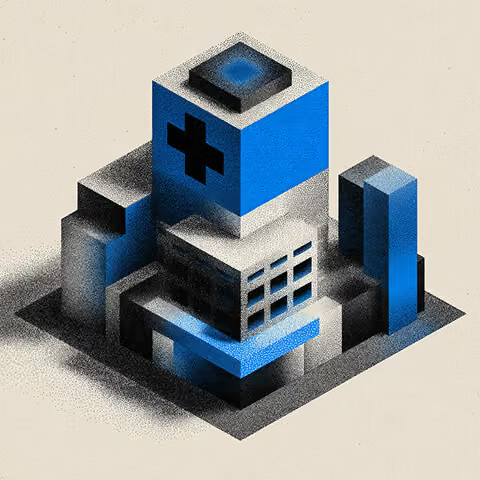
Patients now behave like informed consumers. They research providers online, compare experiences, read reviews, and assess credibility long before booking an appointment. At the same time, competition across nearly every medical category has intensified — from private practices and specialty clinics to healthcare platforms and service providers.
For medical business owners, CMOs, and marketing directors, this means branding and marketing are no longer tactical functions. They are strategic growth levers that influence patient demand, reputation, recruitment, partnerships, and enterprise value.
What Is Medical Branding and Marketing?
Medical branding and marketing refers to how a healthcare organization defines, communicates, and delivers its value to patients, partners, and the broader healthcare ecosystem.
While medical marketing focuses on visibility, acquisition, and engagement, medical branding provides the foundation that makes those efforts effective. Branding shapes perception — marketing amplifies it.
Together, they determine:
- How trustworthy a medical business appears
- How clearly it is differentiated from competitors
- How confidently patients choose it
- How efficiently marketing dollars perform
Without strong branding, marketing becomes louder but less effective.
Why Medical Branding Matters More Than Ever in 2026
Several forces are accelerating the importance of branding in healthcare.
Patients Decide Before They Contact You
Websites, Google results, online reviews, and content now form the first impression. If a brand feels unclear, outdated, or generic, patients move on — often without ever making contact.
Healthcare Markets Are Saturated
Many medical categories look and sound the same. Similar services. Similar messaging. Similar visuals. Branding is now the primary way to escape price-based and convenience-based competition.
Trust Is the Currency of Healthcare
In healthcare, trust is not optional. A strong brand reduces perceived risk and increases patient confidence — especially for elective, specialized, or ongoing care.
Free Brand Health Audit
Make sure your brand is built to sell
Search has changed. Your customers aren't just Googling anymore. They're asking ChatGPT, Perplexity, Gemini and other AI platforms what to buy, who to trust and which brands they should consider.
If your brand isn't showing up clearly in those answers, you're already losing opportunities. Our free Brand Health Audit shows you where your brand stands across traditional search, AI search and brand positioning.

Sample brand audit
Live preview
Traditional search
72
AI search (GEO)
34
Brand positioning
58
Core Elements of Effective Medical Branding in 2026




Successful medical branding aligns strategy, identity, and experience.
Clear Positioning
Positioning answers a simple but critical question:
Why should a patient choose this medical business over others?
Strong positioning defines:
- The audience you serve best
- The problem you solve most effectively
- The value only you deliver
Without it, marketing lacks direction.
Consistent Brand Identity
Visual and verbal consistency reinforces credibility. Logos, colors, typography, messaging, and tone should feel unified across digital platforms, physical locations, and communications.
Consistency builds familiarity — and familiarity builds trust.
Human, Patient-Centered Messaging
Medical brands in 2026 communicate with clarity, empathy, and authority. They focus on outcomes, reassurance, and understanding rather than jargon or aggressive claims.
Medical Marketing Strategies That Work in 2026
With branding as the foundation, medical marketing becomes significantly more effective.
Search Visibility and Local Presence
Patients still search locally for care. Optimized websites, accurate listings, and location-based content ensure medical businesses appear where intent is highest.
High-Performance Healthcare Websites
A medical website must do more than look good. It should:
- Load quickly
- Work seamlessly on mobile
- Be accessible and easy to navigate
- Guide users toward booking or contact
In 2026, websites are trust tools first, conversion tools second.
Content That Educates, Not Advertises
Educational content builds authority and reduces patient anxiety. Blogs, guides, and videos that answer real questions perform better than promotional messaging alone.
Want to learn more about Branding and Marketing? Keep reading!
If you need help with your company’s marketing, contact us for a free custom quote.
Case Study: Redefining Healthcare Mobility With Unified Transit

Medical branding becomes most powerful when it reshapes how a category is perceived.
The Challenge
Millions of Americans miss medical appointments each year due to transportation barriers. In the Non-Emergency Medical Transportation (NEMT) space, options had long been split between:
- Fast but impersonal rideshare services
- Well-intentioned but outdated traditional providers
Unified Transit had the technology and vision to do better — but was being viewed as just another transportation startup.
The Branding Strategy
Instead of competing in an existing category, Unified Transit was repositioned as compassionate, tech-enabled healthcare mobility — an extension of care, not logistics.
The brand focused on:
- Dignity and autonomy for riders
- Care continuity rather than transportation
- Human connection supported by technology
Visual identity, messaging, and experience all reinforced this positioning.
The Outcome
Unified Transit emerged as a healthcare partner rather than a vendor, standing apart in a crowded, commoditized market. The brand created clarity, trust, and differentiation where none previously existed.
Case Study: Modernizing Optometry With Look Optometry
Not all medical branding challenges require creating a new category — some require reimagining an existing one.
The Challenge
Optometry branding had become predictable and clinical. Look Optometry delivered premium care, but its brand did not reflect the experience or personality of the practice.
The Branding Insight
Vision is not just medical — it is personal and cultural. Patients care about how they see and how they feel.
This insight led to a defining brand idea:
“For those with good taste and bad eyesight.”
The Result
The brand blended credibility with personality:
- Trust-anchoring colors and typography
- Playful, human touches that reduced intimidation
- A boutique-like experience rather than a clinical one
The result was a brand that patients wanted to engage with — and one that scaled seamlessly as the practice grew.
Who Medical Branding and Marketing Is For
Medical branding and marketing delivers the greatest impact for organizations seeking differentiation and sustainable growth.
Healthcare Businesses That Benefit Most
- Physician-led practices and specialty clinics
- Dental and orthodontic groups
- Optometry and vision care practices
- Urgent care and outpatient centers
- Mental health and behavioral health providers
- Med spas and wellness clinics
- Home health, telehealth, and senior care providers
- Healthcare platforms and medical service companies
For owners, CMOs, and marketing directors, branding directly influences patient trust, demand, and long-term value.
Ethics, Compliance, and Trust Remain Central
In both the U.S. and Canada, healthcare marketing must remain ethical and compliant. Strong medical brands prioritize honesty, transparency, and respect for patient privacy.
Ethical branding is not a limitation — it is a competitive advantage.
How Success Is Measured in Medical Branding and Marketing
In 2026, performance is measured beyond clicks and impressions.
Key indicators include:
- Growth in branded search demand
- Improved patient acquisition efficiency
- Higher appointment conversion rates
- Increased retention and referrals
- Stronger online reputation and sentiment
Brand equity compounds — and its impact becomes more measurable over time.
Frequently Asked Questions About Medical Branding and Marketing

Is medical branding different from general branding?
Yes. Medical branding must balance trust, compliance, empathy, and authority while clearly communicating expertise and credibility.
Who should own branding decisions internally?
Medical branding should be guided by owners, CMOs, or marketing directors working alongside specialized healthcare branding partners.
Can smaller practices compete with large health systems?
Absolutely. Clear positioning and a strong brand often outperform size and scale in competitive markets.
Does medical branding really impact revenue?
Yes. Strong brands reduce patient acquisition costs, improve retention, and increase referrals over time.
Is digital marketing enough without branding?
No. Without branding, digital marketing becomes more expensive, less consistent, and harder to sustain.
How long does medical branding take to show results?
Brand equity builds over time, while marketing performance and engagement often improve within the first few months.
Conclusion: Medical Branding Is the Advantage Healthcare Leaders Can Control
Medical branding and marketing in 2026 is not about trends or aesthetics. It is about clarity, trust, and long-term differentiation.
Healthcare organizations that invest in strong branding don’t just attract more attention — they earn more confidence.
At the Branded Agency, we help medical businesses across the United States and Canada build brands that patients trust, teams believe in, and markets remember.

Quincy Samycia
As entrepreneurs, they’ve built and scaled their own ventures from zero to millions. They’ve been in the trenches, navigating the chaos of high-growth phases, making the hard calls, and learning firsthand what actually moves the needle. That’s what makes us different—we don’t just “consult,” we know what it takes because we’ve done it ourselves.
Want to learn more about brand platform?
If you need help with your companies brand strategy and identity, contact us for a free custom quote.
We do great work. And get great results.
+2.3xIncrease in revenue YoY
+126%Increase in repurchase rate YoY


+93%Revenue growth in first 90 days
+144% Increase in attributed revenue



+91%Increase in conversion rate
+46%Increase in AOV

+200%Increase in conversion rate
+688%Increase in attributed revenue